Scientists built a sunflower-inspired cooling system that delivered 135% more cooling power at solar noon than a fixed horizontal surface

Scientists built a sunflower-inspired cooling system that delivered 135% more cooling power at solar noon than a fixed horizontal surface

Representative Image of a sunflower-inspired cooling system tilting to optimize radiative cooling under direct sunlight (AI Generated Image) Researchers in China have developed a radiative cooling system inspired by the way sunflowers track the sun, with experiments showing a 135% increase in cooling flux at solar noon compared with a fixed horizontal version of the … Read more
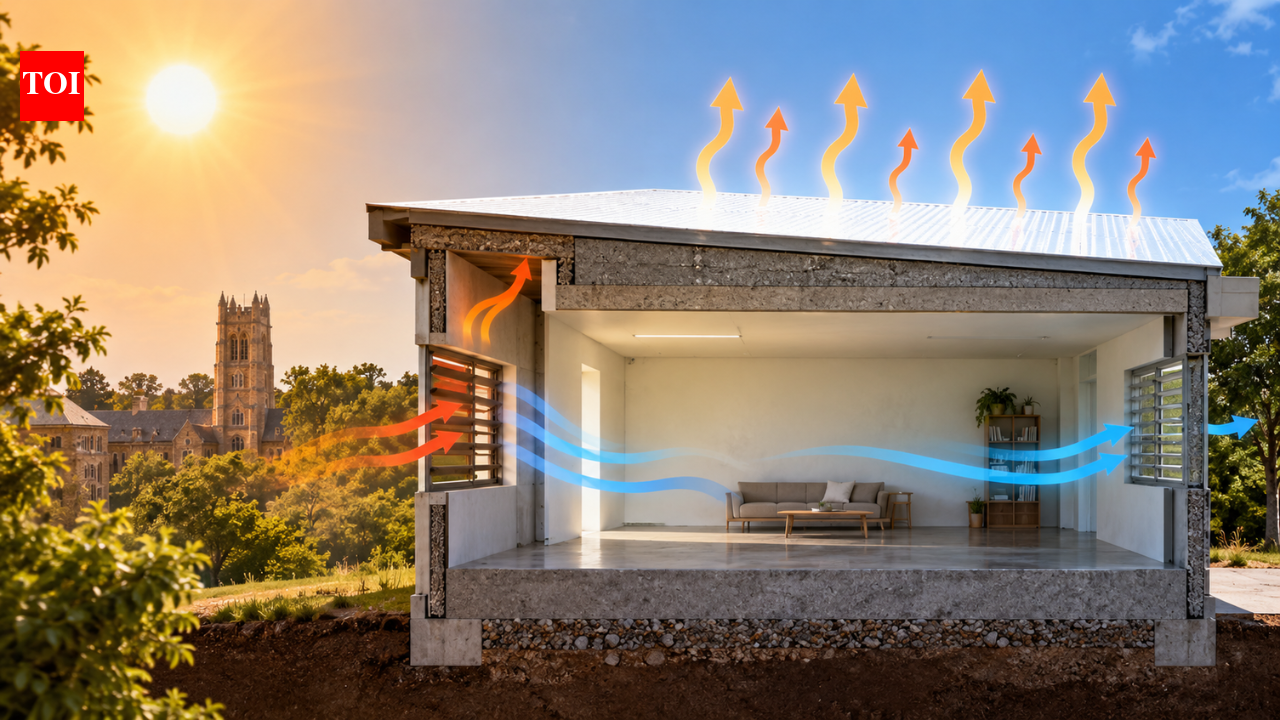

In 2023, Princeton researchers tested radiative cooling with natural ventilation and thermal mass, keeping a building 3.9°C below outdoor air

In 2023, Princeton researchers tested radiative cooling with natural ventilation and thermal mass, keeping a building 3.9°C below outdoor air

In 2023, researchers tested whether a building could be cooler than the air outside while still relying on natural ventilation. The experiment used two insulated boxes in California to study how radiative cooling, thermal mass and temperature-driven airflow could work together without fans or mechanical systems. The test box had an uninsulated aluminium roof covered … Read more

A Swedish hospital stores winter snow under wood chips and pumps its meltwater through the building in summer; in its first year it supplied 93% of cooling demand

A Swedish hospital stores winter snow under wood chips and pumps its meltwater through the building in summer; in its first year it supplied 93% of cooling demand

According to Science Direct, the hospital’s annual cooling demand is about 1,000 MWh. A hospital in central Sweden found an unusual way to meet its summer cooling needs by storing snow from winter and using it months later. The Sundsvall Regional Hospital uses a large snow storage system designed to preserve winter cold until the … Read more

In 2000, Cornell began pulling 39°F water from 250 feet below Cayuga Lake to cool its campus; the system now cuts cooling energy use by about 85%

In 2000, Cornell began pulling 39°F water from 250 feet below Cayuga Lake to cool its campus; the system now cuts cooling energy use by about 85%

Cornell is one of the biggest and most esteemed universities in the world, sitting on a hill overlooking the 38-mile-long Cayuga Lake with an area of 2,300 acres. In the late 1980s and early 1990s, most institutions, including Cornell, used CFC chillers. These first-generation Ozone-Depleting Substances (ODSs) were destroying the ozone layer and warming the … Read more