
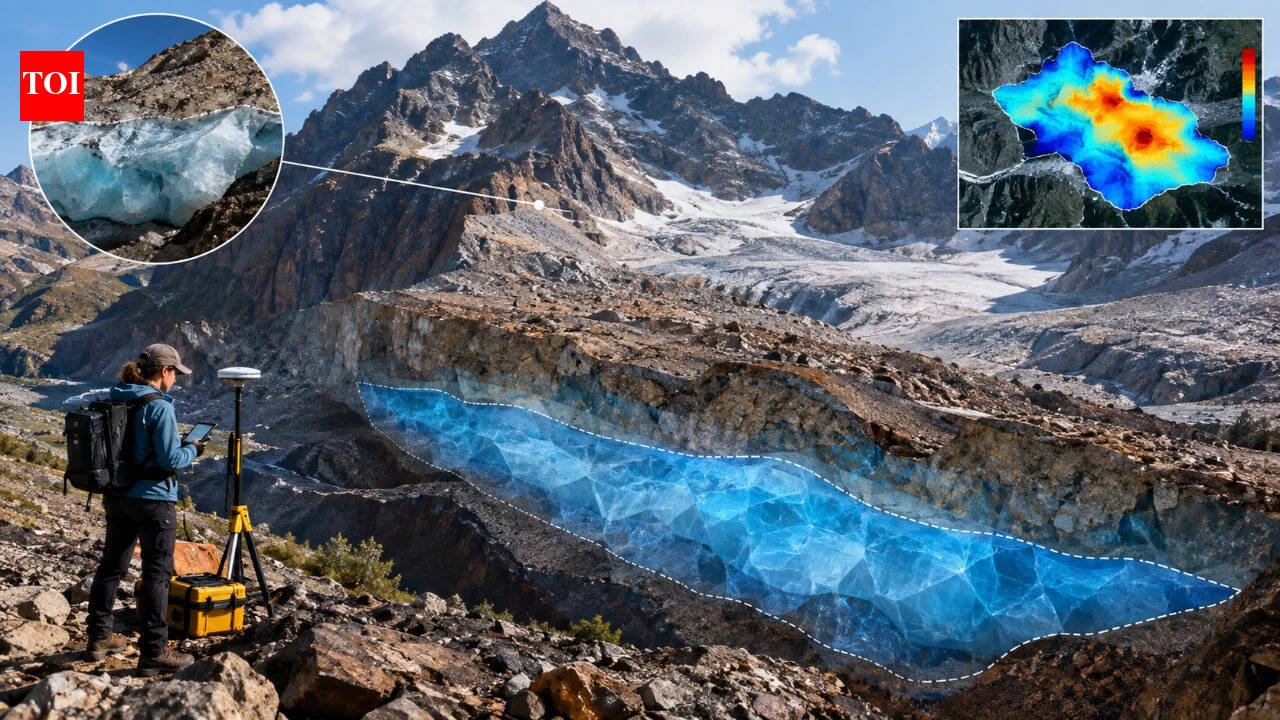
At first glance, Utah’s rocky mountain slopes may look completely dry, with loose stones and boulders covering the ground. But beneath some of those rocks lies an enormous store of frozen water. Researchers have now estimated that Utah’s rock glaciers contain about 0.99 gigatonnes, or nearly 1 billion tons, of water equivalent. These unusual formations are bodies of ice buried beneath thick layers of rock and debris, allowing them to survive in places where conventional glaciers cannot. The discovery comes from a study of the Timpanogos Rock Glacier beneath Mount Timpanogos, where scientists used subtle changes in Earth’s gravitational field to reconstruct what was hidden underground. Published in the Journal of Geophysical Research: Earth Surface, the research was led by Bronson Cvijanovich with Michael S. Thorne, Surya Pachhai, Leif S. Anderson, Ivan Tochimani-Hernandez, Christian L. Hardwick and Tonie van Dam, from the University of Utah and Utah Geological Survey.
A glacier hidden beneath rocks
Rock glaciers look nothing like the bright, exposed ice fields people normally associate with glaciers. They are instead masses of ice covered by layers of loose rocks and debris, with the ice slowly moving downhill beneath the surface. That rocky blanket can insulate the ice from warmth and sunlight, allowing these formations to persist in mountain environments that may no longer support conventional glaciers. The researchers explain in their study, ‘The Internal Ice Content of Timpanogos Rock Glacier, Utah, USA From 3-D Bayesian Inversion of Gravity Data,’ that rock glaciers are increasingly important as climate change reduces conventional glacier ice. They can store water, provide refuges for cold-adapted species and, if destabilised, create hazards for communities below. Yet scientists have struggled to determine exactly how much ice these formations contain because their rocky surfaces hide their interiors.
Scientists used gravity to see underground ice
To look beneath Timpanogos Rock Glacier, the team turned to a method that does not require drilling through the entire formation. They collected 232 gravity measurements across the site and used a three-dimensional Bayesian inversion to reconstruct the hidden structure. Ice is substantially less dense than the surrounding bedrock, so a sufficiently large buried ice mass creates a tiny but measurable reduction in gravitational acceleration. By mapping these variations, researchers could estimate where the ice-rich material was located and how thick it was. The study also found an estimated ice volume of about 1.55 million cubic metres, with an average thickness of 18.8 metres. The researchers’ preferred model indicates that the entire rock glacier is about 72% ice by volume, while its ice core is approximately 83% ice.
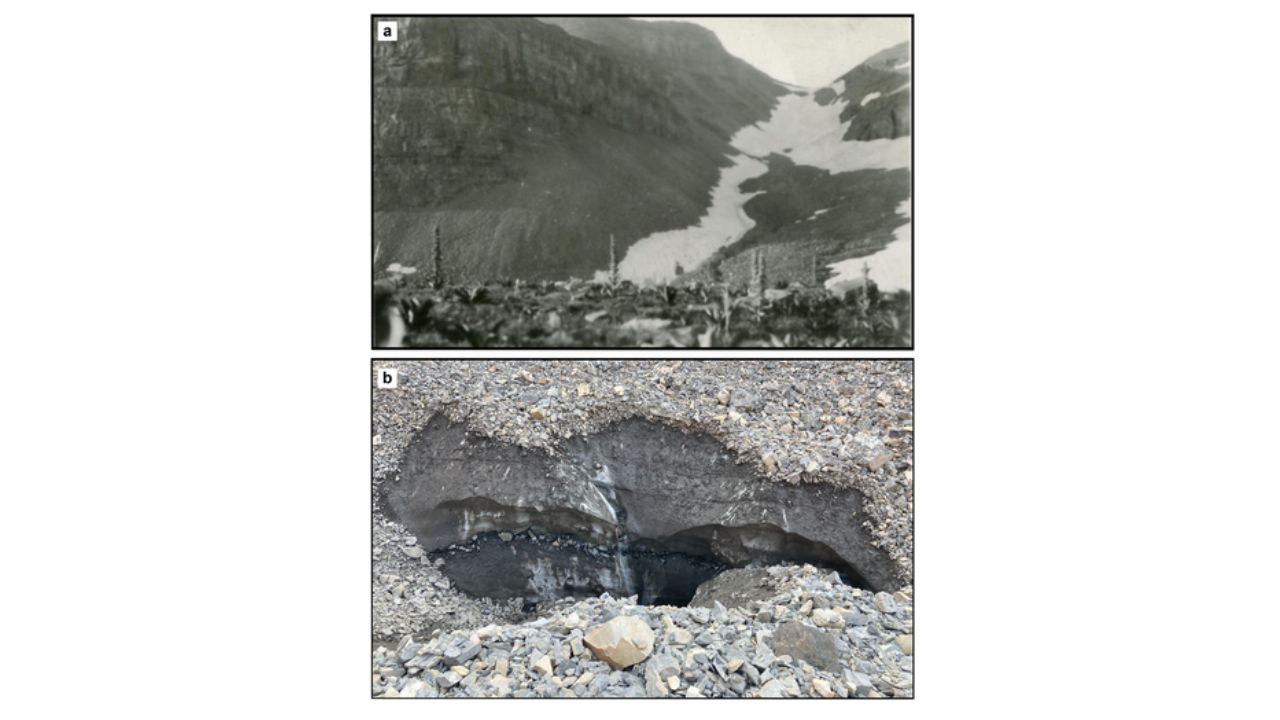
Images of Timpanogos Rock Glacier. (a)Photo of Timpanogos Rock Glacier on 1 August 1925, showing the rock glacier (right side of the frame) flanked by seasonal snow (University of Utah Photo Archives)(b)Image of a moulin-like feature on the upper portion of Timpanogos Rock Glacier, with layers of firn separated by thin debris layers. We expect that the firn transitions to ice at depth. (Image: University of Utah Photo Archives)
One Utah rock glacier holds hundreds of swimming pools of water
The amount of ice beneath Mount Timpanogos is difficult to visualise, so the researchers compared it with something more familiar. Their estimated 1.55 million cubic metres of ice is roughly equivalent to the volume of 600 Olympic-sized swimming pools. More importantly, Timpanogos Rock Glacier provided the researchers with a way to estimate the hidden water stored across many similar formations. Using their measurements alongside data from other rock glaciers, the team developed a new area-volume relationship. In the research this method produced an estimate of 0.99 gigatonnes of water equivalent for Utah’s intact rock glaciers. The western United States was estimated to contain about 11.92 gigatonnes, while intact rock glaciers worldwide could hold approximately 48.03 gigatonnes.
A hidden water reserve facing a changing climate
The discovery matters because rock glaciers could become increasingly important as conventional glaciers retreat. Their insulating debris can protect buried ice for longer, making them relatively resilient stores of frozen water in warming mountain environments. But the researchers also caution that their estimates are not perfectly complete. Persistent snow and steep terrain prevented gravity measurements in the upper reaches of Timpanogos Rock Glacier, meaning the calculated ice volume is likely a lower estimate of the total. The study also notes uncertainties in modelling the relationship between ice thickness and density. Even so, the findings reveal a substantial reservoir that is almost invisible from the surface. As temperatures rise and mountain ice changes, understanding these buried stores could become increasingly important for water resources, ecosystems and assessing hazards in alpine regions.