

A small brown goose with a white neck ring nearly vanished from the Pacific, and the world is pointing the finger at the fox. Researchers at Humboldt State University said in a Wildfowl review that Aleutian cackling geese were feared extinct until a small group was found on Buldir Island in 1962. The same review puts the population at 790 birds in 1967. By 2022, Ducks Unlimited estimates the flock had grown to about 215,000.
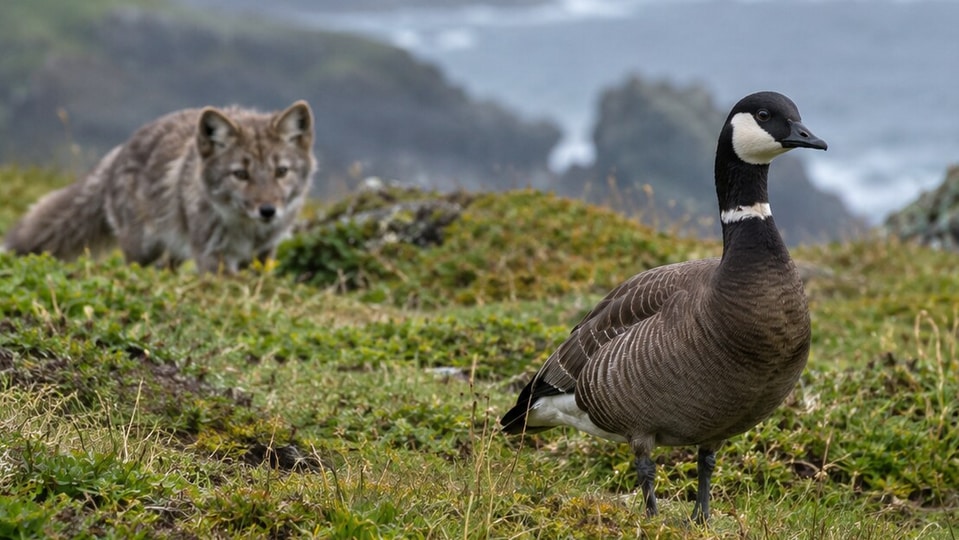
How foxes destroyed a safe home
The Aleutian goose is small. A big male only weighs about 4.5 pounds. It’s dark brown, black-necked, and has a white cheek patch.
These geese nest on some of the Aleutian Islands that arc west from Southwest Alaska toward Russia. The story starts in 1741, when the islands were discovered for Russia by the Danish-born explorer Vitus Bering. The fur rush came later, after survivors of his expedition reported rich fur resources. Arctic and red foxes were valued, but many islands had neither. By 1750, trappers started moving foxes onto fox-free islands. By the 1930s, some 190 islands had been invaded by foxes.
Foxes are very good hunters. They eat eggs, but mostly they go for the nesting females. When you lose a female, you lose that year’s chicks and her future chicks too. The Wildfowl Review names these introduced Arctic foxes as the main cause of the decline in the geese. Habitat loss in their migration and wintering areas and hunting made matters worse.
A successful rescue plan
The geese were listed as federally endangered in 1967. Biologists drafted a recovery plan. The biggest step was trapping all the foxes on several islands. This made sense because it was a one-time effort to remove animals that did not belong there, and new ones could not move in from nearby land.
Next, captive flocks of geese were released, and wild families were translocated from Buldir Island, where the remnant population had been found. Those birds didn’t do well, and the captive releases were stopped after a few years. The wild families did much better. The geese were also protected from hunting, and key resting and wintering areas were restored and protected.
From 790 birds to 215,000
Within a few years, the population began to recover. Ducks Unlimited says the geese were reclassified from endangered to threatened in 1990, and they came off the U.S. endangered species list altogether in 2001, when the Wildfowl review puts the population at more than 30,000 birds. The Pacific Flyway management plan had called for a goal of 60,000, and by 2022 the flock had grown to about 215,000, more than three times that.
Success brings new problems
The story is not all tidy. Ducks Unlimited says the geese now damage spring grazing pastures for cattle in Northern California and Oregon. California and Oregon have fairly liberal hunting seasons for the species, including a late season to keep birds off private land. The Wildfowl review also notes hard issues, including the harvest of a once-endangered bird and farm conflicts. Managers have to balance goose populations, hunting, and crops.
What this story teaches us
Nature can recover, but only with sustained effort. The recovery took more than three decades of groundwork. People had to trap foxes, move the geese, defend the land, and stop hunting. The Wildfowl review calls it a conservation success story and offers strategies to keep it going. The recovery shows that conservation mistakes can sometimes be reversed. The geese also show that the work is never quite done. Even after a big win, someone has to keep watching.