
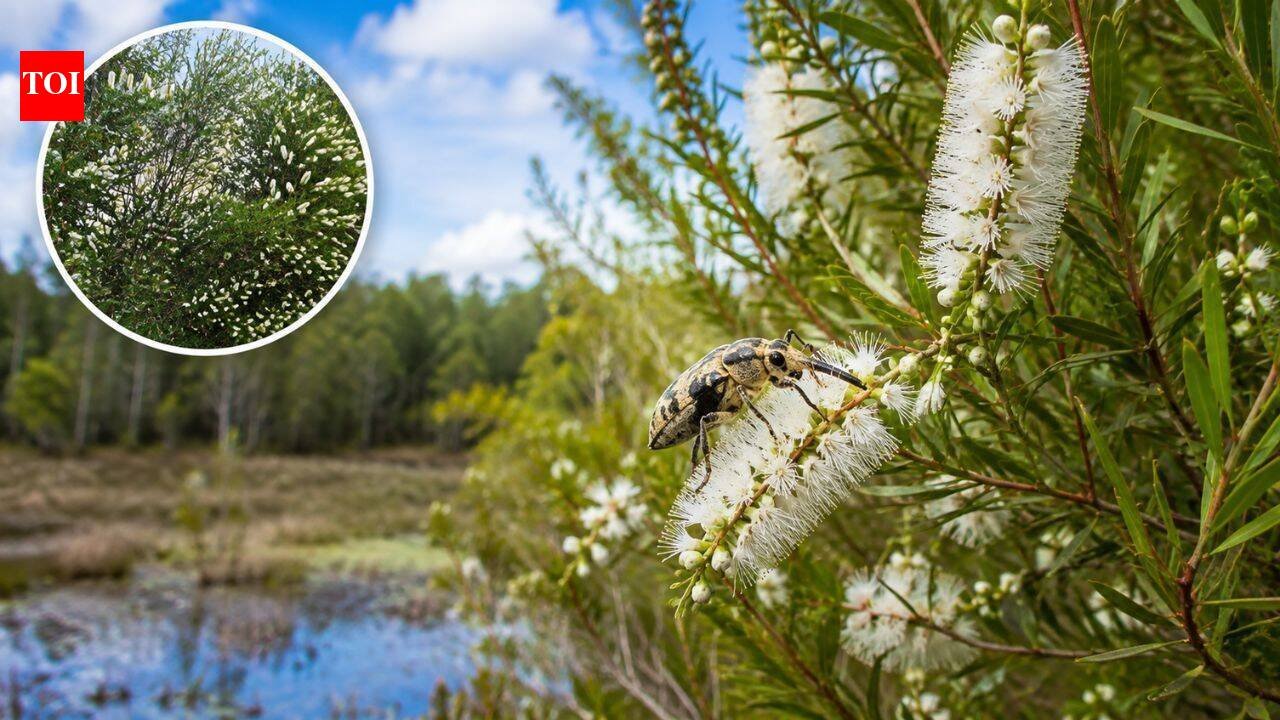
For decades, a tree from Australia spread across South Florida’s wetlands with little to hold it back. Melaleuca quinquenervia, often called paperbark, had been introduced to Florida for practical reasons, including landscaping and efforts to alter wet ground. It eventually escaped those uses and established dense stands across parts of the Everglades and surrounding wetlands. By the early 1990s, estimates put its spread at close to half a million acres.The response was not limited to cutting trees down or treating them with herbicide. Florida and federal agencies also turned to an unusual source of help: insects from melaleuca’s native range in Australia. The idea was straightforward. Find organisms that naturally feed on the tree, test them carefully, and introduce those capable of attacking melaleuca without becoming a threat to other plants.The first of these insects was released in Florida in 1997.
How an introduced tree became a Florida problem
Melaleuca had several advantages once it became established in South Florida. It grows rapidly, tolerates wet conditions and produces enormous numbers of seeds. A single tree can produce millions of seeds a year. Its dense growth can replace native vegetation and alter wetland habitats.The tree had been introduced to Florida decades earlier. It was used as an ornamental and for other purposes, including planting around disturbed areas. By the time its spread became a major conservation concern, it was no longer confined to places where people had deliberately planted it.The scale was difficult to ignore. Melaleuca had infested almost 500,000 acres by 1994, with extensive stands in places including the Everglades, Big Cypress National Preserve and the Arthur R. Marshall Loxahatchee National Wildlife Refuge.That created a problem that could not be solved simply by removing individual trees. Even after an area was cleared, seeds and surviving plants could allow melaleuca to return.
When the first insect arrived in 1997
USDA Agricultural Research Service scientists had spent years looking in Australia for insects that depended heavily on melaleuca. The first to be released in Florida was the melaleuca leaf weevil, Oxyops vitiosa, in 1997.The choice was based on extensive testing rather than simply finding an insect that happened to eat the tree. Scientists examined whether the weevil would feed on useful plants, including melaleuca relatives and a range of agricultural and native species. The aim was to establish a biological control agent that would target the invasive tree without creating another ecological problem.The weevil attacks young growth. Both adults and larvae feed on melaleuca foliage, while damage to developing shoots can interfere with the tree’s growth and reproduction. Experimental work documented reductions in flowering of up to 90 per cent on trees where the weevil had become established.
Florida added more insects to the control effort
The weevil was only the beginning. Scientists continued investigating other insects from Australia that could attack different parts or stages of the tree. A sap-feeding psyllid was released in 2002, while a gall-forming midge followed later.Three biological control agents eventually became established in Florida: the melaleuca weevil, the melaleuca psyllid and the melaleuca gall midge.The insects do not all work in exactly the same way. The weevil feeds on foliage and young growth. Psyllids suck sap and can cause serious damage to seedlings. The gall midge attacks growing tips, producing structures that interfere with the plant’s development and reproduction.The distinction is important. Biological control was not designed as a single release followed by an expectation that the invasive tree would disappear. It became one component of a wider management system.
The insects worked alongside established control methods
Florida continued to use conventional methods alongside the insects. Melaleuca management has combined chemical, mechanical, cultural and biological control. The methods can complement one another, particularly because mature stands and newly emerging plants present different problems.Mechanical removal can deal with individual trees or stands that need to be cleared. Herbicides can be used on larger infestations or on cut stumps to limit regrowth. The US Fish and Wildlife Service has also described hand-cutting, herbicide treatment, aerial spraying, prescribed fire and biological controls among the approaches used to deal with invasive vegetation in the Everglades system.The insects therefore did not replace the more direct methods. Their role was different: suppressing the tree’s growth and reproductive capacity across areas where treating every plant individually would be difficult.
Melaleuca’s decline was not down to insects alone
The melaleuca story is sometimes reduced to a simple before-and-after account: an invasive tree spread across Florida, Australian insects were released, and the infestation fell sharply. The reality is less tidy.The most effective management has involved integrating several control practices. The TAME Melaleuca project also described an integrated pest-management approach, with biological controls used alongside other techniques. By 2004, the project reported that government agencies had cleared almost 100,000 acres of melaleuca from publicly owned natural areas.So a claim that the Australian insects alone reduced the invaded range by roughly three-quarters would be misleading.A more accurate description is that the area dominated by melaleuca has fallen substantially as biological control became part of a broader programme that also included mechanical and chemical removal. The insects helped weaken the tree and reduce its ability to reproduce, while direct removal dealt with established plants.
Why the insects mattered across vast wetlands
Melaleuca can occur across large and difficult-to-access wetland areas. Treating every tree by hand is expensive and labour-intensive. Once biological control insects become established, they can move through infestations without crews having to reach every plant.The weevil, for example, was eventually redistributed across all 22 central and southern Florida counties known to be infested with melaleuca. Its slow natural dispersal meant that people had to help move populations into new areas.That created a different kind of control system. Instead of trying to remove every tree immediately, managers could also reduce the plant’s vigour and seed production, making the wider infestation easier to contain.
A biological-control experiment became part of a larger strategy
The original USDA account of the weevil’s release captures the thinking behind the programme. In 1997, scientists released roughly 1,600 weevils at a series of melaleuca-infested sites in Florida after years of testing in Australia and the United States.The work was unusually cautious because introducing one species to control another carries its own risks. Before release, scientists examined the insect’s feeding behaviour and tested it against plants that might otherwise be affected. The purpose was not simply to find a hungry insect, but one sufficiently specialised to melaleuca.The same principle guided subsequent releases. The psyllid, for instance, was subjected to quarantine studies before being approved for release. By 2004, the weevil had become established in 12 South Florida counties and was associated with an approximately 80 per cent reduction in seed production on trees it attacked. Those figures describe particular biological effects, not a 75% disappearance of the entire infestation.