
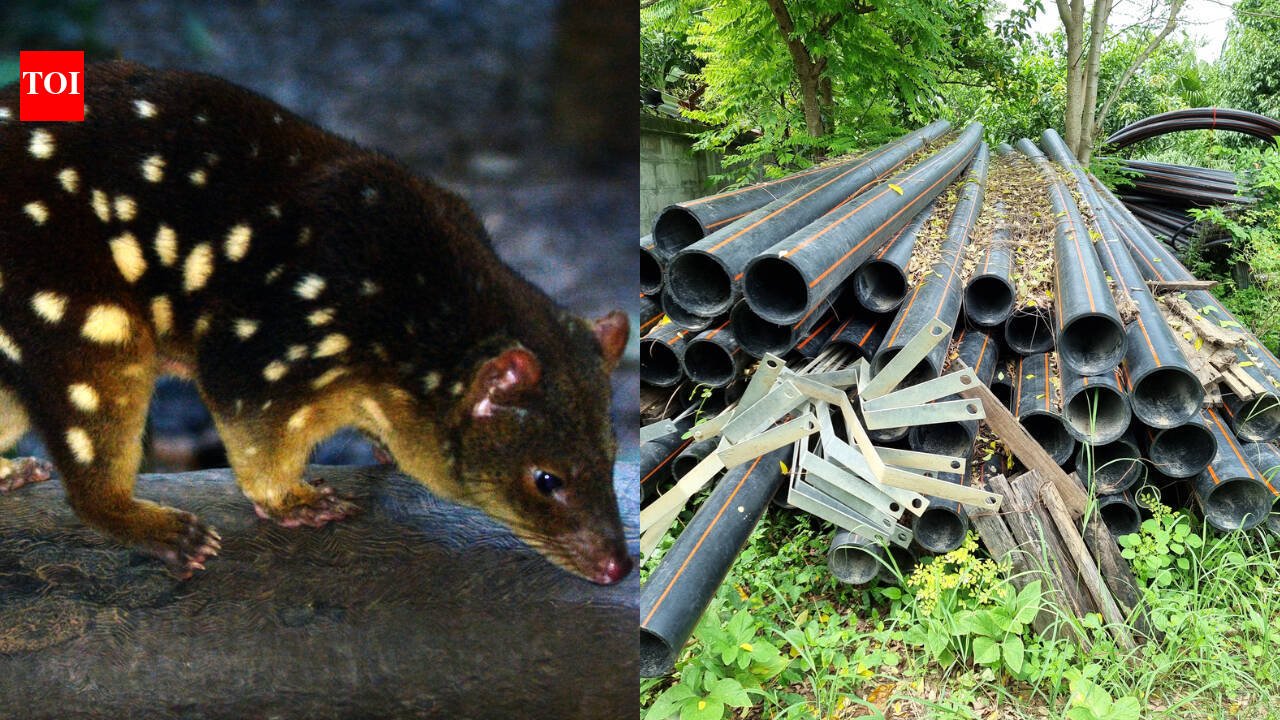

What appears to be industrial waste could provide a small refuge for one of Australia’s most threatened marsupials. Researchers have begun converting discarded plastic piping into artificial dens at former mining sites in north-western Australia to offer northern quolls hidden shelters from harsh temperatures and humidity. According to a research study titled, ‘Designing artificial dens for the Northern Quoll from readily available materials in the post-mining landscape,’ the experimental approach could offer a simple, inexpensive tool for habitat restoration following mining, as well as a new use for material that might otherwise be left behind.
A marsupial under threat from multiple perils
For the uninitiated, Northern quolls (Dasyurus hallucatus) are small carnivorous marsupials closely related to species like the Tasmanian devil. They face a variety of threats, with their numbers plummeting across northern Australia. Invasive cane toads can poison quolls that try to eat them, while feral cats, habitat loss and increasingly intense fires put more pressure on them. Mining can worsen these problems by changing or destroying areas of shelter and breeding.Rehabilitated mine sites can eventually provide habitat, but recreating natural shelters is not always easy. Artificial dens must shelter animals from extremes of temperature and humidity, but must also provide conditions suitable for resting and, perhaps, breeding.
Turning mine waste into quoll sanctuaries
The researchers looked at whether high-density polyethylene (HDPE) pipes could be used in waste-rock piles to create inexpensive artificial dens. The pipes were deep enough to provide a thermal buffer, essentially using the surrounding rock and soil to moderate conditions within. The average maximum temperature in the artificial dens during the demonstration trial was around 33.6°C with relatively low temperature range. Average maximum humidity was around 62% producing conditions similar to those found in natural northern quoll shelters.This approach may be particularly useful as HDPE pipe is widely available at many mine sites and rehabilitation projects may be able to use existing materials rather than build purpose-built dens.
Quolls were filmed using the shelters by cameras
The trial produced the most promising evidence from remote cameras and tracking pads. Northern quolls were recorded entering and exiting the buried pipes, suggesting the animals were willing to investigate and use the artificial structures. But researchers say there is no firm evidence yet that the dens were taken over as permanent homes or successfully used for breeding. This distinction is important because building a shelter an animal uses is not the same as providing habitat that can support reproduction and long-term population recovery.
More testing needed
The researchers stress that the demonstration is just a first step. More replicated experiments are needed to determine optimal pipe length, burial depth and placement, and how the dens should relate to vegetation, food sources and other landscape features. Breeding success is critical to population stability in northern quolls. Artificial dens alone do not restore a species under threat from predators, invasive species, fire and habitat loss.But the experiment suggests a practical possibility: post-mining landscapes could be designed not just to cover up industrial scars, but to actively recreate the shelters and ecological features wildlife needs. A discarded pipe buried under a pile of mine tailings. It may not seem like much. For a northern quoll looking for shelter, it could be the start of a new home.Images Courtesy: istock