Home Blog Page 349

US admiral praises India’s ‘tactical execution’ of Operation Sindoor, says defense ties are on ‘dramatic upward trajectory’ India News

0

US admiral praises India's

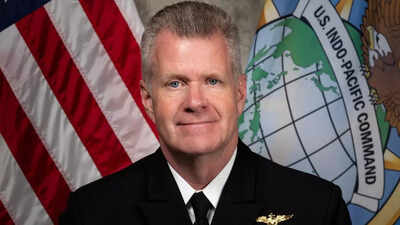
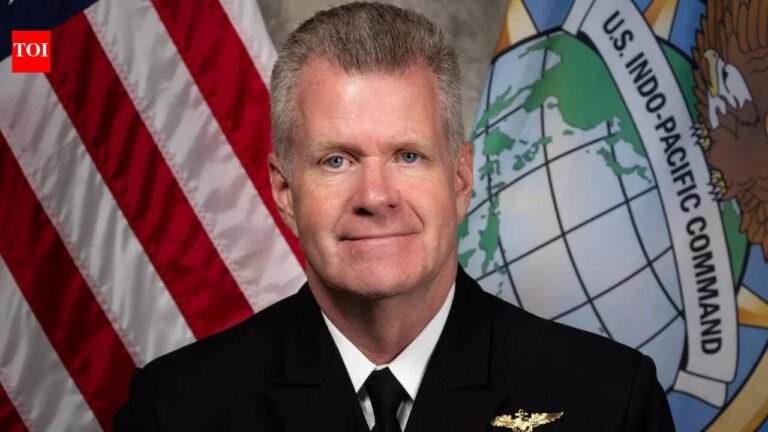
New Delhi: Gen. Samuel J. Paparo, commander of the US Indo-Pacific Command, “praised India’s tactical execution during military operations against Pakistan” during his visit to India on Sunday. operation sindor And said “there are always lessons to be learned from every conflict in the world.”He said the U.S.-India defense relationship is on a “dramatic upward trajectory,” even as he expressed concern about increasing “coercion” and “aggression” in the Indo-Pacific region.

Combat-proven SCALP missile takes India-France defense ties to next phase after Operation Sindoor

Replying to a query from TOI about his views on the Sindoor operation, the US commander, who was interacting with a select group of journalists, said: “First of all, I have the utmost respect for the horrific events (Pahalgam terror attack) that happened before the crisis. In discussions with partners, I appreciated the tactical execution (of the operation). We also sincerely commend the restraint shown. We want to work together to ensure that horrific events like this never happen again.The general also said he saw the Indian military’s strong commitment to learning lessons from the conflict.Asked what lessons the United States learned from Operation Sindor, in which Pakistan used Chinese weapons, General Paparo said, “Sophisticated long-range weapons with complex long-range kill chains.” With the “combination of 21st century sensors, communications, thrusters, warheads, and seekers, geography is no longer a commodity…”Regarding China’s growing military strength, the admiral, who is responsible for all US military operations in the region, said, “Deterrence is our highest duty. My job is to think about the worst-case scenario and prepare for it. India also has some concerns in the Indo-Pacific region, as the region is home to 60% of the world’s population, more than 60% of the world’s GDP and seven of the world’s largest militaries.“We address these issues through an evolving partnership…a ​​mutually respectful sovereign relationship between the world’s oldest democracy and the world’s largest democracy,” he said, adding that the United States and India were both committed to the principles of sovereignty, freedom of navigation and freedom of the seas.“We commend India for its tremendous contributions to the security of the Indian Ocean region,” he said. The two sides also considered strengthening maritime security cooperation, including cooperation in the field of undersea domain awareness.Considering the upcoming Milan Exercises, Admiral Paparo said, “It is good to see the deepening of the Indo-US defense partnership, as reflected in the defense agreement recently signed by US Secretary of War Pete Hegseth and Indian Defense Minister Rajnath Singh in Kuala Lumpur. A series of joint exercises and personnel exchanges such as Exercise Yod Abhayas in Alaska, Exercise Milan, Malabar Series, COPE India and Tiger Triumph Series and personnel exchanges are strengthening the relationship between India and the United States.” We cherish this relationship. “Regarding modern warfare strategy, the admiral said, “The 21st century will increasingly be dominated by actors who master the information environment, namely space, counterspace, electronic warfare, low observability and other technologies.”At the Artificial Intelligence Summit to be hosted by India, he said: “Prime Minister Modi’s visionary Artificial Intelligence Summit. I celebrate India’s vision on how to leverage artificial intelligence in the 21st century. Artificial intelligence has many connections with defense, and the U.S. Indo-Pacific Command is at the forefront of defense applications of artificial intelligence.”

Epstein ranch twist: MAGA candidate Don Huffins named mystery buyer of Jeffrey Epstein’s New Mexico home World News

0

Epstein Ranch Twist: MAGA Candidate Don Huffins Named as Mystery Buyer of Jeffrey Epstein's New Mexico Home

The mysterious owner of one of them Jeffrey EpsteinThe most famous residence is a ranch in New Mexico said to be the home of MAGA millionaire and Texas Comptroller candidate Don Huffines. The real estate mogul purchased the convicted child sex offender’s “Zorro Ranch” in 2023, using an LLC he created weeks before the purchase, the Santa Fe New Mexico newspaper reported. His wife is listed as a trustee and his son is listed as an LLC manager, The Center Square reported.“Four years after Mr. Epstein’s death, the Huffins purchased a property at public auction in New Mexico, with proceeds benefiting his victims. They never toured the property before it was listed at auction,” Huffins’ campaign spokesman Ellen Blackmore said in a statement on Friday.The New York Times previously reported that the 7,600-acre ranch in southern Santa Fe County was the center of Epstein’s so-called plan to “seed humans with DNA by impregnating women.” The ranch was mentioned 4,200 times in more than 3 million documents released with the Epstein dossier.The millionaire renamed the ranch “Rancho de San Rafael,” which apparently contained the bodies of at least “two foreign girls,” both of whom had been strangled, according to an email from the Justice Department’s recently released database of Epstein files. On Friday, a New Mexico official called for an investigation of the property over the email. “If you’re buying a piece of land, the first thing you need to do is be completely transparent. If the property is implicated in criminal activity, why not be transparent with state officials in New Mexico? Huffins wants to manage Texas’ finances, but he’s not going to be transparent about his dealings with Epstein’s former assets,” Wayne Hamilton, former executive director of the Texas Republican Party, told The Center Square. Journalist Molly Jong-Fast questioned in an X post: “It’s such a weird thing to buy this property.”

Who is Don Huffins?

Huffins is a proud Republican and Trump supporter, according to his campaign website. The 67-year-old former Republican state senator for Dallas County’s 16th District is currently running for comptroller, the statewide office in Texas that oversees the state’s financial affairs. Not just a politician, his son Russell Huffines was hired by the Trump administration as deputy director of agency outreach in June 2025 and still holds the position today, with an annual salary of $83,500, RealClear Investigations reported.He unsuccessfully challenged Gov. Greg Abbott in 2022 and now faces competition from Acting Comptroller Kelly Hancock, a former state senator who was appointed last summer by Abbott, Michael Berlanga and Railroad Commissioner Christy Craddick in the March 3 Republican primary.According to his campaign mention on LinkedIn, he plans to implement DOGE for Texas by “reducing government waste and increasing efficiency.” He co-owns and operates Huffines Communities, a real estate and land development company in North Texas, and graduated from the University of Texas at Austin with a degree in finance. He and his wife, Mary Catherine, have four sons and a daughter, and according to his social media profiles, he is also a grandfather. The revelation of his ownership of one of the disgraced financier’s personal properties also formed a major centerpiece of his scandalous criminal saga, raising many questions. The late convict was found dead in his New York jail cell in 2019, but documents released by the Justice Department revealed his vast network that included elected leaders, tech billionaires and even Hollywood celebrities.

Europe and America lose millions of Christians, Africa becomes largest region with 697 million believers |

0

Europe and America lose millions of Christians, Africa becomes largest region with 697 million believers
Christianity declined in the West, losing followers, while sub-Saharan Africa grew rapidly to become the region with the largest Christian population / saintandrewpasadena

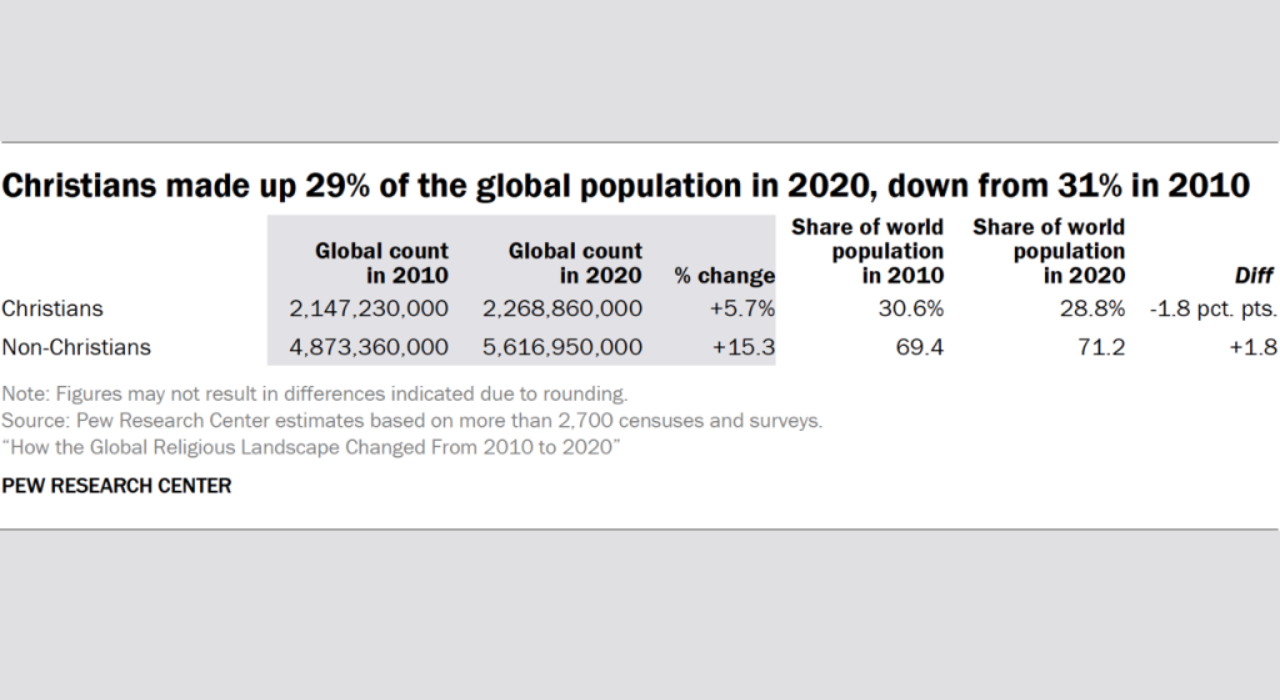
Over the past two thousand years, Christianity has expanded from a small Jewish sect in the Eastern Roman Empire to become the world’s largest religion. Imperial recognition in the fourth century AD, medieval missionary networks throughout Europe, and later colonial-era missionary activity in the Americas, Africa, and parts of Asia steadily expanded its reach. As of 2020, it still accounts for the largest share of humanity, accounting for 28.8% of the global population, or approximately 2.3 billion people. However, new demographic analysis from the Pew-Templeton Future of Global Religion Project shows that underneath this dominance, a quieter shift is taking place. Christianity is still growing in raw numbers but shrinking in proportion, losing followers in dozens of countries while rapidly expanding in others and shifting geographically from its historic base in Europe to sub-Saharan Africa. The findings, which draw on more than 2,700 censuses and surveys in 201 countries and territories, track religious change between 2010 and 2020 and examine the forces driving this change, particularly fertility patterns and religious “conversions” (people giving up their faith in adulthood).

From imperial religion to global majority

The early spread of Christianity relied on itinerant missionaries and the promise of close-knit communities to provide social support and universal salvation. Its trajectory changed dramatically when Emperor Constantine legalized the faith in 313 AD, and it later became the state religion of Rome. Missionary activities in the Middle Ages brought it to various parts of Europe, and from the 15th century onwards, European expansion exported it to all parts of the world. Colonial powers such as Spain, Portugal, England, France, and Belgium often combined territorial expansion with conversion. Missionaries established schools and medical services, translated scriptures, and in some areas used coercive taxation and legal systems to suppress indigenous religions. In modern times, Christianity has become the dominant faith on many continents around the world.
Christian Demographics

From 2010 to 2020, the number of Christians increased by 6%, from 2.1 billion to 2.3 billion, and remains the largest religion in the world.

Such a lengthy expansion explains its contemporary scale. Between 2010 and 2020, the number of Christians still increased by 122 million, from 2.1 billion to 2.3 billion, an increase of 6%. But the global population is growing faster, with non-Christians growing by 15%, causing the share of Christianity to drop from 31% to 28.8%, with all Christians being lumped into one category, including Catholics, Orthodox, and Protestant denominations such as Baptists, Lutherans, Anglicans, Methodists and Pentecostals.

Geographic shifts: Africa rises, Europe falls

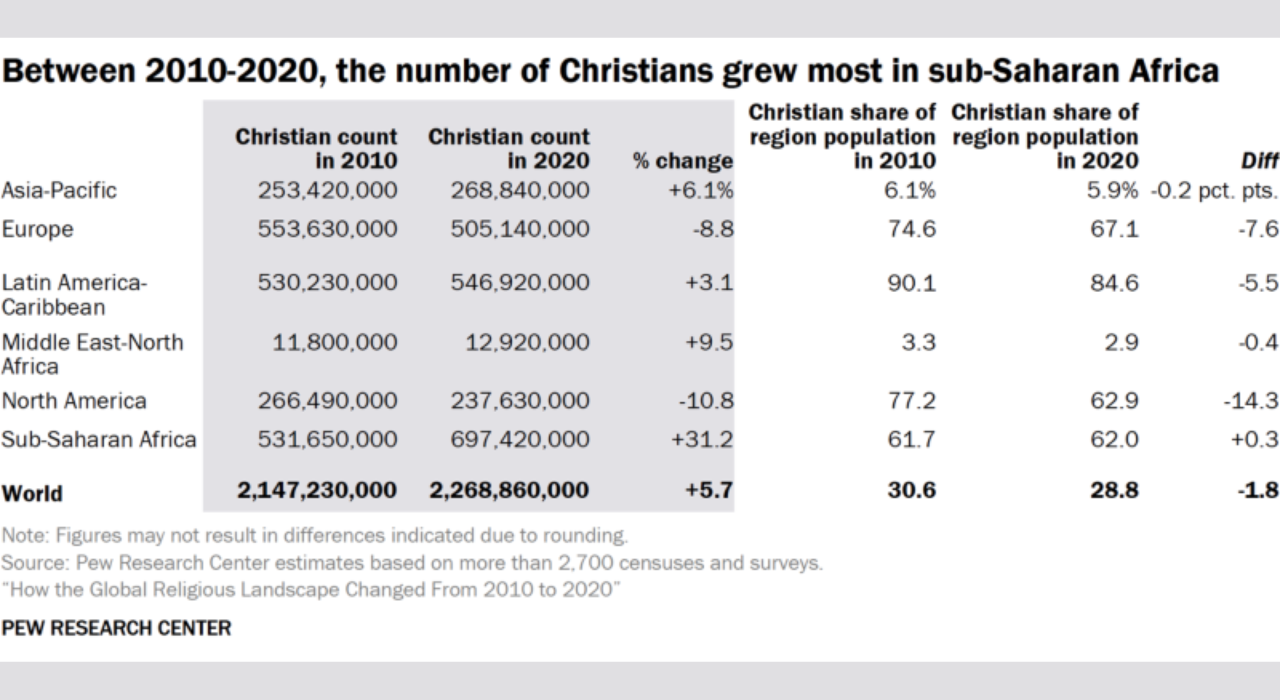
The most striking changes of this decade were geographical rather than numerical. Europe, the historical center of Christianity, no longer has the largest Christian population. The number of Christians declined in both regions. In Europe, the number of Christians fell to 505 million (down 9%). In North America, this number decreased to 238 million (down 11%). In every other region, the number of Christians is growing. Sub-Saharan Africa saw the largest increase, reaching 697 million (+31%).

  • Sub-Saharan Africa: 697 million Christians (up 31%)
  • Europe: 505 million (down 9%)
  • North America: 238 million (down 11%)

As of 2020, 31% of Christians live in sub-Saharan Africa, compared with 22% in Europe. Latin America and the Caribbean account for 24% of the world’s Christians, and North America 10%.
The decline of Christianity

Between 2010 and 2020, the number of Christian believers in sub-Saharan Africa increased by 31%, reaching 697 million believers.

The proportion of the population identifying as Christian has also changed:

  • North America: 63% (down 14 percentage points)
  • Europe: 67% (down 8 percentage points)
  • Latin America and the Caribbean: 85% (down 5 percentage points)
  • Sub-Saharan Africa: 62% (up slightly, less than 1 percentage point)

In the Asia-Pacific and Middle East-North Africa regions, Christians still account for less than 10% of the population, down by less than one percentage point.
Christianity in various countries

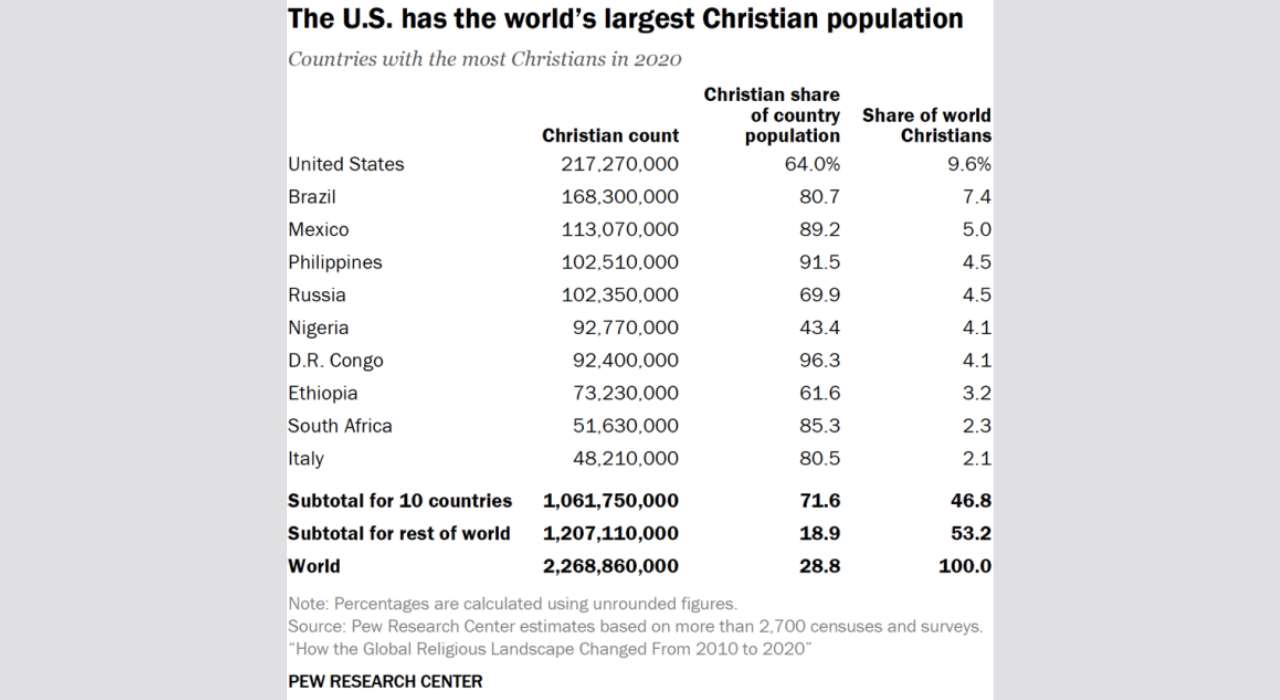
As of 2020, there are approximately 238 million Christians in North America, accounting for approximately 10% of the world’s total Christian population.

However, when measured by individual countries rather than regions, the United States still has the largest Christian population of any country. As of 2020, about 64% of Americans consider themselves Christians, accounting for about one-tenth of the world’s Christians.Also read: Is religion in decline? As Christianity declines, a quarter of the world’s people are now irreligious, making it the third largest group

Where Christianity declined and where it grew

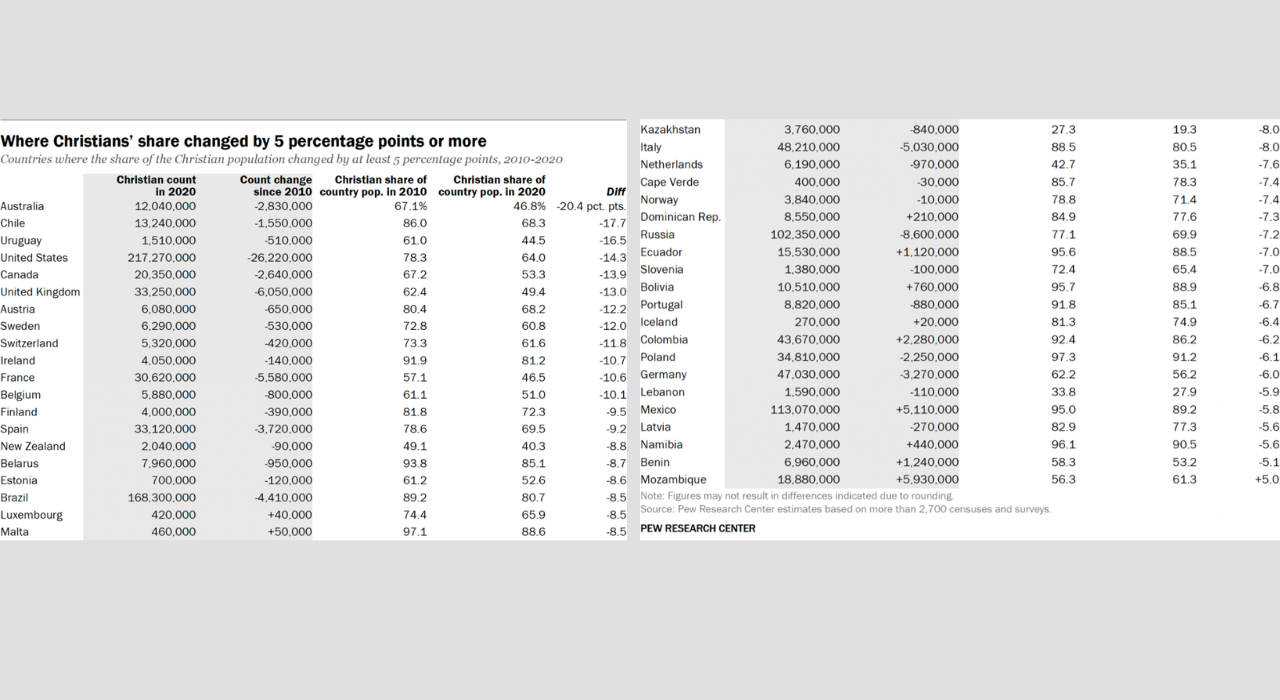
Significant changes (defined as shifts of at least 5 percentage points) occurred in 41 countries, more than for any other religion. Christianity declined in all but one country. Maximum drop:

  • Australia: down 20 points
  • Chile: down 18 points
  • Uruguay: down 16 points
  • United States: down 14 points
  • Canada: down 14 points
  • Benin: down 5 points

Points dropped

Between 2010 and 2020, the share of Christians in North America fell by 14 percentage points, while in Europe it fell by 8 percentage points.

In some countries, Christianity has lost its majority status:

  • UK: 49%
  • Australia: 47%
  • France: 46%
  • Uruguay: 44%

In each case, the religiously unaffiliated made up 40 percent or more of the population. Mozambique was the only country to see a significant increase, rising by 5 percentage points to 61% following the end of the anti-religious government movement in the 1980s. Overall, Christians remain a majority in 120 countries and territories, down from 124 in 2010.

Mechanism: Give up religious belief

The central driver of change was not just birth rates but religious conversion. Christians experienced the greatest net losses: For every 1 person who joins Christianity, 3.1 people leave Christianity. Most people do not join other religions; they become irreligious. This movement explains the declining share of Christianity and the simultaneous growth of “nonbelievers.” Globally, religious conversion shows a clear direction: more people are leaving religions than converting. Among adults aged 18 to 54, for every one person who joins a religion, 3.2 abandon it. Fertility remains important, with Christian birth rates relatively high, but the conversion offsets this. In contrast, Muslim population growth is driven primarily by a younger age structure and higher fertility rates, rather than conversion.

The changing religious landscape

By 2020:

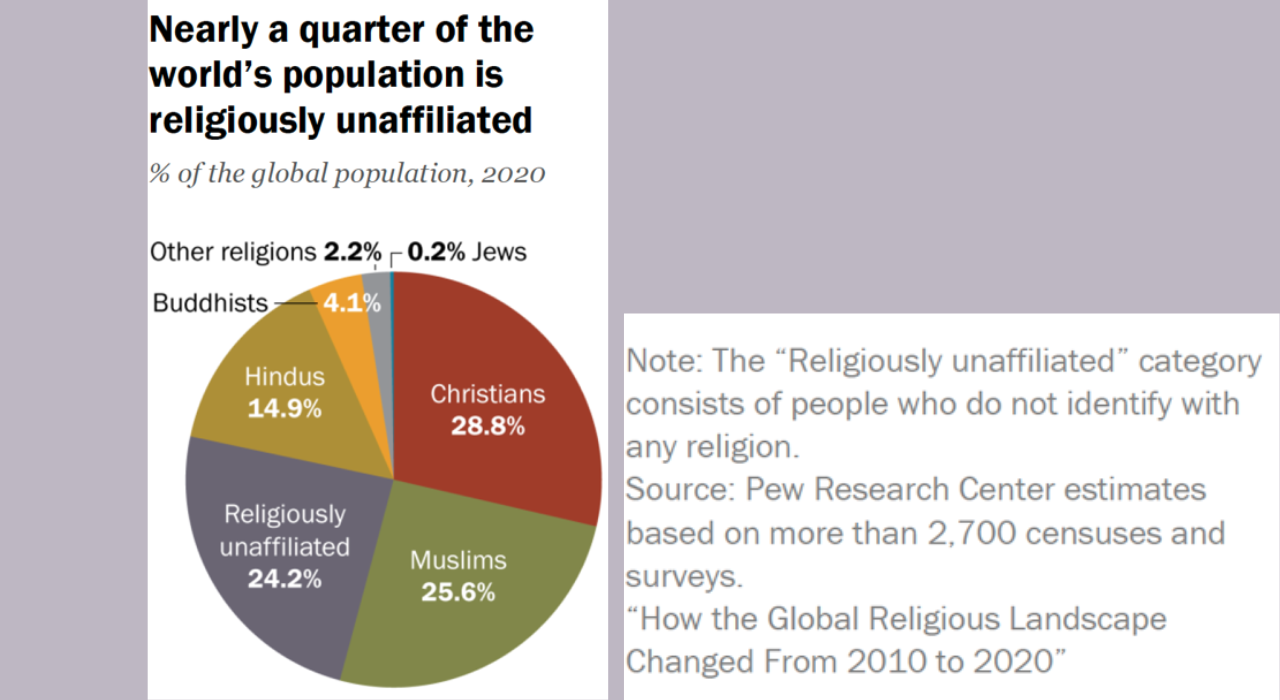
  • Christian: 28.8% (2.3 billion)
  • Muslim: 25.6%
  • No religious affiliation: 24.2%
  • Hindus: 14.9%
  • Buddhist: 4.1%

Globally, 75.8% of people have a religious affiliation and 24.2% have no religious affiliation.
Religion Pew

Currently, independents make up 24.2% of the global population, largely due to the Christian schism.

Figures show Christianity remains the world’s largest religion, but is increasingly concentrated in the Global South and increasingly affected by Western divisions. Over the past century, it has spread across every continent. Over the past decade, its center has quietly shifted.

Mumbai and New Mangalore ports await 3 patrol boats months after contract deadline | India News

0

Mumbai and New Mangalore ports await 3 patrol boats months after contract deadline

NEW DELHI: The Mumbai Port Authority (MPA) and New Mangalore Port Authority (NMPA) are still awaiting delivery of three patrol boats, more than eight months beyond the maximum deadline stipulated in the contract. As for the other two major ports – Paradip and VO Chidambarnar, the delivery of two such ships has been delayed.The four major port authorities awarded the contracts to Mumbai-based Knowledge Marine & Engineering Works Ltd. Port patrol boats are specialized, fast and agile vessels designed for security, surveillance and law enforcement in ports and coastal areas.The four major port authorities awarded the projects to Mumbai-based Knowledge Marine & Engineering Works LtdMPA issued a tender to the company in September 2024 to lease two fully operational patrol boats, to be deployed over seven years. The ships were originally scheduled to be delivered by March 23, 2025, but the company failed to meet the deadline.Last month, the port authority issued a termination notice to the company, saying it failed to provide replacement patrol boats with similar technical specifications during periods of unavailability or delays. The letter, dated January 8, 2026, also stated that the delay caused a loss of Rs 35 lakh to the port authority. The company was given until January 20 to confirm compliance or the contract could be terminated.The MPA did not respond to multiple inquiries about the status of the contract.Likewise, the National Medical Products Administration awarded the company a contract to lease a patrol boat in August 2024, with delivery scheduled for May 2025. The company was allowed to delay deliveries until July 2025, subject to maximum applicable liquidated damages. However, the ship has still not been delivered.A senior NMPA official said the patrol boat was contracted at a cost of Rs 97 crore but has yet to be delivered. Despite the delays, the Port Authority did not terminate the contract.Sources in the Ministry of Ports and Shipping said since port authorities have the power to take decisions regarding contracts and operations, it is their responsibility to take appropriate action.

Trump’s border czar Minnesota’s new policies after immigration cuts: ‘We’re going back to…’

0

More than 1,000 immigration agents have left the Minnesota Twin Cities area and hundreds more will leave in the coming days as part of the Trump administration’s rollback of immigration enforcement, White House border czar Tom Homan said Sunday.

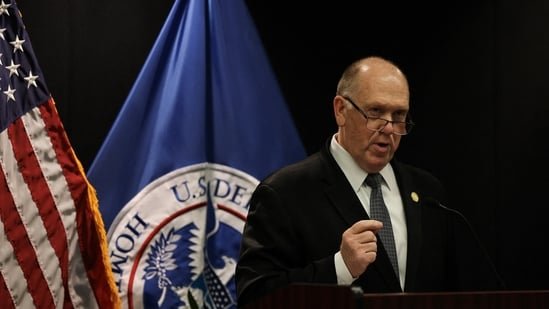
Border czar Tom Homan speaks at a news conference at the Bishop Henry Whipple Federal Building in Minneapolis, Minnesota (Reuters)

Homan told CBS’s “Face the Nation” that a “small” security force will be stationed briefly to protect remaining immigration agents and to respond “when our agents go out and are surrounded by agitators and things get out of hand.” He didn’t define “small.”

He also said agents would continue to investigate fraud allegations and anti-immigration enforcement protests that disrupted church services.

“We’ve already evacuated over 1,000 people, and starting Monday and Tuesday we’re going to evacuate hundreds more,” Homan said. “We’re going back to our original footprint.”

Thousands of officers were dispatched to the Minneapolis and St. Paul areas to participate in U.S. Immigration and Customs Enforcement’s “Operation Metro Surge.” The U.S. Department of Homeland Security said it was the largest immigration enforcement operation in history and proved successful. But as the situation became more unstable and two U.S. citizens were killed, the crackdown came under growing criticism.

Protests became common. Networks of residents work to help immigrants, warn approaching agents or film immigration officials in action. The federal police shootings of Renee Goode and Alex Preti drew condemnation and raised questions about police conduct, prompting changes in operations.

Homan announced last week that 700 federal officials would leave Minnesota immediately, but more than 2,000 remain in the state. He said on Thursday that “significant drawdowns” had begun and would continue into this week.

Homan said enforcement in the Twin Cities will not stop and mass deportations will continue across the country. Officers who leave Minnesota will report back to their respective stations or be assigned elsewhere.

Asked whether future deployments could match the scale of Operation Twin Cities, Homan said “it depends on the circumstances.” (Associated Press)

National Bureau of Standards

National Bureau of Standards

Who is Ophelia Torres? Chicago teen who fought for father’s release from ICE detention dies of cancer

0

Who is Ophelia Torres? Chicago teen who fought for father's release from ICE detention dies of cancer

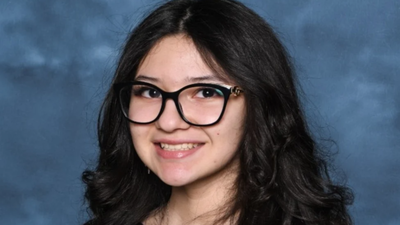
Ofelia Torres, a 16-year-old Chicago student who publicly called for her father’s release from immigration detention while battling a rare cancer, has died, NBC News reports. Ophelia died Friday of stage 4 alveolar rhabdomyosarcoma, a rare and aggressive cancer that affects soft tissue. She was diagnosed in December 2024 and underwent treatment for several months.A few months ago, her father, Ruben Torres Maldonado, attracted attention online when he was arrested by U.S. Immigration and Customs Enforcement (ICE) on October 18, 2025. At the time, Ophelia was receiving care in the hospital and spending time with her family.Shortly after his arrest, she posted a video on Instagram calling for his release and speaking out about families facing similar situations. In the video, she describes her father as a devoted parent.“My father, like many others, was a hard-working man who got up early in the morning and went to work without complaint, thinking about his family,” Ophelia said in the video. She added, “I think it’s so unfair that hard-working immigrant families are being targeted just because they weren’t born here.”The video includes photos of her father with his family as well as photos of Ophelia during her treatment in the hospital.Torres Maldonado was released from ICE custody about two weeks later after posting $2,000 bail. The judge considered his daughter’s medical condition during the hearing before granting the release, according to a family spokesman.In an earlier statement about his arrest, the Department of Homeland Security (DHS) said: “He has been charged multiple times with driving without insurance, driving without a valid driver’s license and speeding. During his arrest, he failed to comply with police instructions and attempted to drive away and reverse into a government vehicle. “Shortly before Ophelia died, a Chicago judge ruled that her father was eligible to have his deportation quashed, arguing that his deportation would have a negative impact on his U.S. citizen children. A family representative said the decision could provide a path to permanent residency and eventually citizenship.Ophelia, a junior at Chicago’s Lakeview High School, attended her immigration hearing via Zoom three days before her death.Her father’s attorney, Kalman Resnick, said: “Ophelia acted heroically in the face of ICE detention and the threat of deportation against her father. We mourn Ophelia’s passing and hope she will serve as an example to all of us of how to be brave and fight for justice until the end of her life.”

J&K’s BJP RS members face criticism for spending majority of MPLAD funds in UP | India News

0

J&K's BJP RS members face criticism for spending majority of MPLAD funds in UP

Jammu: Gulam Ali Khatana, a member of the Bharatiya Janata Party (BJP) Rajya Sabha from J&K (J&K), has been criticized for allocating a major chunk of funds from his Member of Parliament Local Development Fund (MPLAD) to projects in Uttar Pradesh instead of the state he represents in the Upper House of Parliament.“If 94 per cent of a J&K MP’s development funds are spent on Uttar Pradesh, what is the purpose of nominating him? This exposes the harsh truth: J&K’s representation has been reduced to symbolism while its people have been deprived of their due share,” said Tanvir Sadiq, spokesperson of the ruling National Conference.A native of Jammu, Katana joined the BJP in 2008 and was nominated to the federal house from Jammu region in 2022.Under the MPLAD scheme, nominated members of the House of Federation can recommend development projects in any state or region across the country. Khatana recommended 139 development projects in Shahjahanpur, three in Pilibhit, one in Chandauli and one in Badaun in Uttar Pradesh using the scheme.In Jammu and Kashmir, he recommended 17 projects for Jammu region, including 6 for Samba, 1 for Kathua, 6 for Poonch and 2 for Rajouri.PDP spokesperson Aditya Gupta said, “He entered the Assembly from J&K, but his development funds went to Uttar Pradesh. This is the BJP model. Votes from Jammu, funds from Uttar Pradesh.”“Jammu has not been betrayed by outsiders, it has been our own MPs and MLAs who have betrayed our interests,” Gupta said.Catana defended his decision. “I was nominated as an MP. I can recommend works from anywhere in the country,” he told TOI.Sadiq said when Qatana was nominated, it was seen as a move to empower the Gujjar community.Katana hails from the Gujjar community.

Rams WR Puka Nacua drives pace car in Daytona 500, says on social media: ‘On a side mission’

0

Los Angeles Rams wide receiver Puka Nacua drives pace car during game NASCAR Cup Sunday’s Daytona 500 Florida. Social media was amused and reacted to his appearance.

Los Angeles Rams receiver Puka Nacua poses on the NFL Honors red carpet before Super Bowl LX at the Palace of Fine Arts. (Picture from Reuters Connect)

Earlier, Nacua was joined by Bubba Wallace for a speed test at Daytona International Speedway in Daytona Beach. He also participated in NASCAR’s “Speed ​​Seat Thrill Ride” event with Hall of Famer Kurt Busch before the race.

This is Puka Nacua’s first high-profile guest appearance at a NASCAR event.

“Puka Nacua doing side missions,” one user wrote on X, sharing a photo of Nacua’s car on TV being played on a Fox Sports broadcast.

“Puka Nacua rode shotgun with a fellow rider during the Daytona 500. The guy was probably brain dead…”, one of the jokes.

“Michael Jordan, Puka Nakua and Marshawn Lynch in the same photo 🤣😂,” another person wrote as the broadcast turned to them.

“Rams wide receiver Puka Nacua rode in one of the Daytona 500 lead cars today,” reporter Jeff Dubrof wrote, sharing a video of the WR getting into the car.

“A user shared a photo of Kurt Russell and Puka Nakua,” one user said.

Also read: Brad Keselowski Leg injury: Will No. 6 Ford need backup driver in Daytona 500?

Daytona 500 race postponed: What to know

Sunday’s Daytona 500 was delayed 90 minutes due to forecast rain in Daytona Beach on Sunday afternoon. The game was originally scheduled to start at 12 noon ET, but will start at 1:30 p.m. NASCAR announced the change Saturday.

The Daytona 500 event consists of two stages of 500 miles, each stage is divided into 100 laps. Daytona International Speedway is approximately 2.5 miles long.

Railway quietly upgrades network: 81% of tracks are ready to meet speeds of 110 kilometers per hour | Indian News

0

Railway quietly upgrades network: 81% of tracks are ready to meet speeds of 110 kilometers per hour

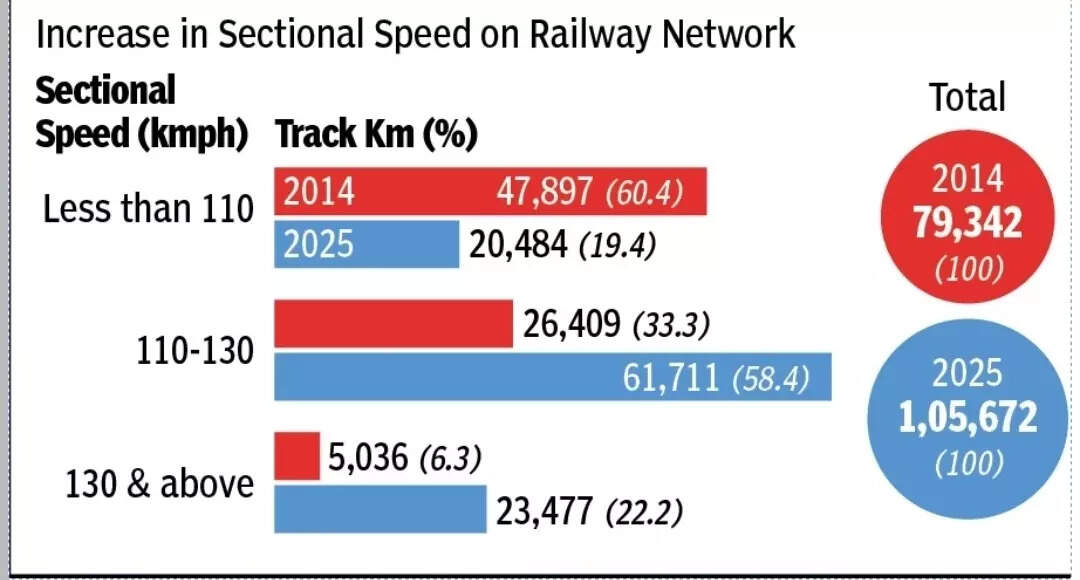
NEW DELHI: Nearly 81 per cent of railway tracks are ready to allow trains to run at speeds exceeding 110 km/h, a two-fold increase from 2014, the government told Parliament in its last session. One-fifth of the existing track allows trains to run at speeds in excess of 130 km/h.This is significant because section speed increases are delivered across the entire rail network rather than limited corridor-based upgrades. According to government data, of the less than 110,000 km of the railway network, 84,888 km have been upgraded to support speeds of 110 km/h and above, of which 23,477 km are capable of running at speeds of 130 km/h and above.This system upgrade has allowed the Railways to introduce new-age Vande Bharat (including soft-seat coaches and sleeper trains) as well as faster Amrit Bharat trains.

,

Experts say the step-by-step speed upgrade is also important because unlike countries such as China, Japan and France, which have achieved higher speeds mainly by laying new passenger high-speed rail lines, India has followed a fundamentally different and more complex path.India’s approach focuses on upgrading existing tracks carrying mixed traffic (passenger and freight), which is more challenging than building segregated high-speed corridors as it requires strengthening track geometry, signaling, electrification and safety systems without disrupting daily operations.Railway Ministry officials said India’s strategy is to gradually upgrade the speed of large stretches of continuous track from 110 km/h to 130 km/h, and even further increase it to 160 km/h.“This creates a stepped speed ecosystem, rather than a sharp division between ‘slow’ conventional lines and isolated high-speed lines. This grading allows trains, crew training and signaling systems to develop organically, reducing transition risks,” an official said.Speed ​​capabilities are also available across all railway zones, including freight-intensive areas such as East Central Railway, South East Central Railway and South Central Railway. “This ensures uniformity across the country and avoids the creation of elitist, passenger-centric corridors that are disconnected from the rest of the network,” the official said.The railway operates some of the world’s longest freight trains, carrying more than 250 million passengers every day, operating with heavy axle loads of 22.9-25 tonnes and maintaining long welded rails, full electrification and increasingly automated signaling – all on the same track. They added that no other rail system has attempted speed upgrades on a comparable scale under such constraints.

MacKenzie Scott donates $26 billion in 7 years, more than Elon Musk and Jeff Bezos’ combined lifetime donations

0

MacKenzie Scott donates $26 billion in 7 years, more than Elon Musk and Jeff Bezos' combined lifetime donations

According to Forbes, Mackenzie Scott has donated $26 billion in the past seven years, including a record $7.2 billion in 2025. This rate of giving makes her the third-largest philanthropist of all time. Scott is a novelist and former spouse of Amazon founder Jeff Bezos. She distributes funds primarily through large, unrestricted grants to nonprofit organizations throughout the United States and internationally. Her total giving since 2019 has now reached $26 billion, according to public data compiled by philanthropy trackers and financial publications.She donated $7.2 billion in 2025, the largest donation in a single year in her philanthropic career. The record year accelerated her overall giving total and put her ahead of most living donors in cumulative lifetime giving.Scott donated $26 billion during his lifetime, making him the third-largest philanthropist of all time in absolute terms. Only two people in modern history have made more contributions in their lifetime.Her 2025 donation alone exceeds the combined lifetime contributions of several prominent billionaires, including Tesla and SpaceX CEO Elon Musk, Google co-founder Larry Page, Oracle co-founder Larry Ellison and her ex-husband Jeff Bezos.Scott’s philanthropic strategy differs from that of many large donors. Rather than establishing a traditional foundation with an extensive application process, she relied on an advisory team to identify organizations and make grants with few restrictions on how the funds could be used. Recipients include charities focused on education, racial equity, public health, housing, food security and community development.Since announcing his intention to give away most of his wealth in 2019, Scott has moved unusually quickly compared to other billionaires. The $26 billion total represents one of the fastest large-scale charitable distributions in modern history.Much of her wealth comes from her 2019 divorce settlement with Jeff Bezos, when she received a stake in Amazon. She has since sold some of her shares to fund her charitable giving.This comparison is based on the total public donations made by Musk, Page, Ellison and Bezos during their lifetimes. Despite their large pledges and charitable foundations, they’ve actually given away less to date than Scott has given away in 2025 alone.Scott has not publicly indicated a set end date for her donation. However, her pace over the past seven years suggests she intends to continue distributing the majority of her wealth.