Home Blog

Robin Gunningham Banks? Everything about the artist believed to have adopted the identity of David Jones

0

The identity of the elusive street artist popularly known as banksy is the headline news. a new one investigation report According to Reuters, the person behind the pen name may be Robin Gunningham, a British artist from Bristol who reportedly later adopted the name David Jones.

On July 17, 2003, graffiti artist
On July 17, 2003, graffiti artist “Banksy” displayed pigs painted in police car colors in the “Turf Wars” exhibition. REUTERS/Peter MacDiarmid (REUTERS)

Banksy has never publicly confirmed his identity, and representatives associated with the artist have disputed or declined to comment on many previous attempts to reveal his identity.

The investigation claims to have uncovered evidence linking Gunningham to an anonymous graffiti artist who has spent more than two decades creating politically charged murals around the world.

Read more: Banksy unveils new art in London, following speculation over mural depicting stargazing figures

Banks: Robert Del Naja, David Jones or Robin Gunningham

Banks is rumored to be Massive Attack frontman Robert Del Naja, who is said to have become a prominent artist due to his interests in politics and graffiti.

Three men listed by Reuters visited Ukraine at the same time in 2022.

According to a Reuters investigation, the connection was due to Banks’ trip to Ukraine in late 2022. Dernadja’s appearance in Ukraine in 2022 cast a shadow over the investigation. However, the musician was joined by another man, whom Reuters identified as Banks.

Banks = Robin Gunningham

Reuters reporters traced Banksy’s identity through public records, interviews with art industry insiders and historical police documents.

Reuters lists three people who may be Banks. The three names under investigation are Thierry Guetta, Robin Gunningham and Robert Del Naja

The photo of Banksy was taken by Jamaican photographer Peter Dean Rickards, who allegedly posted a photo of Banksy’s face and was arrested in New York in 2000, where a signed, handwritten confession was discovered.

Furthermore, the identity of Bristol resident Robin Gunningham was “unmasked” by the Mail on Sunday back in 2008. The British tabloid said its year-long research was “as close as possible to revealing” Banks’ identity.

Banksy’s anonymity is part of the Banksy brand

Banksy’s career has revolved around secrecy, making few public appearances and often identifying his artwork only through social media posts or official certifications.

For Banks, “working anonymously or under a pseudonym serves a vital social interest. It protects free speech by allowing creators to speak truth to power without fear of reprisal, censorship or persecution,” Banks’ lawyer Mark Stephens told Reuters in the context of the release of the “revelations.”

In 2010, when Time magazine named him one of the most influential people in the world, Banks posed for a photo with a bag on his head.

Read more: A rare Banksy owned by a member of Blink-182 is up for auction. it could sell for $6 million

Banksy’s anti-establishment art generated hundreds of millions of dollars in art sales

Banksy was questioned by other artists about his anti-establishment stance on his art and his diversity after receiving special treatment from British powers.

Reuters lists a quote from Banks’ Time Out London 2010 that sums up his thinking nicely. “I told myself I was using art to promote dissent, but maybe I was just using dissent to promote my art,” he said. “I’m not guilty of selling my work. But I’m pleading in a bigger house than I was used to living in.”

According to art market data cited by Reuters, despite being outside the traditional art market, sales of Banksy’s artworks on the secondary market have reached nearly $250 million since 2015.

Although only a small percentage of the proceeds from these sales goes to the artist, the artist is entitled to royalties under UK law.

However, industry insiders say that Banksy now conducts private transactions for VIP collectors and may directly earn millions of dollars.

Banks’ wealth also comes from companies such as Pest Control Office

Reuters found seven companies with direct ties to Banksy over the years, and at least two others linked to the artist by name or through his lawyers and accountants.

The Office of Pest Control, established in 2008, performed most prominently in the survey. It is both a certification body for artists and a commercial enterprise. Its parent company, Picturesonwalls Limited, previously ran a London gallery.

According to the 2009 financial report, the Pest Control Office’s total assets amounted to £243,019. The latest report shows that the total net worth in 2024 is approximately £5.7 million

However, the documents did not specify whether these were stocks or unsold art. These reports are available from Companies House, the UK business register.

Djidji Ayokwe: France returns Africa’s talking drum: This sacred instrument once “speaks” to an entire village and warns of danger | World News

0

France returns African talking drum: sacred instrument that once 'spoke' to entire villages and warned of danger

The sacred drum, once a powerful communication tool for Ivorian communities, is back home more than a century after it was seized during French colonial rule. Known as the Djidji Ayokwe, the massive wooden instrument was confiscated by French authorities in 1916 and later shipped to France, where it remained in museum collections for decades. Its recent return marks an important moment of cultural restitution and historical justice. For the Ebri people, the drum is more than just a craft. It represents a living symbol of identity, tradition and authority that was once able to convey a message to an entire community through sound alone.

The Return of the Sacred Talking Drum

Djidji Ayokwe has been officially returned to Côte d’Ivoire after the French parliament approved a special law allowing the artifact to be removed from France’s national collections. The Sacred Drum has been on display in Paris for decades, first at the former Trocadéro Museum and later at the Quai Branly Museum.The dance group arrived in Abidjan on a special flight and was welcomed by traditional dancers, local chiefs and cultural officials at Félix Houphouet-Boigny International Airport. The drum was kept in a large wooden box marked “fragile” as part of the care taken to preserve historical artifacts during transportation.Francoise Remarck, Côte d’Ivoire’s Minister of Culture, described the moment as deeply moving and historically significant.“This is a historic day filled with a lot of emotion,” she said. “We are experiencing a moment of justice and remembrance that finally marks the return of the Gigi Ayoqui people to their place of origin.”

Traditional dancers in Abidjan welcome the return of Djidji Ayôkwé.

Traditional dancers in Abidjan welcome the return of Djidji Ayôkwé.

What is Djidji Ayokwe Talking Drum?

The Djidji Ayokwe, sometimes translated as “Leopard Lion”, is a giant wooden talking drum, over 3 meters long and weighing approximately 430 kilograms. It is carved from iroko, a durable hardwood widely used in West African craftsmanship.Unlike the small talking drums used by musicians, this instrument was designed for communication over long distances. Its powerful sound can travel across large tracts of land, allowing messages to reach multiple villages.The drum belongs to the Ebri people, an ethnic group that historically lived in the region of Abidjan, which is now Côte d’Ivoire’s largest city. In Ebri society, drums are considered sacred and closely associated with leadership and community authority.

why it’s called a talking drum

The name “talking drum” comes from the way the instrument mimics the rhythmic and tonal patterns of human speech.Many West African languages ​​are tonal, meaning the pitch and rhythm of words can change their meaning. Skilled drummers learn how to reproduce these tonal patterns with carefully controlled beats. By adjusting rhythm, speed and pitch, they can transmit recognizable phrases and signals.Drums were an early communication system for communities living in forests and lagoons.Through specific rhythmic patterns, it can announce gatherings, convey important information, warn of danger, or summon people to rituals and emergencies. Villagers who are familiar with these patterns can decipher what the drum is “saying” even from a distance.

Ceremony commemorating the return of the Djidji Ayôkwé talking drum.

Ceremony commemorating the return of the Djidji Ayôkwé talking drum.

The drum of authority

In addition to its practical use, Djidji Ayokwe also has deep symbolic meaning. It represents authority within the community and is closely associated with traditional leadership.Drums are typically used by designated drummers who are entrusted with conveying important messages on behalf of chiefs and elders. Due to its sacred status, the instrument is not viewed as an ordinary musical device but as a cultural object associated with identity and governance.Its presence in a village signals unity and organization within the Ebri community.

How drums were taken away during colonial rule

The drum’s dismantling dates back to 1916, during French colonial rule in Côte d’Ivoire. French authorities reportedly confiscated the tool because they were concerned about its ability to mobilize communities and spread information quickly.After being seized, the drum was eventually shipped to France in 1929. There it became part of a museum collection documenting colonial African culture.For decades, Djidji Ayokwe remained distant from the community that created him.

part of a wider movement to repatriate cultural artefacts

The return of the talking drum is part of a wider international debate over the return of artifacts seized during colonial rule.In recent years, France has begun to return some important cultural relics to African countries. The process received a boost in 2017 when French President Emmanuel Macron declared that African heritage should be able to return to the continent.Côte d’Ivoire has requested the return of more than a hundred artifacts currently held in European museums. Djidji Ayokwe was one of the first artifacts to be repatriated.Similar comebacks have occurred elsewhere. France has previously returned royal treasures from Abomey to Benin, as well as a historic saber belonging to the Senegalese leader.

The Holy Drum’s new home

Upon his return, Djidji Ayokwe will be exhibited at the Museum of Civilization in Abidjan.Museum director Francis Tagero said the instrument will take center stage in the institution’s galleries so visitors can understand its cultural significance.“We are very happy and proud to receive this sacred drum,” Tagero said. “It means a lot to us and it will raise cultural awareness among the younger generation.”For many Ivorians, the return of the drum represents more than just the restoration of a historical artifact. It restores symbols of collective memory and reconnects a community with its cultural heritage that has been missing for more than a century.

Doctors: Sleep disorders put lakhs of Indians at risk

0

Insomnia affects nearly 37% of seniors

NEW DELHI: Doctors check blood pressure, diabetes and cholesterol regularly. But they rarely ask a question that may be just as important: How well did you sleep? On March 13, World Sleep Day, experts warn that sleep disorders may be affecting millions of Indians and quietly increasing the risk of heart disease, diabetes and depression. New research shows the problem is widespread. A 2025 systematic review published in the Indian Journal of Public Health analyzed 100 studies involving nearly 68,000 people and found that 25.7% of Indians suffer from insomnia, while obstructive sleep apnea (OSA) affects about 37.4% of Indians. Another 10.6% suffer from restless legs syndrome, a disorder that disrupts sleep. For patients with other medical conditions, the burden is even higher. Nearly 48% suffer from sleep apnea and 32% suffer from insomnia, suggesting that sleep disorders may worsen chronic conditions. Experts estimate that about 52 million working-age Indians may suffer from sleep apnea, with nearly 29 million suffering from moderate to severe disease. Insomnia affects nearly 37% of older adults. Prof (Dr) JC Suri, Head and Head, Department of Pulmonary, Critical Care and Sleep Medicine, Sitaram Bhartia Institute of Science, said lifestyle habits are exacerbating the problem. A survey of IT professionals in Hyderabad found that 97% used electronic devices for at least an hour before bed, while 62% reported difficulty falling or staying asleep. Dr Vikram Sarbhai, president of the Sleep Disorders Association of India, said: “Sleep deprivation is probably the world’s biggest silent epidemic since the advent of the electric light and has been worsening for decades, driven by our shift to a 24-hour society.” “Humans follow a circadian clock that regulates sleep and wake cycles, so sleep is critical for restoring brain and body function.” Healthy sleep depends not only on duration but also on quality and regularity, which are increasingly disrupted by modern lifestyles, shift work and the use of technology, he said. Typically, adults in the 18-45 age group need 6-8 hours of sleep, adults in the 45-70 age group need about 5-7 hours, and people 70 and older need about 5 hours. These are estimates for individuals without excessive alcohol or caffeine exposure, toxic exposure, behavioral disorders, or medical conditions that affect sleep. The broader crisis could be even greater. A 2025 report by AGR Knowledge Services estimated that three out of five Indians are sleep-deprived, with many turning to online therapy instead of seeking medical help. Professor (PhD) JC Suri said poor sleep is closely linked to high blood pressure, heart disease, stroke, diabetes, obesity, depression and cognitive decline. Lack of sleep is also becoming a road safety risk. A study by the Central Road Research Institute found that around 40% of accidents on the Agra-Lucknow Expressway were related to driver fatigue. Despite these risks, India has no national policy mandating screening of commercial drivers for sleep disorders, unlike countries such as the United States, United Kingdom and Japan. Experts say poor awareness and the lack of sleep medications in most medical curricula means many patients remain undiagnosed. Addressing sleep disorders may be an important but overlooked opportunity in preventive health care, they say.

Maggie Haberman: Five things New York Times reporter Trump slammed as a ‘maggot’ after criticizing Iran war

0

president Donald Trump On Friday, she launched a scathing attack on New York Times reporter Maggie Haberman, calling her a “maggot” in a post for The Truth Society. Trump’s anger appeared to boil over after Haberman’s explosive interview with CNN. Caitlan Collinsshe lashed out at the president iran is.

Maggie Haberman is a New York Times reporter who has come under fire from Donald Trump. (X/@MatthewNichol5, X/@hfrpodcast)

“Margot Hagman, another SLEAZEBAG writer for the failed New York Times, persists in writing false stories about me, even though she fully knows and understands that everything she says is often the exact opposite of the truth,” Trump wrote.

He added, “Regardless, I am considering adding Maggott and some of her “associates” to the lawsuit I have filed against The Times in Florida, and happily, that lawsuit appears to be moving forward smoothly. Thank you for your attention to this matter! DJT President.”

Haberman’s reportage has been critical of Trump, to say the least, and her author page features articles with titles like “Trump’s Tangled Web of Deals, Policies and Fortunes” and “Trump Frees Fraudster Just Days from Seven-Year Prison.”

ALSO READ | ‘I just love watching her talk’: Donald Trump criticized for ‘sexist’ comments about female journalists

Here’s everything you need to know about Maggie Haberman.

Maggie Haberman: 5 things to know

  1. Haberman was born in New York City, the son of Clyde Haberman, a longtime reporter for The New York Times, and Nancy Haberman, director of media communications at the Rubenstein Institute. Her mother worked for powerful clients in New York, including Donald Trump.
  2. A graduate of Sarah Lawrence College, her first reporting job was at the New York Post.
  3. Thereafter, Haberman worked at the New York Daily News and Politico before joining the New York Times. During her career, she has covered five presidential elections, several gubernatorial races and the New York City mayoral race. She is also the author of The Confidence Man: The Rise of Donald Trump and the Collapse of America
  4. Haberman, who is of Jewish descent, is married to New York Daily News reporter Darre Ardash Gregorian. The couple has three children and lives in Brooklyn.
  5. Haberman was part of a team that won a Pulitzer Prize in 2018 for its coverage of Trump’s advisers and their ties to Russia. In 2021, she was part of a team that was a Pulitzer finalist for its coverage of Trump’s handling of the coronavirus.

Haberman on Trump and the Iran War

“The president does know there’s a correlation between gas prices and oil,” Haberman said on Collins’ show. “Everything the president has said is very clear, and he’s said it publicly, he thinks this thing will be over by now. I don’t know why he thinks that, and I don’t know why there isn’t some kind of contingency with what we’re seeing now. But there’s clearly no plan to deal with this other than talking about how the tankers should be tough and keep going. That’s — it’s not — it’s not working.”

She added, “So, it looks like this is going to be a couple more weeks. The president has expressed different timelines as to A, when he’s going to leave, and B, what he wants to accomplish. That may not be up to him at this point. So, we’ll see.”

The New York Times reporter continued, “…different countries have said that they are really waiting for the end of this war to come and the president to make a decision. But even if he makes a decision tomorrow, it does not mean that the impact of this war will stop tomorrow.”

It’s worth noting that the attack on Haberman is not the first time Trump has attacked a female reporter. He told Bloomberg’s Katherine Lucey “a quiet little pig” when asked about Epstein’s files. Collins was also targeted when the president noted that she should “smile” more when she asked the president about Epstein’s survivors.

Video of Trump wearing a cowboy hat

While Trump’s comments about Haberman drew widespread reactions online, the president himself can be seen in the video wearing a cowboy hat in the Oval Office.

This happened during his meeting with the rodeo world champion.

SC: Mandatory furloughs may deter companies from hiring women

0

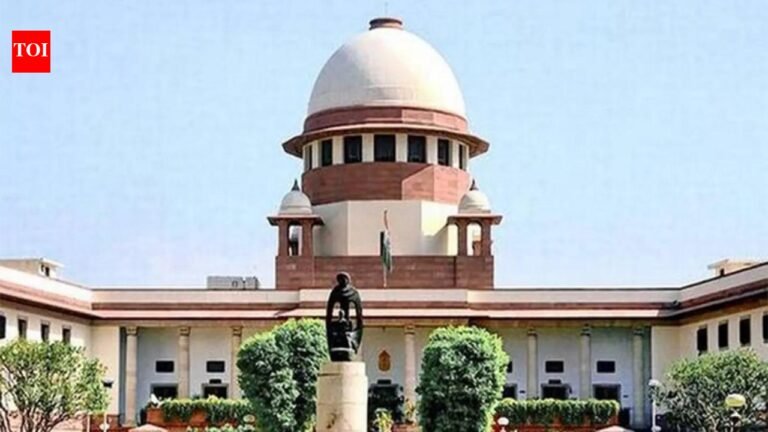
NEW DELHI: Upset over an advocate’s repeated attempts to seek two days of paid menstrual leave per month for women workers through PILs, the Supreme Court on Friday said the move may create a psychological barrier in women and make them consider them inferior to men as they cannot work during menstruation. A bench of Justices Surya Kant, Joymalya Bagchi and Vipul M Pancholi of the CJI said, “Please understand the long-term implications of this move. Affirmative action for women is constitutionally recognized. The less attractive the human resources are, the less possibilities there are for consumption in the job market.” “We can rule from a rights perspective. But look at it from an employment model perspective. Will the employer be happy if the employee takes leave every month? You want to create a situation where the employer is not willing to give a woman a job,” the judge said. However, it said, “it is for the government to formulate model policies…”SC warns petitioners not to pursue issues On February 24, 2023, the SC asked the government to consider taking a policy decision on this issue after studying the need and possible consequences of employers being dissuaded from hiring large numbers of women in the workforce. Regarding the petitioner SM Tripathi, senior advocate MR Shamshad said that despite the passage of nearly three years, no action has been taken. Bihar has been doing this since 1992 and Karnataka has also implemented it in schools, Shamshad said. Some private companies have voluntarily implemented menstrual leave policies for female employees. CJI Surya Kant said, “If they do it voluntarily, it is welcome. But once it is forced to do so, you don’t know how much damage it will cause to their careers. No one will give them responsibility. In terms of justice, day-to-day trials cannot be assigned to them.”

.

The bench warned petitioner Tripathi that if he approaches the court on the issue for the third time, he will be subject to an adverse order. His petition raising the same issue was rejected twice, in February 2023 and July 2024. In February 2023, Spain became the first EU country to implement 3-5 days of menstrual leave, with wages paid by the government. The former Soviet Union had a policy that paid wages to female workers who missed work due to menstrual pain. Japan and South Korea enacted laws in this regard in 1947 and 1953 respectively.

USS Tripoli: Why the US is sending the USS Tripoli and thousands of Marines to the Middle East and what it means for Iran’s war with Israel

0

Why the U.S. is sending the USS Tripoli and thousands of Marines to the Middle East, and what it means for Iran's war with Israel
US expands Middle East military presence amid tensions between Iran and Israel, USS Tripoli aircraft carrier deploys Marines

The United States is significantly expanding its military footprint in the region middle EastThousands of Marines and a powerful amphibious assault ship have been dispatched to the region as tensions with Iran rise. The deployment comes amid a rapidly escalating conflict between the United States, Israel and Iran that has triggered missile strikes, drone strikes and instability across the Gulf.According to reports, the Pentagon has ordered the amphibious assault ship USS Tripoli (LHA-7) and its Marine Expeditionary Unit to deploy to the region to transport thousands of combat-ready troops and advanced military equipment closer to the conflict zone. The move signals that Washington is preparing for a broader confrontation while also trying to protect U.S. strategic waterways and assets in the Middle East.

U.S. quickly builds military power in Iran-Israel war

The deployment reportedly includes approximately 2,000 to 2,500 Marines, as well as additional sailors and naval assets that will operate from the aircraft carrier USS Tripoli and its accompanying ships. The Marine Expeditionary Force is designed to be a highly agile force capable of performing a wide range of missions, including:

  • amphibious assault
  • evacuate civilians
  • Attack enemy targets
  • humanitarian action
  • Securing strategic infrastructure.

Because these forces operate from amphibious ships rather than land bases, the U.S. military is able to respond quickly to crises without relying on host nation permission. Officials said the deployment was at the request of U.S. Central Command, which oversees U.S. military operations in the Middle East. The goal is to provide commanders with more options as tensions with Iran continue to escalate.

Why the U.S. is now sending Marines to Iran’s war with Israel

This decision was made against the backdrop of the rapid expansion of regional conflicts triggered by the US-Israeli attacks on Iranian military and nuclear targets in late February 2026. The attacks reportedly killed several senior Iranian leaders and damaged key military installations, prompting Tehran to launch retaliatory missile and drone strikes against Israeli and U.S. positions in the Gulf. Since then, the conflict has spread on multiple fronts:

  • Iranian missiles, drones target Israel, Gulf states
  • Shipping routes near the Strait of Hormuz were attacked
  • Drones, militias attack US bases in Iraq, Syria
  • Iran-backed groups launch rocket attacks in Lebanon.

The deployment of the Marines is widely seen as a precautionary measure aimed at deterring further Iranian escalation while ensuring the United States can respond quickly if the conflict expands.

The strategic importance of the Strait of Hormuz in the war between Iran and the United States and Israel

One of the main concerns driving the deployment is security in the Strait of Hormuz, one of the world’s most critical energy chokepoints. About a fifth of the world’s oil shipments pass through the narrow waterway, making it a vital artery for the global economy.Iran’s recent actions in the region, including threats to shipping and increased naval activity, have raised concerns that the strait may be disrupted or temporarily closed. This move will have an impact on global energy markets and may trigger a major international military response.Therefore, the arrival of amphibious ships and marines serves two purposes:

  1. Protect commercial routes
  2. Prepare for possible military escalation

What the USS Tripoli brought to the battlefield in the war between Iran and the United States and Israel

The Tripoli is an America-class amphibious assault ship that functions almost like a small aircraft carrier.It can host:

  • More than 1,600 Marines
  • Helicopters and tilt-rotor aircraft
  • Advanced fighter jets such as F-35B
  • Landing craft and armored vehicles.

This combination enables the ship to launch air strikes, amphibious landings and rapid reaction missions from the sea. By not requiring a nearby air base, the ship provides U.S. forces with the flexibility to operate in the Persian Gulf, Arabian Sea and surrounding areas. The Marine deployment is part of a broader U.S. military buildup in the Middle East that has been expanding since early 2026. These gatherings include:

  • aircraft carrier strike group
  • Fighters such as the F-35 and F-22
  • missile defense system
  • Additional naval battleships.

Analysts say the deployment is the largest in the region since the Iraq War. The build-up reflects growing concern in Washington that the conflict with Iran could escalate into a regional war involving multiple countries and armed groups.

Regional conflict between Iran and US-Israel war has expanded

The war between Iran and the US-Israeli alliance has had ripple effects across the Middle East. According to reports:

  • Iran retaliatory attacks target U.S. bases, regional allies
  • Hezbollah rocket launched from Lebanon
  • The shipping disruptions have raised concerns about the impact on the global economy.

Civilian casualties are also rising in many countries, and governments in the region are bracing for further escalation. Meanwhile, international leaders, including European and Middle Eastern governments, have called for de-escalation and diplomatic negotiations.

What happens next in the Iran-U.S.-Israel war?

Military analysts say the deployment of Marines does not necessarily mean a ground invasion of Iran is imminent. Instead, the move provides the United States with several strategic options:

  • Evacuate civilians from conflict areas
  • Protect critical infrastructure and routes
  • launch a limited attack or operation
  • Prevent Iranian attacks on U.S. forces.

However, the presence of thousands of additional U.S. troops also significantly increases the risks. If Iran directly targets U.S. forces or allies, the conflict could quickly expand into a broader regional war.The deployment now underscores the level of turmoil in the Middle East in recent weeks. The arrival of the USS Tripoli and its marines shows that Washington is bracing for the possibility of further escalation as missile exchanges, drone strikes and maritime confrontations increase in the region.It remains to be seen whether the move serves as a deterrent or is a prelude to a wider war. The clear message, however, is that the Middle East is once again at the center of a geopolitical crisis that could reshape global security and energy markets for years to come.

Why Judge James Boasberg blocked Jeanine Pirro’s action against Jerome Powell – explained

0

Federal Judge James Boasberg on Friday blocked the Justice Department’s efforts to subpoena documents from the Federal Reserve, issuing a scathing rebuke to prosecutors investigating the cost of renovating the central bank’s Washington headquarters. In a March 11 ruling, a U.S. district judge vacated a subpoena to the Federal Reserve Board of Governors, finding that the subpoena was improperly motivated. Documents detailing the decision were released on Friday.

Federal Reserve Chairman Jerome Powell speaks at a news conference after the two-day meeting (Reuters)

“As a result, the court finds that the subpoena was issued for improper purpose and will vacate it,” Boasberg wrote.

Read more: The U.S. has spent $11 billion on the Iran war, and costs are rising

What did Judge Boasberg say?

In his order, Boasberg said the subpoena was not to investigate renovation costs but to pressure Federal Reserve Chairman Jerome Powell.

“There is substantial evidence that the administration issued these subpoenas to the board to compel its chair to vote for a rate reduction or resign,” the judge wrote.

U.S. Department of Justice investigation

The controversy dates back to January, when Powell revealed that the Justice Department had opened an investigation into cost overruns related to renovations of the Federal Reserve headquarters in Washington.

Read more: Trump suffers dramatic meltdown after KC-135 crash; Hegseth makes new demands on Iran’s top leader

The investigation is highly unusual because federal investigations into central banks are rare. Powell responded to warnings at the time that the move could be an effort to intimidate the agency and undermine its independence.

“This is about whether the Fed can continue to set interest rates based on evidence and economic conditions, or whether monetary policy will be guided by political pressure or intimidation,” Powell said.

Judge criticizes Justice Department

Boasberg’s ruling was particularly critical of the Justice Department’s case, arguing that prosecutors failed to provide meaningful evidence linking Powell to any wrongdoing.

“The government has presented essentially zero evidence that it suspects Chairman Powell committed a crime; in fact, its grounds are so weak and unproven that the court can only conclude that they are pretexts,” the judge wrote.

Jeanine Pirro responded

U.S. Attorney Jeanine Pirro quickly denounced the ruling and confirmed that the Justice Department would challenge the ruling in court.

“This is the antithesis of American justice. Exonerating anyone without any record, without investigation or questioning, is not how our criminal justice system works,” Pirro told reporters.

She added that the government would appeal.

“Friends, no one is above the law, and the U.S. Department of Justice will appeal this outrageous decision,” she said.

Tensions with the White House

The dispute comes amid longstanding tensions between the White House and the Federal Reserve over monetary policy. President Donald Trump has repeatedly criticized Powell and the central bank’s interest rate decisions.

(Using AFP input)

Stranded Iranian navy ship crew flies out of Kochi

0

Kochi: Nearly 100 crew members of the Iranian naval ship “IRIS Lavan” docked at the Kochi port have left India through the Kochi airport, according to people familiar with the matter. However, the Southern Naval Command has not officially confirmed the news. Sources said the Iranian crew left the Cochin airport on a plane that took off from Colombo. The plane left the Kochi airport late on Friday. The source did not disclose the destination of the plane. The warship and its remaining crew are still in Kochi.The ship was conducting an international fleet review in the area. The naval facility here houses nearly 183 sailors. On March 4, a US submarine sank the IRIS Dena in southern Sri Lanka, just days after Iran contacted India about providing a safe harbor for the ship.Iran received Iran’s request for the IRIS Lavan on February 28, the day the United States and Israel launched an “epic fury” offensive. Iran said the docking in Cochin was urgent due to “technical” problems with the ship.Approved on March 1st. IRIS Lavan docked in Kochi on March 4.New Delhi’s decision may have helped the Iris Rawan avoid the fate of the Iris Dena, which was torpedoed and sunk by a US submarine in international waters. At least 87 Iranian sailors were killed in the attack.

H-1B visas: ‘Not bound by choice’: Indian Americans explain why H-1B visas are dominated by Indians and green cards trap them in temporary status

0

'Not bound by choice': Indian Americans explain why H-1B visas are dominated by Indians and green cards trap them in temporary status

An Indian-American immigration advocate says so many Indians hold H-1B visas not out of choice but because of flaws in the U.S. immigration system that make it extremely difficult for them to obtain permanent residency.Sidharth, founder of the Indian American Advocacy Council, posted on X that the long wait for green cards has forced many Indians to stay in the H-1B program for years. “This is not because Indians like to hold temporary visas. It is because the green card system does not allow them to exit the temporary visa program,” he wrote.In his post, Sidharth pointed to the way green cards are distributed in the United States, saying Indians face longer wait times than people from many other countries. “India gets the same quota as Iceland,” he wrote, adding that the wait for an EB-2 green card could be more than 134 years for Indians, while it could be less than two years for Pakistani and Somali citizens.He said the system differentiated between people with the same job, employer and skills based solely on their place of birth. “A different place of birth equals a different life,” Siddharth writes. He added that Indians are not voluntarily “stuck” on H-1B visas but are “trapped by a system that penalizes one country’s needs while liberally doling out green cards to others.” Additionally, he pointed to the artificial impact of the backlog, claiming that more than 400,000 Indian applicants will die before receiving green cards.The comments come as the United States under the Trump administration is making several changes to the H-1B work visa program that affect Indian workers and employers. The U.S. Citizenship and Immigration Services (USCIS) replaced the traditional random lottery for H-1B visas with a salary-based screening system that prioritizes high-wage and high-skilled applicants. This change takes effect on February 26, 2026 and applies to the 2027 cap season.The annual cap on H-1B visas remains at 85,000, but the agency also charges a hefty $100,000 filing fee for employers seeking H-1B workers.Meanwhile, many Indian applicants for H-1B visas face long waits for appointments to complete their visa stamping interviews in India, with some delayed until 2027. U.S. officials said the delays stemmed from increased vetting and security measures, not discrimination against any nationality.Separately, U.S. immigration experts have noticed a sharp decline in H-1B applications, which they attribute in part to changes such as higher fees. These developments have forced some Indians working or seeking to work in the United States to explore other visa options or postpone their plans while facing longer waits and new rules.

Maha anti-conversion bill proposes seven years’ jail term and fine of Rs 1 lakh

0

MUMBAI: The Maharashtra government on Friday introduced a bill with strict provisions to prevent religious conversion through coercion, fraud or marriages involving inducement, coercion or deception, joining other BJP-ruled states in enacting “religious freedom” laws. The Freedom of Religion Bill 2026, tabled for debate in the Legislative Assembly, provides that a person who “illegally converts to a religion on the pretext of marriage” can be jailed for seven years and fined Rs 1 lakh. The bill treats the offense as non-bailable and therefore compels the police station officer-in-charge to lodge a complaint. Civil society groups have objected, saying the law is being weaponized to create a climate of fear around interfaith marriages. The bill says any child born out of a marriage or a “relation of a marital nature” arising out of an unlawful conversion shall “be deemed to belong to the religion of the mother prior to such marriage or relationship.”

.

It requires that anyone intending to convert, as well as any person or institution organizing a conversion ceremony, must give at least 60 days’ advance notice in a prescribed form to the competent authorities. Upon receipt of this information, the authorities will publish the details on the notice boards of their offices as well as the offices of panchayat or local authorities concerned. Public comments will be solicited within 30 days from the date of publication. The bill requires converts and the person or institution organizing the ceremony to submit a declaration to the authorities within 21 days of conversion. It allows relatives by blood, marriage or adoption to file an FIR if they suspect illegal conversion. The bill also provides that those who “participate” in mass conversions can be jailed for seven years and fined Rs 5 lakh. Repeat offenders may be jailed for 10 years and fined Rs 5 lakh. Temptations that may be considered illegal include gifts, employment, education, a better lifestyle, or divine healing. The person who caused, aided or abetted the conversion had the onus to prove that the conversion did not contravene the provisions of the Act. The bill has been called draconian by critics, who say “forced” and “involuntary” religious conversions are increasing in the state. “The right to freedom of religion guaranteed by the Constitution of India is not absolute but is subject to public order, morals, health and other provisions of Part III of the Constitution relating to fundamental rights of citizens,” the bill said. Dolphy D’Souza of the Mumbai Catholic Congress said: “We are extremely disappointed that the bill has been brought without discussion with the various stakeholders who will be affected. It takes away a person’s right of conscience to follow a religion of one’s choice or marry a partner of one’s choice. We urge the opposition to speak out and demand that it be referred to a special committee for discussion as some of its provisions are very harsh, to say the least. HCs from Karnataka, Uttar Pradesh, Uttarakhand and Congress have filed legal challenges against the anti-conversion laws filed by civil rights groups like Citizens for Justice and Peace. Parts of those laws have been put on hold and states have taken them to the Supreme Court.