
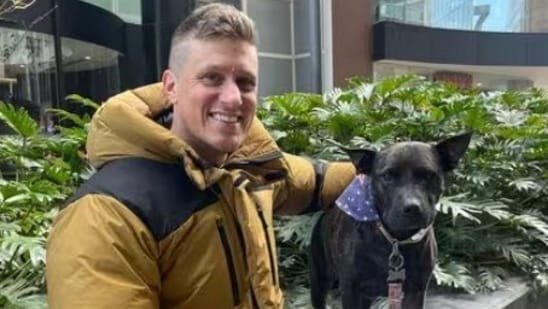
While narratives about the misuse of artificial intelligence are becoming increasingly common, an interesting finding has emerged in Australia. A tech enthusiast used ChatGPT and Google DeepMind’s AlphaFold to create a vaccine for his dog, which has just months left to live.

Paul Conyngham, an Australian tech expert, told Today, “Rosie is my best friend and, uh, she’s been with me through really hard times, going through breakups, going through tough business deals, walks in the woods, and when she got this sentence, uh, I felt like I had to do my part for her as well.”
How does artificial intelligence contribute to Rosie’s cancer treatment?
In 2019, Conyngham adopted a Staffie-Shar-Pei mix named Rosie from an animal shelter. Five years later, Rosie was diagnosed with cancer. Despite spending thousands of dollars on conventional treatments such as chemotherapy, the tumor did not shrink in size. At this point, Paul decided to take action and use artificial intelligence to help him.
Australian technology experts chose to sequence the dogs’ DNA to find out what the problem was and develop a remedy. To do this, he turned to ChatGPT. “I went to ChatGPT and came up with a plan on how to do this,” he told The Australian.
Conyngham is well versed in artificial intelligence and has 17 years of experience in machine learning and data analysis.
He contacted the University of New South Wales Ramajyoti Genome Centre, which provided him with a genome sequencing service for A$3000.
Cancer vaccine development
Conyngham then compared Rosie’s healthy DNA to the tumor’s DNA to identify the problem. He elaborates, “It’s like you have the original engine of a car and then use a version of that engine on 300,000 kilometers of road – you can compare them and see where the damage is.”
Paul then used AlphaFold, an artificial intelligence system developed by Google DeepMind to help understand protein function. This allows technicians to pinpoint mutations and link them to drugs needed to treat tumors.
This will help Paul and UNSW develop customized mRNA vaccines for dogs. mRNA vaccines stimulate an immune response by using synthetic messenger RNA to instruct cells to produce harmless viral proteins.
“This is the first time a personalized cancer vaccine has been designed for dogs,” said Professor Pall Thordarson, director of the RNA Institute at the University of New South Wales, according to The Australian. “This is still at the forefront of cancer immunotherapy – eventually, we will use it to help humans.” What Rosie taught us is that using mRNA technology, personalized medicine can be very effective and can be done in a time-sensitive way. “
Rosie’s first injection and further treatment
Rosie received her first jab in December, followed by a booster jab. Although the cancer was in an advanced stage, the size of the tumor decreased significantly after treatment.
Conyngham, who is currently developing a second vaccine aimed at targeting residual tumors, said: “In fact, for some cancers, we have the potential to move it from a terminal disease to a manageable disease.”