Scientists developed a starch-based wash that removes pesticide residues and keeps fruits and vegetables fresh for 15 days


Fruits and vegetables can retain pesticide residues on their surfaces after they are harvested, while their quality can gradually decline during storage. Researchers have developed a wash that aims to tackle both the problems together. The study, published in ACS Nanodescribes a starch-based wash that uses a protective material made with tannic acid and iron. The wash was designed to capture pesticide residues from produce surfaces and help keep fruits and vegetables fresh during storage after harvest. The treatment also helped the fruits and vegetables retain their quality for up to 15 days of storage.
How researchers designed the starch-based wash to remove pesticides
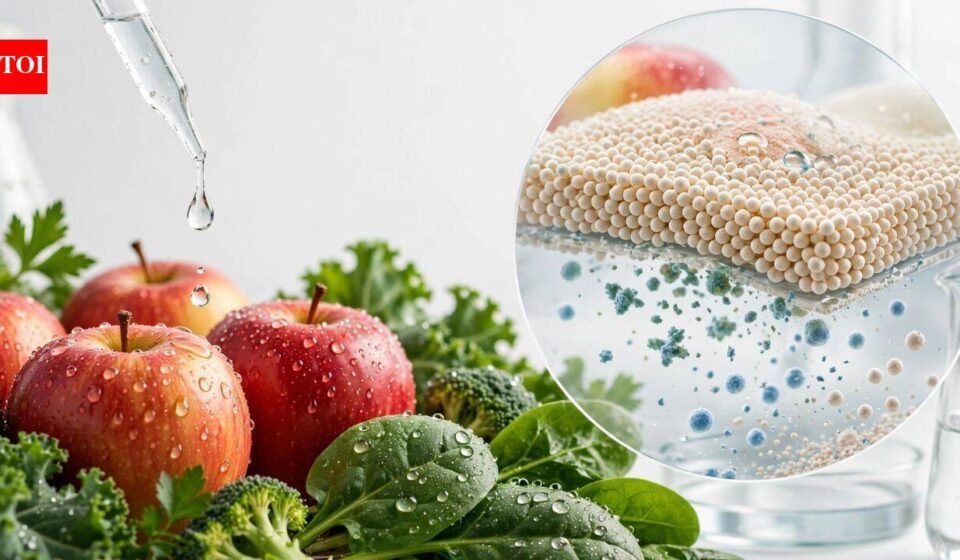
Researchers developed the wash by combining tiny starch particles with a protective material made from tannic acid and iron. The starch forms the base of the treatment, while the added material helps capture pesticide residues on produce surfaces. The team tested different amounts of both ingredients to find the combination that worked best. The final mixture was not designed simply to wash away unwanted residues. It was also intended to leave a protective layer on the produce. This layer could help slow the loss of quality during storage after harvest. In this way, the researchers designed the wash to tackle two post-harvest problems with one treatment.

PC: AI Generated
New starch-based wash removes more than 93% of pesticide residues
The wash showed strong results when tested on produce with pesticide residues. It removed more than 86% of one pesticide from the surface. With the improved formula, the researchers recorded even higher removal rates, reaching 93.51% for one pesticide and 89.03% for another. The team also compared the new wash with conventional washing solutions and found that it removed more of the tested residues. These results reveal that the starch-based treatment can work against several types of pesticide residue rather than targeting just one.
What makes the material effective against different pesticides
The researchers also looked at how the protective material captured pesticide molecules from produce surfaces. Computer-based tests showed that several types of molecular attraction helped the pesticides remain attached to the material. These included hydrogen bonding and other interactions between the molecules. The results supported what the researchers observed in their washing tests. The material showed a strong ability to bind with all three pesticides examined in the study, helping explain why the wash was able to remove different residues. The computer tests were carried out alongside laboratory experiments to better understand how the material worked and why it was effective.
How does the protective layer help produce retain its quality
Removing pesticide residues was only one function of the treatment. The researchers also wanted to see whether the wash could help fruits and vegetables retain their quality after harvest. They tested both whole and freshly cut produce over 15 days of storage, tracking changes in appearance, weight, acidity, and dissolved sugars. The treated produce maintained these quality measures throughout the storage period. Together, these findings suggest that the wash was designed to do more than simply remove residues from the surface. It could also provide a protective layer that helped the produce remain in good condition during storage. Together, these two functions form the basis of the treatment.
What makes the starch-based wash a sustainable option
The researchers describe the starch-based wash as a sustainable approach because it uses materials such as starch and tannic acid. They also report that the system is biodegradable and has the potential to be produced on a larger scale. By bringing pesticide removal and produce preservation together, the treatment is designed to address two problems that arise after harvest.This could help improve food safety while reducing the amount of produce lost before it reaches consumers. However, the findings are based on the specific tests carried out in the study. Further research would be needed to see how the wash performs with different produce, pesticide residues, and storage conditions.