

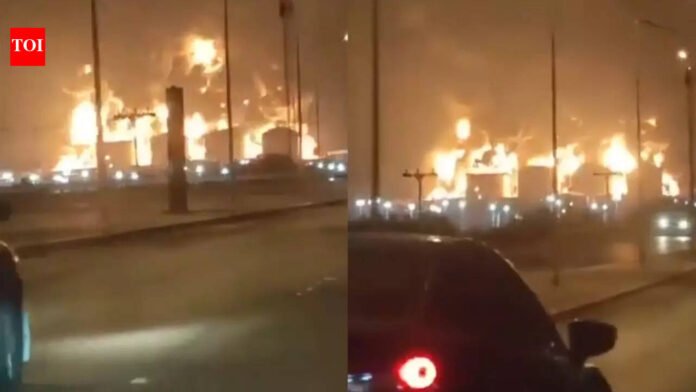
The widening conflict between Iran, the United States and Israel has now reached one of the Gulf’s most strategic maritime hubs. On March 11, 2026, multiple drones attacked fuel storage tanks in the Port of Salalah in Oman, causing fires and sounding the alarm for the global energy and shipping markets. Authorities confirmed that while several drones were intercepted, several others managed to breach air defenses and hit the port’s oil storage infrastructure.Although the attack caused at least two fuel tanks to catch fire, officials said there were no reports of casualties among port workers or residents, and there was no damage to commercial ships docked nearby. The incident marks the latest escalation in a regional war that has rapidly expanded beyond Iranian, Israeli and U.S. targets and threatens Gulf energy infrastructure and maritime trade routes.
Fire breaks out in Oman’s strategic energy center during Iran-U.S.-Israel war
The Port of Salalah is located on the Arabian Sea coast in the Dhofar region of Oman and is one of the most important ports in Oman. middle Eastmajor shipping and logistics center. The port handles container shipping, oil storage and bunkering operations, serving ships between Asia, Europe and Africa. Fuel tanks in a port storage area caught fire and sent thick smoke into the sky when a drone struck the facility. Videos circulating online showed flames engulfing parts of the oil depot.Authorities said emergency services responded quickly and brought the fire under control, while security forces scrambled to intercept more drones approaching the area. Several drones were successfully shot down before reaching the port. Despite a swift response, at least one drone successfully struck a storage area, underscoring the growing vulnerability of critical energy infrastructure across the Gulf.
Shipping and port operations disrupted at Salalah port in Oman due to war between Iran and US-Israel
After the attack, port operations were temporarily disrupted and shipping companies began to reassess the security situation in the area. A major terminal operator at the port confirmed that container terminal operations have been suspended until further notice, while vessels in nearby waters were advised to remain vigilant.Global shipping giant Maersk also halted activities at the port following the strike, citing safety concerns around the facility. The shutdown highlights how an attack on a single energy storage facility can ripple through global supply chains, particularly in the Gulf region, which handles a large portion of the world’s oil and container shipping volumes.The strike in Salalah is not an isolated incident. This is part of a wider campaign targeting ports, refineries and energy infrastructure in the region since the outbreak of war between Iran, the United States and Israel on February 28, 2026. Since the conflict began, several facilities in the Gulf have been attacked or threatened by drones and missiles. In early March, Oman’s Duqm port was also attacked by a drone, damaging fuel storage tanks and injuring a foreign worker.Among other events:
- Earlier this month, a drone hit a fuel tank in the port of Duqm.
- During the escalation, an oil tanker off the coast of Oman was also attacked.
- Several Gulf states that host U.S. military assets reported air threats or interceptions.
The incidents have heightened concerns that the conflict is broadening from military targets to include economic infrastructure, particularly oil storage and transportation facilities.
Iran denies involvement in Salalah port drone attack in US-Israel war
Iran said a drone strike on the Omani port of Salalah may have been part of a “false flag” operation, raising questions about who was responsible. In a statement from the central headquarters of Khatam al-Anbia (Holy Prophet), which coordinates Iran’s armed forces, a spokesman called the incident “suspicious” and said the Islamic Republic was investigating the circumstances surrounding the attack.Iranian officials deny that their forces are deliberately targeting Oman, stressing that Oman is considered a “friend and neighbor” and that Iran does not seek confrontation with nearby Muslim countries. Instead, Tehran has warned that the United States and Israel may attempt to conduct false flag attacks on regional infrastructure to blame Iran and expand the conflict across the Gulf.According to Iran’s statement, such actions could involve targeting diplomatic sites or strategic facilities in neighboring countries to “tarnish Iran’s image” and draw more countries into the war.
Why Oman matters in the Iran-U.S.-Israel conflict
The Salalah strike is particularly important because of Oman’s historical role as a neutral mediator in Middle East diplomacy. The sultanate has maintained friendly relations with Iran and Western countries for decades, often hosting secret diplomatic negotiations. Oman played a key role in facilitating early secret negotiations that ultimately led to the 2015 Iran nuclear deal. Because of this neutral stance, Oman has largely avoided becoming a battleground for regional conflicts.However, the latest drone strikes suggest that the war may now be spreading to countries that have not traditionally been involved in the confrontation. Analysts said the attack on Oman’s infrastructure could be an attempt to send a message to Gulf states seen as cooperating with U.S. or Israeli military activities.
War between Iran and US-Israel raises risks in global energy markets
The Salalah attack has raised concerns about the security of oil infrastructure in the Gulf. The region is home to some of the world’s most important energy facilities, including major refineries, export terminals and shipping routes. Energy analysts warn that continued attacks on fuel depots and ports could have multiple consequences:
- Global oil supply disruptions
- Fuel prices soar
- Transportation insurance surcharge
- Change tanker routes away from conflict areas
Even a relatively small disruption could have significant knock-on effects on global markets, as the Gulf region exports a large portion of the world’s crude oil and liquefied natural gas.
The growing role of drone warfare
The attack also illustrates the growing role of drones in modern warfare, particularly in the Middle East. Compared with traditional missiles or air strikes, drones are cheaper to deploy, harder to detect, able to fly long distances and target infrastructure with precision.Many drones used in regional conflicts resemble loitering munitions, sometimes called “kamikaze drones,” which hover near targets before striking. Their increasing use has changed the impact of conflict on infrastructure, allowing attackers to target ports, refineries and airports far from traditional battlefields.
Iran’s position and regional propositions in the US-Israel war
Tehran has previously denied responsibility for some attacks in neighboring countries, although many analysts and security firms attributed the attacks to Iranian retaliation against U.S. and Israeli targets. Iranian officials argue that attacks on neutral countries could be part of an effort by hostile actors to expand the conflict and blame Iran.Meanwhile, Western and Gulf officials say Iran’s military strategy is increasingly targeting the region’s energy infrastructure as part of its broader confrontation with Washington and Tel Aviv. The attack in Salalah highlights how the ongoing war is gradually spreading across the region.The escalating conflict has caused heavy casualties and damage in several countries, affecting thousands of people, according to regional reports. Each new attack increases the risk of further escalation, especially where critical energy infrastructure or shipping routes are repeatedly targeted.The drone attack on the Omani port of Salalah marks a dangerous new phase in the conflict between Iran and the United States and Israel, which threatens not only military targets but also the economic lifeline of the Gulf region. For a country like Oman that has long had a reputation for diplomatic neutrality, the attack underscores how the conflict is spreading far beyond its initial battlefields.With energy facilities, shipping hubs and ports increasingly under threat, warfare is no longer limited to missiles and military bases. It is now testing the resilience of global trade routes and energy supply chains, and if attacks on strategic ports continue, ripple effects could soon ripple not just across the Middle East but throughout the global economy.


