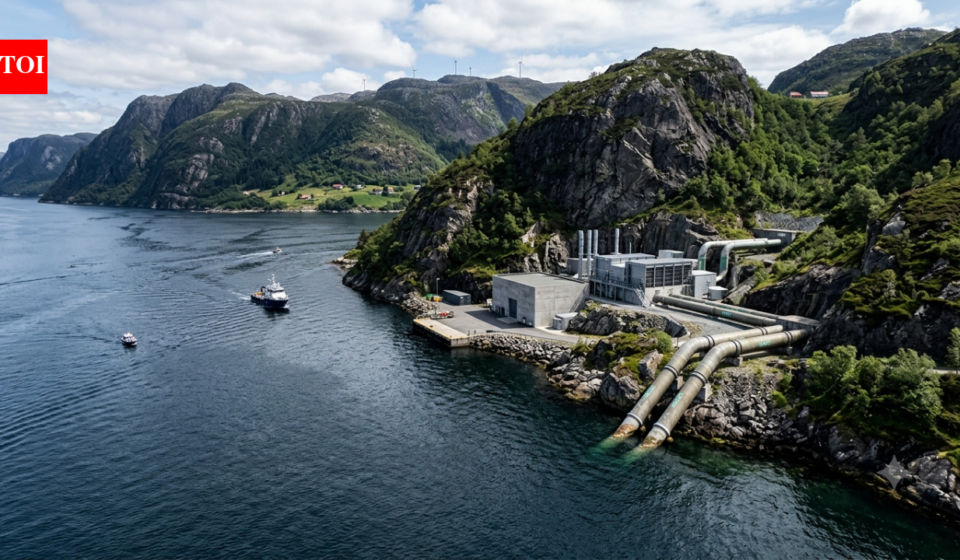
Norway’s Green Mountain data centre uses 8°C fjord water to cool its servers, turning a naturally cold resource into free refrigeration

A data centre quietly produces heat every second it is operating. Behind the walls, rows of servers process data continuously, turning large amounts of electricity into computing power and, inevitably, excess heat. That heat has to be removed to keep the equipment within safe operating temperatures, adding significantly to the facility’s energy demand. Green Mountain has approached the problem differently at its Norwegian sites, using the country’s naturally cool conditions as part of the cooling infrastructure. At one facility, water drawn from a nearby fjord remains at about 8°C at depth. Instead of making cold mechanically, engineers use this naturally chilled water to carry heat away.
How data centre cooling keeps servers running safely
Servers turn electricity into computing power, but a large share of that energy eventually becomes heat. Keeping temperatures within operating limits therefore becomes a permanent requirement, with cooling systems running alongside the IT equipment.Green Mountain says conventional data centre cooling can require an additional 40 to 80% of the electricity used to power the servers. That makes the cooling system an important part of a facility’s total energy performance, particularly at sites operating continuously.The company uses what is commonly called free cooling, or natural cooling. The basic idea is straightforward: instead of producing cold through energy-intensive mechanical refrigeration, the facility makes use of naturally cold air or water already available outside.
How 8°C fjord water cools the data centre
At Green Mountain’s SVG-Rennesøy site, the cooling source is the fjord immediately beside the data centre. The location has a particular underwater structure. The entrance to the fjord is relatively shallow, while the central section reaches considerable depth.Reportedly, at depths below roughly 75 metres, the water stays at about 8°C. Green Mountain installed intake pipes reaching down to around 100 metres, allowing the facility to access that cold water throughout the year.The water does not simply flow through the server rooms. Instead, it enters a cold-water basin and passes through a titanium heat exchanger. Heat from the data centre’s separate chilled-water circuit is transferred to the cold seawater, which is then returned to the fjord.That arrangement keeps the two water systems separate.
How the cooling system uses gravity and recycled water
There is an unusual simplicity to the way the cold fjord water reaches the facility. The intake is designed so that water can enter the cold-water basin through gravity rather than being pumped up from the seabed. Inside the facility, a closed-loop freshwater system circulates through the cooling infrastructure. The same chilled water can continue moving around the data centre without being consumed as part of the cooling process.Once it has absorbed heat through the heat exchanger, the seawater is discharged back into the fjord. Green Mountain says the warmed discharge does not create a negative environmental impact.The company also lists an energy figure for the system of 3 kW of power for 1,000 kW of cooling, illustrating how little electrical energy is needed for the cooling process itself compared with conventional refrigeration.
What PUE reveals about data centre energy use
Data centre operators commonly use Power Usage Effectiveness, or PUE, to assess how much energy a facility consumes beyond the electricity delivered directly to its IT equipment. A PUE of 1.0 would mean all the facility’s electricity went to computing equipment. Real data centres are higher because they also need power for cooling, lighting, electrical infrastructure, security systems and other supporting equipment.Green Mountain designed its facilities to reach a PUE of 1.2 or lower and says it frequently records values close to 1.10. The company attributes much of this performance to its cooling approach. For comparison, it cites an Uptime Institute average PUE of 1.56 for 2019.Even the electrical infrastructure itself contributes to the figure. UPS systems, which protect servers against power interruptions, lose some energy when converting electricity between forms. Green Mountain estimates that a typical redundant UPS arrangement can add a partial PUE of about 1.06 to 1.10 before transformer losses and other requirements are considered.
How Green Mountain keeps its cooling system protected
The fjord water never becomes the air circulating through the server rooms. Heat is transferred through the titanium exchanger, while the chilled freshwater remains in its own circuit. That separation is useful for more than water management. The environment inside the data centre does not have to be exposed directly to outside humidity, pollutants or other contaminants carried in by air.The cooling infrastructure is also duplicated. Green Mountain uses an N+N arrangement, meaning the cooling station, pipework and pumps have redundant counterparts. Both systems can operate during normal conditions, while the design allows maintenance to take place without taking the entire cooling arrangement offline.Under the server-room floor, chilled water is supplied through duplicated routes. The facility can also accommodate different cooling requirements, from conventional server densities to higher-density installations reaching up to 40 kW per square metre.
How Green Mountain keeps its cooling system efficient
The fjord system relies on relatively few moving components, with circulation pumps doing much of the mechanical work. That reduces the number of parts that require regular servicing compared with a more complicated refrigeration installation.Green Mountain also says the intake location has little algae growth, which helps reduce cleaning requirements for the titanium heat exchanger.The cooling station is connected to the site’s data centre infrastructure management system. Its operation is automated, with the system adjusting to changes in demand and continuously reporting its condition.There is also an environmental benefit in avoiding some synthetic refrigerants. Conventional refrigeration systems can rely on gases such as hydrofluorocarbons, which can present an environmental risk if they escape into the atmosphere.
How 330 days of free cooling works at Rjukan
Not every data centre has a deep, cold body of water sitting next to it. Green Mountain uses a different form of free cooling at its TEL-Rjukan facility, where the surrounding Norwegian climate provides the cold source.There, an indirect air-cooling system uses outside air to remove heat through a heat exchanger. The air entering the server environment remains in a separate closed circuit, rather than being brought directly into the data rooms.At Rjukan, Green Mountain says the system can provide free cooling for around 330 days a year. The site’s median temperature is about 13°C, and its location receives little direct sunlight during part of the year, conditions that help reduce the need for mechanical cooling.During warmer summer periods, water can be introduced on the outside-air side of the cooling equipment. Evaporating that water lowers the temperature available to the cooling system and extends the period in which it can operate efficiently.
How the Rjukan cooling system scales with server demand
The Rjukan system was developed with scalability in mind. Its cooling equipment is built in individual units rated at either 250 kW or 500 kW.That means capacity does not have to be installed all at once. As more computing equipment is added, further cooling units can be incorporated into the infrastructure.The approach is also designed around hot-aisle containment, directing heat away from server equipment and allowing the cooling system to deal with it more efficiently. With limited piping and relatively few moving parts, Green Mountain says the design reduces both maintenance requirements and the number of components that could fail.The two Norwegian sites use different natural resources, but the principle is much the same. At Rennesøy, the cooling system takes advantage of water that is already cold. At Rjukan, it makes use of the temperature of the outside air.