
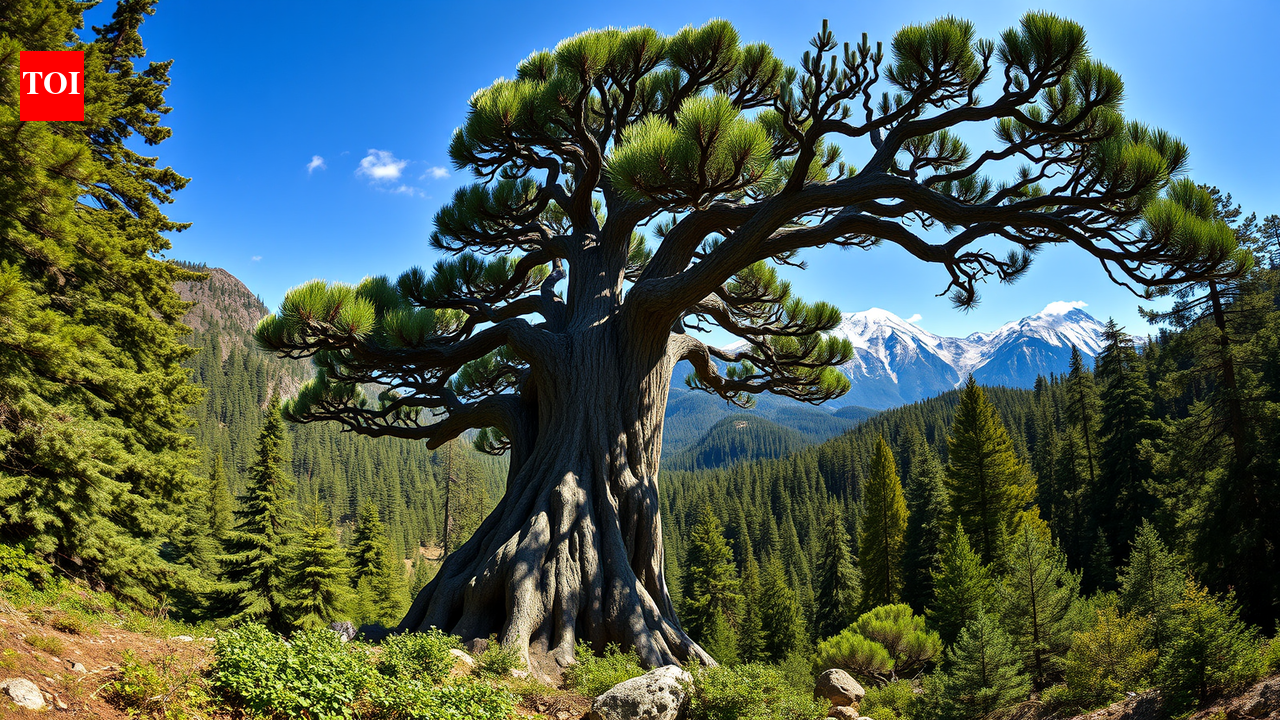
Some trees stand out simply because of how long they have been standing. The monkey tree, scientifically known as Araucaria, belongs to a very ancient lineage whose ancestors shared the earth with dinosaurs, and the root systems of individual trees surviving today can be traced back to nearly two thousand years ago. Native to the temperate montane forests of western Chile and Argentina, it is Chile’s national tree, a cultural cornerstone of indigenous communities who have relied on it for food and rituals for generations, and one of the most visually distinctive conifers on Earth. According to popular legend, its name dates back to the 1850s, when English lawyer Charles Austin looked at a plant growing in his garden in Cornwall and reportedly said that climbing on it would confuse monkeys, a statement that has somehow outlasted anything he ever said.
What the monkey puzzle tree looks like up close
Monkey Puzzle is an evergreen coniferous tree that grows in a strikingly symmetrical, almost architectural shape, with a straight trunk up to 50 meters high and a crown that starts out pyramidal when young and expands into a broad, round umbrella of branches when mature. The branches spread out in distinct horizontal whorls and are completely covered with tough, triangular, spiky leaves that overlap like scales and coil tightly around each branch and stem. These leaves are not as soft or temporary as most leaves. A leaf can cling to a branch for up to 15 years before falling off, giving the tree an almost reptilian texture up close, which immediately explains why Austin’s monkey climbing comments are so firmly etched in the popular imagination.
Spanning the lifespan of human civilization
Individual Araucaria trees are among the longest-lived organisms in South America, with some specimens known to live up to 2,000 years under the right conditions. Ecological and dendrochronological studies of the species, documented in conservation studies including by Kew Gardens Online World PlantsIt was confirmed that the trunk diameter can reach 1.5 meters and that the ecology of this species is closely related to periodic natural disturbances, including volcanic eruptions, wildfires, landslides and storms, all of which the trees have adapted to survive through thick bark, outer bark buds capable of re-sprouting after fire damage, and seed biology suitable for colonization of disturbed land. A single tree alive and well growing today was most likely a sapling from the formation of medieval European kingdoms, a fact that gives the monkey puzzle a historical importance that few creatures can match.
Edible seeds sustained Aboriginal people for thousands of years
One of the most useful and important characteristics of the piñon is its large, nutritious seeds, known as “piñon”, which have been an important part of the diet of the Mapuche-Pehuente people of the southern Andes long before European contact. The seeds are rich in carbohydrates and can be eaten raw, boiled or roasted, or fermented into a traditional drink called Chavid. Research published in ecology and society Research on Araucaria forest landscapes across South America confirms that for thousands of years the pine has had deep cultural, economic and spiritual significance to the Mapuche-Pehuente people, extending far beyond its nutritional value to becoming a cornerstone of community identity, seasonal rituals, territorial ties and harvest rituals. During the autumn harvest season, waffles can account for 10 to 15 percent of a family’s diet, and during the long Andean winters (June to September), waffles continue to rise in content and become a major source of carbohydrates.
Endangered status and long history of deforestation
Despite its protected status, the monkey puzzle tree is listed as endangered on the IUCN Red List, where it was listed in 2013 after decades of logging, land clearing, repeated man-made fires and cattle overgrazing had fragmented and reduced its natural range. Study of the effects of cattle grazing on Araucaria regeneration, published in biological protectionA clear negative relationship was found between cattle activity and seedling survival, with grazing pressure significantly inhibiting the ability of trees to regenerate naturally across much of their remaining habitat. Chile declared the monkey a national monument in 1976, and logging is legally prohibited. The species is also listed in Appendix I of the Convention on International Trade in Endangered Species, restricting international trade. Conservation measures also exist in Argentina, but enforcement outside national park boundaries remains inconsistent and logging pressure persists in some areas.
Mapuche-Pehuneche People and Sacred Trees
For the Mapuche-Pehuente people, the monkey enigma is not just a source of food or wood, but a sacred being that occupies the center of their cosmic and ritual lives. The Mapuche name for this tree is pewen or pehuen, which gave a branch of the Mapuche people the tribal name Pehuenche, meaning pewen people. Traditionally, families would set up summer camps near Araucaria forests during harvest season, with each family having rights to a designated forest area. Piñon harvesting is not a recreational activity, but an organized, public activity that is directly related to issues of territorial sovereignty and indigenous land rights, as documented in the Ethnobotanical Research on Indigenous Resource Rights and Conservation. economic botany. The researchers note that Aboriginal interest in protecting trees is directly linked to self-determination, and that where communities retain meaningful control over their ancestral forests, Araucaria populations tend to be better managed and more ecologically stable than in areas where control has been lost.
Why Monkey Puzzle Becomes a Favorite Ornamental Tree Around the World
During the Victorian Era, outside of its native range, the riddle became extremely popular as an ornamental tree throughout the temperate world, particularly in Britain, where its bold, alien silhouette appealed to the period’s enthusiasm for exotic plant specimens. Scottish botanist Archibald Menzies introduced the plant to Europe in the 1790s, reportedly after collecting cone seeds given to him at a dinner party in Chile, where it quickly spread throughout country house gardens, parks and suburban avenues across Britain and beyond. Today it remains a familiar and instantly recognizable sight in temperate gardens from the British Isles to New Zealand, and while garden specimens rarely reach the scale of wild Andean trees, they are living ambassadors of one of the oldest and most resilient lineages on Earth, a conifer that survived the extinction of the dinosaurs and outlasted the entirety of human civilization, still standing, prickly and undisturbed, in the mountain forests where it has always grown.