
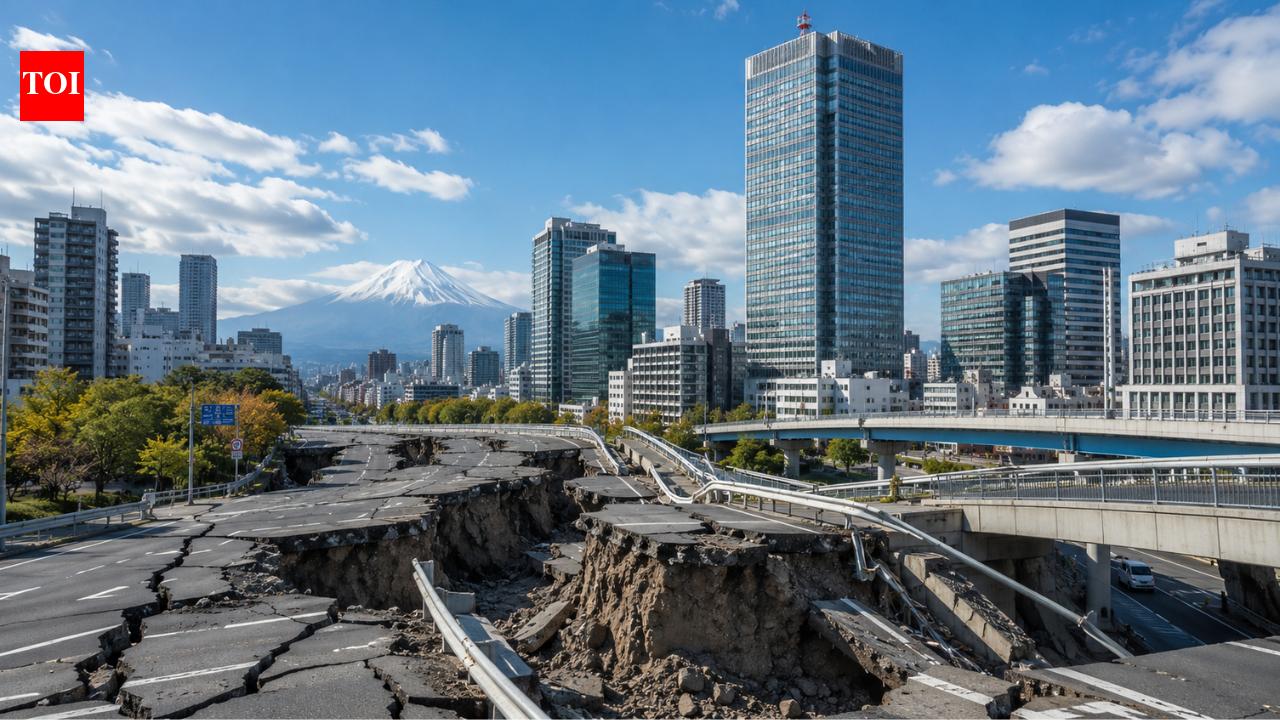
Japan experiences about 1,500 powerful earthquakes every year, a shocking number that would seem catastrophic to most countries. However, despite Japanese cities being located in one of the most seismically active regions on Earth, widespread building collapses are rare after major earthquakes. The contrast has become even more striking with recent earthquakes in other parts of the world that have collapsed buildings and killed people. So, what makes Japan special? The answer lies not in luck but in decades of scientific research, world-leading engineering, stringent building regulations, cutting-edge technology and a culture of preparedness that transforms one of nature’s greatest threats into a manageable risk.
Why do Japan have so many earthquakes?
Japan’s location is both its greatest geographical challenge and the reason for its extraordinary earthquake resistance. The country is located at the intersection of four major plates: the Pacific Plate, the Philippine Sea Plate, the Eurasian Plate, and the North American Plate (called the Okhotsk Microplate, according to some geological models). These plates are constantly moving, colliding, and sliding beneath each other.According to the U.S. Geological Survey, about 10% of the world’s earthquakes and nearly 20% of earthquakes of magnitude 6 or above occur in and around Japan. The country records thousands of seismic events every year, but only about 1,500 are strong enough to be noticed.
Japanese buildings are designed to move, not to withstand earthquakes
One of Japan’s greatest engineering achievements is that its buildings are designed to move with earthquakes rather than strictly resist them.Modern Japanese skyscrapers and many public buildings use a technique called base isolation. Thick layers of rubber and steel bearings are installed between the building’s foundation and superstructure. During an earthquake, these bearings absorb most of the ground motion before it reaches the buildings above.Another widely used technology is seismic dampers, often compared to shock absorbers in cars. These devices dissipate the energy generated by seismic vibrations, thereby reducing the shaking of buildings.Research published by Japan’s National Institute of Earth Science and Disaster Resilience shows that during strong earthquakes, basic isolation buildings experience significantly lower vibrations than conventional structures. Today, thousands of buildings across Japan incorporate some form of isolation or energy-dissipating technology.
Strict building codes save countless lives
Japan’s building codes are among the strictest in the world, but they were learned the hard way.The devastating Great Kanto Earthquake killed more than 100,000 people and exposed the weaknesses of urban construction. Decades later, the Great Hanshin Earthquake killed more than 6,000 people and triggered another major adjustment in earthquake resistance standards.Following these disasters, Japan introduced increasingly stringent seismic design requirements. Buildings built to modern standards must be able to withstand strong vibrations without collapsing even if damaged.The results are remarkable. During the 2011 Tohoku earthquake and tsunami, one of the strongest earthquakes on record, relatively few modern buildings collapsed due to the earthquake itself. Most of the nearly 20,000 deaths were caused by the massive tsunami that followed, underscoring the effectiveness of Japan’s earthquake engineering.
Every major earthquake makes Japan safer
Unlike many countries that rebuild after disasters, Japan also learns lessons from each earthquake.Engineers carefully inspect damaged structures, collect data, revise construction standards and improve future building designs. This continuous learning cycle has been occurring for decades.Researchers from the Institute of Architecture and universities across the country conducted comprehensive experiments using giant earthquake simulators. One of the world’s largest shaking tables, called E-Defense, allows scientists to recreate strong earthquakes and observe the performance of full-scale buildings before making recommendations for improved building standards.
Japan has one of the fastest earthquake warning systems in the world
Japan cannot predict earthquakes days or weeks in advance, but it can detect them within seconds after they occur.The country’s earthquake early warning system is run by the Japan Meteorological Agency, using more than a thousand seismic monitoring stations across the country.When an earthquake occurs, sensors detect fast-moving primary waves, known as P waves. These waves travel faster than the more destructive secondary waves, giving people anywhere from a few seconds to tens of seconds of warning.This brief warning is enough to send an alert to a cell phone, stop high-speed trains, slow down elevators, stop factory machinery and move people away from immediate danger.
Even bullet trains stop automatically
Japan’s famous Shinkansen bullet train is directly connected to the national earthquake detection network.Once seismic sensors detect significant shaking, the train automatically brakes before the strongest waves arrive. The system has successfully operated through multiple earthquakes, becoming one of the best examples in the world of combining infrastructure with disaster management technology.
Earthquake drills have become part of daily life
Japan’s resilience cannot be achieved through technology alone.Children practice earthquake drills from an early age. Schools, offices, hospitals and businesses conduct regular emergency evacuation drills. Many households have emergency kits that contain food, drinking water, flashlights, batteries and medical supplies.This focus on preparedness means people know how to react quickly when an earthquake strikes rather than panic.The United Nations Office for Disaster Risk Reduction has repeatedly highlighted Japan as a global leader in disaster risk reduction because of its combination of public education, engineering and government planning.
Ancient Japanese architecture also inspired modern engineering
Interestingly, Japan’s earthquake wisdom is not entirely modern.Many traditional wooden towers have survived centuries of earthquakes. Their flexible timber frames, interlocking timber joints and central columns known as “shinbashira” allow them to absorb seismic energy rather than strictly resist it.Modern engineers have conducted extensive research on these ancient structures. Research from institutions like Kyoto University helps explain why these centuries-old buildings perform so well during earthquakes and is inspiring aspects of modern earthquake engineering.
The real reason Japan’s cities are still standing
Japan’s resilience is not the result of a single breakthrough, but the combination of multiple layers of protection. Strict building codes, advanced seismic engineering, ongoing scientific research, advanced warning systems, regular public drills, strong government planning and a willingness to learn from every disaster all come together.