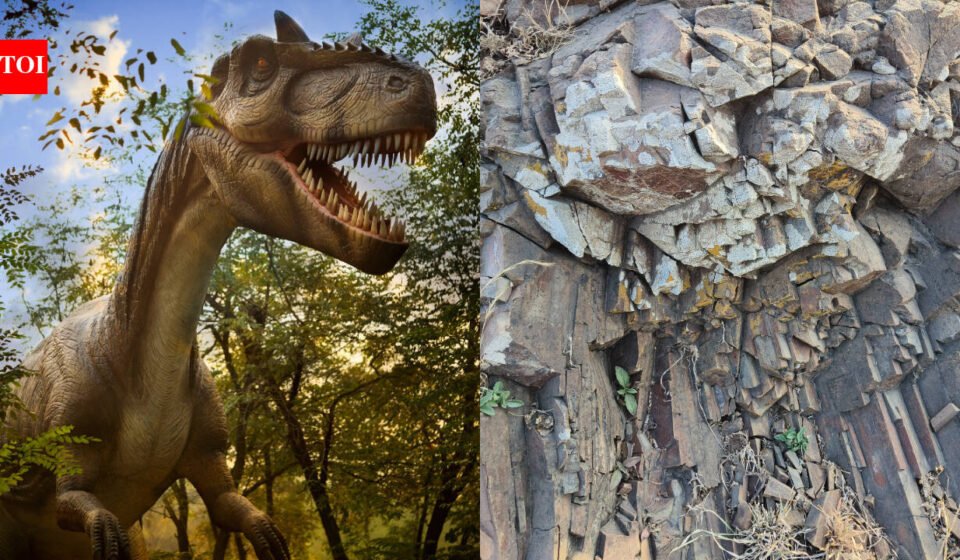
In 2016, a Montana researcher picked up a rock half the size of a golf ball; 10 years later, scans showed dinosaur dung holding the finest feather yet found from the age of dinosaurs

Sometimes, the most extraordinary discoveries are hiding in things that look utterly ordinary. In 2016, a researcher working in Montana spotted a small, reddish-brown rock while searching for fossils. It was about half the size of a golf ball, hardly the kind of object that would seem destined for a major scientific discovery, states a study published by Science Daily. But a closer look revealed a tiny fossil feather on its surface. A decade later, advanced scans showed that the rock held a much bigger story: it was fossilized dinosaur dung containing remarkably preserved feathers, bones and scales, including what researchers describe as the finest feather specimen yet discovered from the age of dinosaurs. Scroll down to read the details.A 66-million-year-old findThe coprolite, or fossilized feces, dates to roughly 66 million years ago, near the end of the Cretaceous Period. Inside, researchers found several feathers along with tiny fish scales and leg bones belonging to a hesperornithiform, an extinct group of aquatic birds. The evidence suggests that a large dinosaur, potentially a T. rex or Nanotyrannus, had eaten the bird. The discovery offers an unusually intimate glimpse into an ancient food chain. Instead of reconstructing predator and prey relationships from separate fossils, scientists can see evidence of one animal’s final meal preserved in a single specimen.The feather that survivedDavid DeMar Jr., a researcher with the University of Washington’s Burke Museum, discovered the unusual nodule while conducting fieldwork in northeastern Montana’s Hell Creek Formation. Researchers later suspected that the rock might be a coprolite, but its real significance became clear only after it was examined using micro-CT scanning. The technology allowed scientists to look inside the specimen without breaking it apart. The scans revealed a remarkable collection of remains — including feathers, bones and scales preserved in three dimensions. For lead author Jingmai O’Connor of Chicago’s Field Museum, the discovery could help answer one of paleontology’s biggest questions: why did some birds survive the asteroid impact that wiped out nearly all other dinosaurs?Why did some birds survive?When the asteroid struck Earth 66 million years ago, most dinosaur lineages disappeared. Among the birds, only the group known as Neornithes survived, eventually giving rise to every bird alive today. Scientists have proposed several explanations, including the possibility that aquatic habitats helped some birds withstand the environmental chaos that followed the impact. But the newly studied hesperornithiform complicates that theory. These birds were also closely associated with water, yet they went extinct. Instead, researchers believe their feathers may offer an important clue. The fossil shows a mixture of relatively modern-looking, waterproof feathers and smaller, primitive body feathers.Images Courtesy: istock