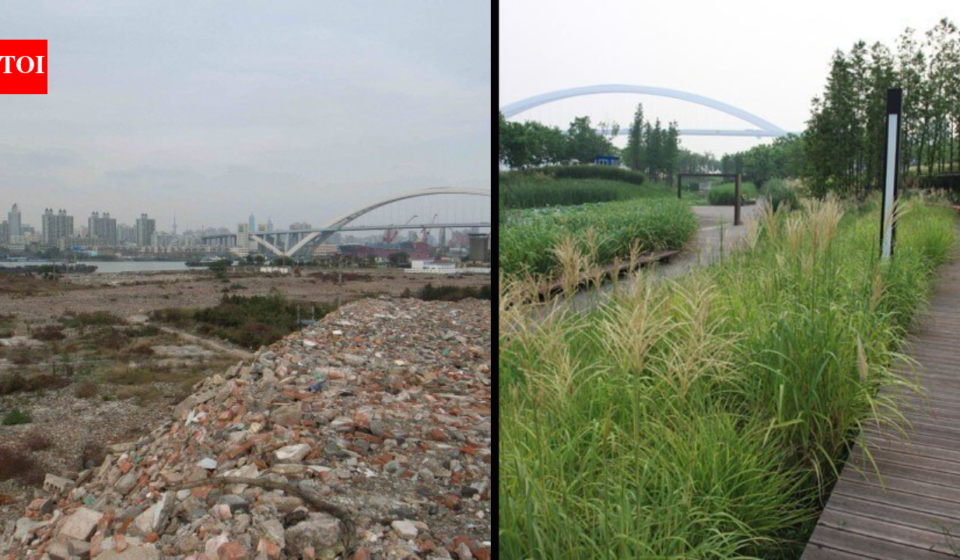
In 2010, Shanghai turned a polluted industrial brownfield into Houtan Park; its wetlands now clean up to 634,000 gallons of river water a day

In 2010, Shanghai transformed a polluted industrial brownfield into Houtan Park. Its wetlands now clean up to 634,000 gallons of river water each day. The 14-hectare linear park stretches along the Huangpu River and was once home to a steel factory, a shipyard, and a heavy industrial storage facility. For decades, the site was used as a dumping ground for industrial waste and leftover materials. Security walls separated it from the surrounding city, while polluted runoff flowed through the area.A detailed post-occupancy performance study by the Landscape Architecture Foundation (LAF), part of its Landscape Performance Series, shows how the design team, led by landscape architect Dr. Kongjian Yu and his firm Turenscape, completely reshaped the site. Instead of using energy-intensive chemical treatment plants or traditional concrete pipes, the team created a living biological filter. The multi-stage wetland takes raw, highly polluted Grade V river water, the lowest quality level under China’s national standards and completely unsafe for human contact and improves it to Grade II quality. This makes the water suitable for landscape irrigation and water features.The site was first developed as a green space and major pedestrian route for the 2010 Shanghai World Expo, welcoming roughly 590,500 visitors during the event. After the Expo ended, the park became a permanent part of the city’s public infrastructure and continued to attract local residents, regional tourists, and international visitors.
How the living biofiltration cascade works
The biological filtration system is based on a continuous, 1-mile-long artificial wetland that runs through the centre of the park. Water is taken directly from the Huangpu River and pumped to the highest point of the site. Gravity then moves the water through a series of terraced drops, oxygenating cascades, sand beds, and dense reed beds that help trap suspended solids.Special aquatic plants and microorganisms in the plants’ root zones absorb heavy metals, nitrogen, and phosphorus from the water. Oxygen is added naturally as the water flows over stone steps and terraced landforms inspired by traditional Chinese agricultural landscapes. After the initial intake pump, the system does not need chemical additives or motorized filtration equipment.According to the LAF research documentation, the biological system also provides direct economic benefits to nearby municipal developments. The park supplies 264,000 gallons of treated water each day to the ponds, fountains, and streams in the adjacent Expo Park. Using this biologically cleaned water saves $116,800 each year in municipal tap water costs that would otherwise be needed to fill these features.The technical innovations created during the project resulted in eight national design patents in China. The design approach used at Houtan Park has since been copied in 20 to 30 other ecological water purification projects across the country as part of wider national sponge city planning efforts.
Carbon capture and species recovery metrics
Replacing the concrete industrial riverbank with living wetlands produced immediate and measurable ecological benefits. The LAF assessment estimates that the park’s dense ecosystem, including wetland vegetation, perennial crops, and broadleaf trees, captures about 242 tons of carbon each year.The change from a polluted industrial site to a natural habitat also led to a quick recovery of local plants and animals. Environmental surveys recorded 93 plant species and more than 200 animal species across the site. The park now acts as an ecological corridor along the riverfront, providing nesting areas for birds and aquatic habitat for fish species that had disappeared from this section of the riverbank during its industrial period.The construction process also followed low-carbon principles. Instead of removing all existing structures and sending the debris to landfills, the design team kept important parts of the site’s industrial history. Workers recovered 37 tons of structural steel from former factory buildings and about 34,000 post-industrial bricks found across the site. These materials were cleaned, reshaped, and reused in pedestrian paths, shade structures, terraced seating, and park pavilions. This on-site recycling approach reduced construction waste and saved an estimated $17,300 in building costs.
Urban flood protection and public access
The site was also designed to reduce urban flood risk while treating polluted water. Shanghai regularly faces typhoon-season storm surges and rising sea levels in the Yangtze River Delta. Traditional flood protection often depends on tall concrete seawalls that separate people from the riverfront.Turenscape removed the existing concrete floodwall and replaced it with a terraced embankment planted with native wetland species. During storm surges or high tides, the lower terraces can naturally flood without damaging park facilities or nearby buildings. The soil layers and plant roots absorb excess water, helping reduce pressure on municipal storm drains during heavy rainfall.Pedestrian paths, raised boardwalks, and seating areas are positioned above the flood line, allowing visitors to reach the water’s edge even when river levels change. Agricultural features, including seasonal fields of wheat and sunflowers, were added to the upper terraces to connect city residents with regional farming traditions.By combining flood protection, water filtration, industrial heritage preservation, and public recreational space in one design, the project created a model for converting polluted industrial sites into useful public spaces in dense cities.