

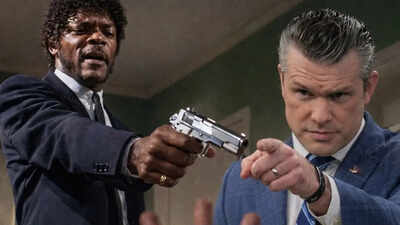
Some films become cultural icons and have had a profound impact throughout the ages. quentin tarantinoPulp Fiction is one of those movies that left such a huge cultural imprint that you can quote lines from the movie without context. One of the most popular memes is Ezekiel 25:17, which any fan can quote from memory: a biblical-sounding, biblical-feeling monologue that has been considered biblical for decades.But that’s not the case.The actual verse is serious, almost cold, a verse about revenge, without poetry or drama. What Tarantino does is give it a cloak of grandeur, giving it rhythm, morality and the illusion of ancient wisdom. He turned a sentence into a sermon, and in doing so created something more memorable than the original. This is the version that most people agree with. That’s what’s happening inside the Pentagon this week, but in a slightly altered form.
overall view
U.S. Secretary of War at Pentagon Service Peter Heggs recited what he called “CSAR 25:17,” presenting it as a military prayer relevant to combat search and rescue missions. He believes this is to reflect Ezekiel 25:17, which is where the confusion begins.What he delivers is neither a biblical verse nor a monologue in Tarantino’s original form. This is the third version, a military adaptation that borrows the film’s structure and emotional power while basing it on the Bible for legitimacy. Tarantino himself performed a similar expansion, turning a sparse biblical line into a cinematic sermon. Heggs’s version repeats this process in a different context, replacing theology with operational language.“Men of Justice” became “Downed Airmen,” “Charity and Goodwill” became “Comradeship and Duty,” and finally an invocation to divine authority was recast as a call sign, “You will know my call sign is Sandy One.” The wording changes, but its architecture remains unmistakable, with its ever-increasing pace, moral framework and climactic declaration of revenge.
drive news
The scene gives the moment its weight. This was not a casual remark, but a liturgy within the Pentagon, live-streamed and presented as part of institutional practice.Hegseth said Sandy 1 prays for A-10 crews before conducting combat search and rescue missions, including recent operations over Iran involving downed U.S. personnel. He describes it as a common phenomenon in military settings, suggesting that the line has been absorbed into a specific military culture, with repetition giving it a traditional feel.Audiences watching the ceremony immediately recognized the familiar beat, and the clip spread online, raising questions about whether Hollywood monologues were being repurposed as prayers. This reaction also reveals the gap between those who view these words as pop culture and those who view them as institutional language.
why this is important
The instinctive reading is to dismiss this as a misquote or a moment of confusion, but that ignores what actually happened. This is not a simple case of mistaking Tarantino for the Bible. This is an example of how language accumulates layers over time.Biblical verses provide authority, film versions provide drama, and military adaptations provide context. Together they create something that feels coherent and convincing, even if it’s not textually faithful to any one source.
This is why the question of whether Hegseth knew what he was quoting does not have a dramatic answer. There is no clear evidence that he consciously quoted Pulp Fiction. He describes this quote as something rooted in the book of Ezekiel and embedded in military practice, suggesting that distinctions between scripture, film, and adaptation have effectively disappeared in this context. This phrase functions as a prayer because it sounds like a prayer and because it is repeated multiple times to gain authority.
meme lover
There’s a broader pattern that explains why this moment feels entirely at home in Trump-era politics. This is a political ecosystem that treats culture as a usable vocabulary, with film, television, and the language of memes often used to construct ideas and convey meaning. Authority often comes from familiarity, not from the source material.Pulp Fiction fits this framework perfectly because its most famous monologue already carries the rhythms of a Bible and the clarity of a moral parable. It provides a ready-made structure through which violence, justice, and purpose can be expressed in a way that is both dramatic and explicit.Hegseth’s CSAR 25:17 sits at the intersection of these influences, combining elements of scripture, film, and military tradition into a language that feels complete at the moment of delivery.The discomfort it creates comes from the realization that the line doesn’t need to be identifiable as a movie reference to be valid. It has transcended that stage and now operates in a way that sounds authoritative, has moral weight and is appropriate for the occasion, even if its origins are much more complex than they appear.