
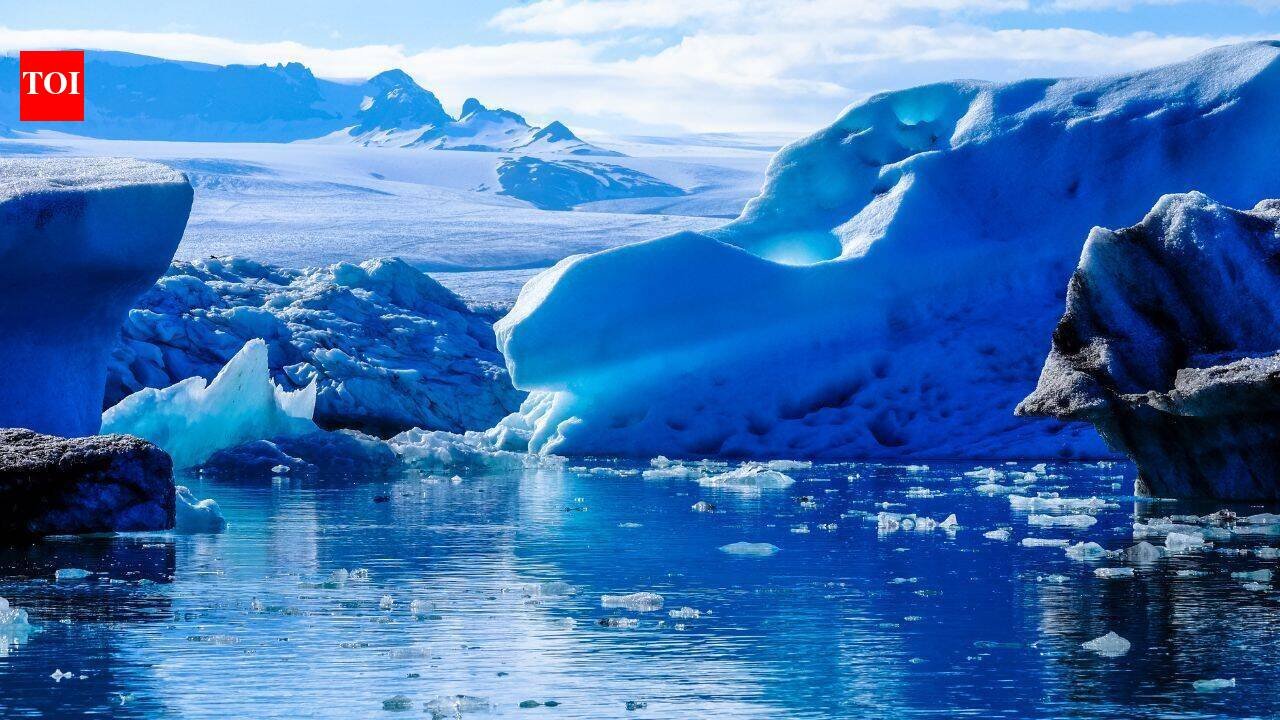
For a long time, the story seemed simple. As carbon dioxide levels in the atmosphere drop and the Earth cools, large ice caps are beginning to spread across the polar regions. However, there’s one awkward detail that doesn’t quite fit. About 34 million years ago, Antarctica was covered by a large amount of ice, while the Arctic was essentially ice-free for tens of millions of years. If global cooling is the main trigger, why are the poles reacting so differently? A study published in the journal Science titled “Uplift driven by continental breakup drives southeastern ice sheet formation,” now point to answers buried deep within Antarctica itself. Researchers believe it wasn’t climate alone that acted alone, but changes in the continent’s landscape driven by geological events that began more than 100 million years ago, helped create the conditions needed for permanent ice to take hold. Antarctica’s altitude may be as important as its cool atmosphere.
Why Antarctica froze millions of years before the Arctic
The Arctic region faces a very different situation. Reuters points out that glaciers in high northern latitudes appeared and disappeared over millions of years, but stable continental-scale ice sheets did not appear until much later. Geography helps explain why.Unlike Antarctica, the Arctic is located in the middle of the ocean rather than on top of a continent. There is no large landmass directly at the poles that can gradually rise above the snow elevation threshold. Without vast highlands, colder global conditions would be required to form permanent ice. Antarctica actually had a geological head start. Its elevated interior allowed ice caps to form while the world was still relatively warm. Northern Hemisphere glaciation requires additional cooling because most of the available terrain is still at lower elevations. This difference helps explain one of the most enduring mysteries in Earth’s climate history: why the Antarctic entered the Great Ice Age about 20 to 25 million years earlier than the Arctic.This timing does not appear to be a simple result of falling carbon dioxide, but is determined by long-term interactions between deep Earth processes, mountain building and climate. The ice in Antarctica appears to have begun forming long before the Arctic, because the continent itself has been quietly rising, achieving the necessary conditions, for millions of years.
How the breakup of Gondwana could reshape Antarctica’s future
The roots of this story can be traced to the breakup of Gondwana, the ancient supercontinent that once connected Antarctica to Africa, South America, Australia and the Indian subcontinent. When Africa began to separate from Antarctica during the Jurassic Period, the process didn’t just change the coastline. Deep within the Earth, disturbances propagate through the mantle. The scientific study describes these disturbances as long-lived mantle waves that gradually migrate beneath the continents over tens of millions of years.As these waves move inland, they change the density structure beneath Antarctica. Material at the bottom of the continental crust is stripped away, making parts of the land more buoyant. Over long periods of time, parts of East Antarctica slowly rose.The researchers used landscape evolution models combined with ice sheet and climate simulations to reconstruct these changes. Their results show that the uplift spread inland from Antarctica’s ancient edge, eventually rejuvenating the Gamburtsev Mountains, a mountain range now buried under kilometers of ice in Antarctica’s interior.According to the study, this process began when the continents separated more than 160 million years ago, but continued to affect Antarctica’s surface long after that. Reuters reports that long before similar conditions emerged in the Arctic, the uplift eventually produced terrain high enough for permanent ice to form.
The Antarctic Ice Sheet and the Origin of the Antarctic Frozen Landscape
The Antarctica we are familiar with today is a world of ice deserts, towering glaciers and temperatures that can drop below -80°C. Early in Earth’s history, it looked very different.During the Eocene Epoch, about 56 to 34 million years ago, Antarctica had forests and a fairly mild climate. Global temperatures were warmer than today, and sea surface temperatures around the continents were much lower than the freezing conditions associated with the Southern Ocean today.However, somewhere near the boundary between the Eocene and Oligocene epochs, a dramatic transformation began. Ice sheets expanded across East Antarctica, eventually coalescing into the massive ice mass that still dominates the continent. Confusingly, this happened while parts of the world were still relatively warm. Research shows the problem cannot be explained by carbon dioxide in the atmosphere alone. In contrast, Antarctica appears to have been unusually well prepared for glaciation, as its landscape has been reshaped over millions of years.
How Antarctica’s rising mountains create ideal conditions for ice sheets
Mountain environments behave differently than low-lying areas. The air gets cooler as elevation increases, allowing snow to be preserved longer and increasing the chance of ice forming year-round.According to the study, East Antarctica is gradually crossing a critical threshold. About 45 million years ago, expanding highlands and revitalized mountains raised large areas above elevations conducive to maintaining permanent ice and snow. As these high altitude areas grow, so does the potential for glacier development and persistence.Researchers estimate that when major glaciation began about 34 million years ago, nearly 90 percent of the Gamburtsev region was above the elevation needed to support persistent ice. Early in the continent’s history, only a small portion of the landscape occupied this climate zone.Their model suggests that this topographic evolution helped the ice sheets expand even though global temperatures remained higher than modern temperatures. Once the ice begins to spread, its reflective surface increases the amount of sunlight reflected back into space, thereby enhancing cooling and promoting further ice growth.In this view, Antarctica is not just fighting climate change. The continent’s rising landscape is actively affecting how climate translates into the formation of ice caps.