
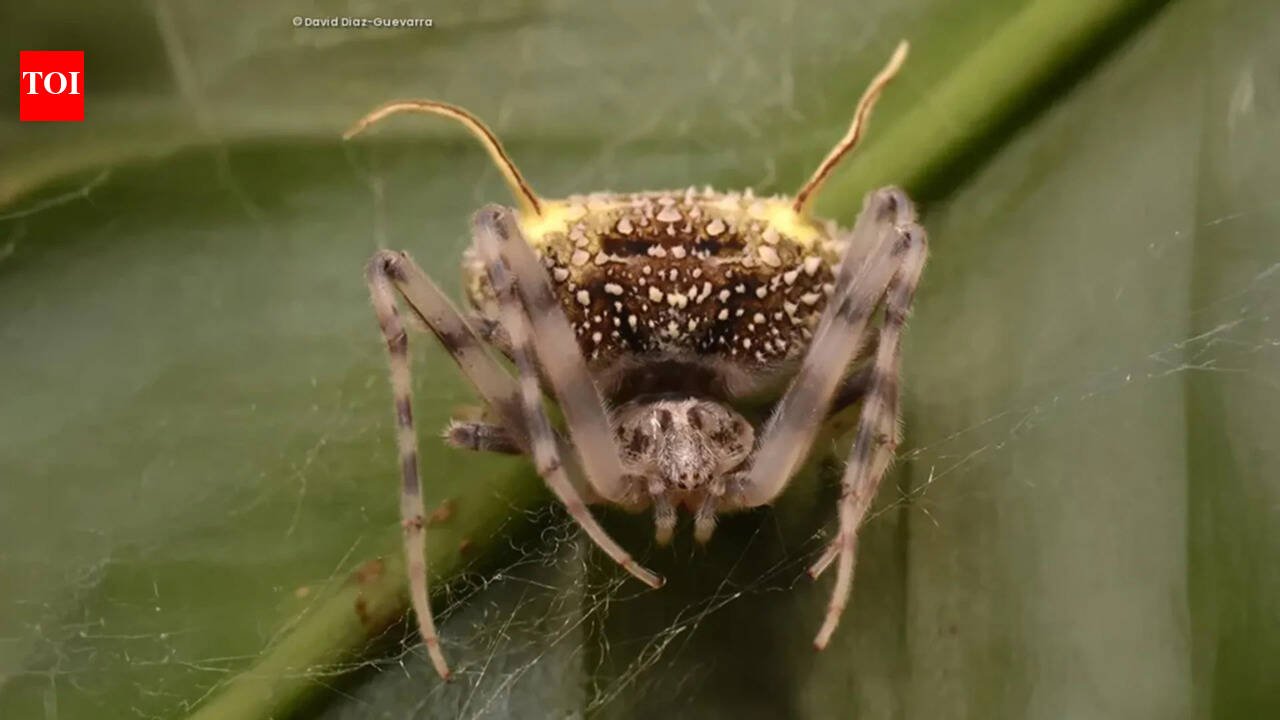
Researchers are exploring Ecuador Amazon Tropical Rainforest believes they discovered a small mushroom stuck to the underside of a leaf during a nighttime investigation. A closer look revealed something very strange. It’s a spider that disguises itself as a parasitic fungus, fooling even seasoned scientists.The newly discovered species was named Takzanowskia Vaskais the first known documented spider to mimic the fungus that infects spiders. The discovery, made by an international team of researchers including scientists from the Leibniz Institute for the Analysis of Biodiversity Change (LIB), has been published in the journal animal group.The spider was discovered in the Langanates-Sangay corridor of the Ecuadorian Amazon, an area considered one of the most biologically rich on Earth. During a nighttime field expedition, researchers initially thought they were observing a mushroom growing under a leaf, before realizing it was a live spider.The mistaken identity itself became one of the strongest clues that the species had evolved unusually effective camouflage.
Spider that looks like a parasitic fungus
Unlike most spiders that blend into bark, leaves or flowers, Takzanowskia Vaska have evolved to resemble the fruiting bodies of fungi of this genus Giberula. These fungi are well known because they grow on spiders after infecting and killing them.The similarities are striking.The spider is pale in color and has elongated structures on its abdomen that look like fungal growths. It also behaves in a way that enhances hallucinations. Instead of actively moving around in search of prey, it remains completely motionless on the underside of the leaf, which is exactly where it is. Giberula Fungi are commonly found in rainforests.The researchers say the combination of appearance and behavior suggests a highly specialized form of mimicry that has never been documented in spiders before.This camouflage helps the spider avoid predators and makes it look like something it can ignore. At the same time, remaining undetected allows it to more effectively ambush unsuspecting prey.
Scientific first
The study describes Takzanowskia Vaska This is the first documented example of a spider imitating a parasitic fungus to infect its own species.This makes the discovery significant beyond the description of a new species. It also provides scientists with new evidence of how mimicry evolves in nature and the different ecological roles such adaptations may play.The researchers say the discovery expands current understanding of spider survival strategies and raises new questions about how similar forms of mimicry might have evolved in other rainforest species that have not yet been studied.Spiders belong to the genus Araneus Takzhanowskaa group considered both rare and poorly understood. Members of this genus are rarely encountered in the wild, so much of their ecology and behavior is unknown.
Unexpected discoveries with the help of citizen scientists
This discovery did not begin in a laboratory or during a planned search for a new species.Instead, it first uploads observations to the citizen science platform iNaturalist. What observers thought was a mushroom caught the attention of platform users, who realized that the unusual object might actually be a spider.This online observation prompted scientists to investigate further and ultimately formally identify a species that had never been described before.Researchers say the case shows how the public can play an important role in biodiversity research, especially in remote areas where many species remain undocumented.Nadine Dupérré from LIB Hamburg Museum of Natural History contributed to the research by examining reference specimens in scientific collections and helping to classify the newly discovered spiders.“These discoveries demonstrate the value of scientific collections. They allow us to classify new species and compare them with historical specimens. Combined with international collaboration and citizen science, this opens up new opportunities for studying biodiversity,” explains Nadine Duperre.
Why mimicking fungi is so unusual
Mimicry is common in nature, but this case stands out because the spider isn’t imitating a plant, leaf, or innocuous object. It mimics a parasitic fungus that infects other spiders.The fungus belongs to the genus Giberula. It is known to grow on spiders after infection, eventually producing pale stem-like structures from the host’s body. In humid rainforest environments, these fungi often cling to the undersides of leaves.similarities created Takzanowskia Vaska It was close enough that researchers initially failed to identify it as an animal during field visits. The spider’s body shape and pale, fungus-like extensions closely match the appearance of an infected spider Giberula.Its behavior adds another layer to the disguise. By being motionless in the location where an infected spider is usually found, it reinforces the illusion that it is not a living thing in the usual sense.The researchers believe this combination of body shape and behavior may serve two purposes. It helps spiders avoid detection by predators, who learn to ignore fungus-infected prey. It also allows it to ambush an insect that gets too close, mistaking it for something inedible.
A rare genus that is still little known
Spiders belong to the genus Araneus Takzhanowskathis group remains poorly researched. Scientists rarely encounter members of this genus in the wild, leaving significant gaps in understanding their behavior, distribution, and ecological role.Because of this, each new discovery adds important details to a group that remains largely undocumented. The discovery of a species with such a specialized form of mimicry raises further questions about how diverse survival strategies may be within the genus.
Discovered through citizen observation
The chain of discovery begins far away from the formal research environment. An image uploaded to the citizen science platform iNaturalist shows what appear to be mushrooms growing on leaves in an Ecuadorian rainforest.Users on the platform questioned this explanation, suggesting it could be an animal. That discussion sparked greater scientific scrutiny, ultimately leading to field confirmation and formal classification of the new species.This case reinforces the growing role of citizen science in biodiversity research, particularly in remote ecosystems where scientific investigation is limited.
Amazon Biodiversity and Science Collaboration
The spider was discovered in the Langanates-Sangay corridor, an area of the Ecuadorian Amazon rainforest known for its high levels of biodiversity and limited scientific exploration. The area is constantly producing new species of different organisms, from insects to plants and fungi.The research team involved in the discovery includes scientists from the Leibniz Institute for the Analysis of Changes in Biodiversity (LIB) as well as international collaborators. Museum collections also played a key role, helping researchers compare specimens and confirm the spider’s classification.Nadine Dupérré from LIB Hamburg Museum of Natural History confirmed that the species is new to science by examining preserved specimens and assisting with taxonomic work.
Publication details
Research results published in journal animal group 2026, titled: “Cordyceps Spider”: Taczanowskia waska sp. November (Araneae: Araneidae), new species of spider and new cases of arachnid-mimetic pathogenic fungi (Cordyceps: Gibellula).The study describes Takzanowskia Vaska This is the first documented case of a spider mimicking a parasitic fungus that infects the spider itself, a form of mimicry not previously documented in arachnids. This finding is further evidence that rainforest ecosystems still possess complex and unexpected evolutionary strategies, many of which have yet to be documented.During the fieldwork, researchers noted that the animal’s camouflage was so convincing that it was initially thought to be a mushroom, before closer inspection revealed its true identity to be a spider.