
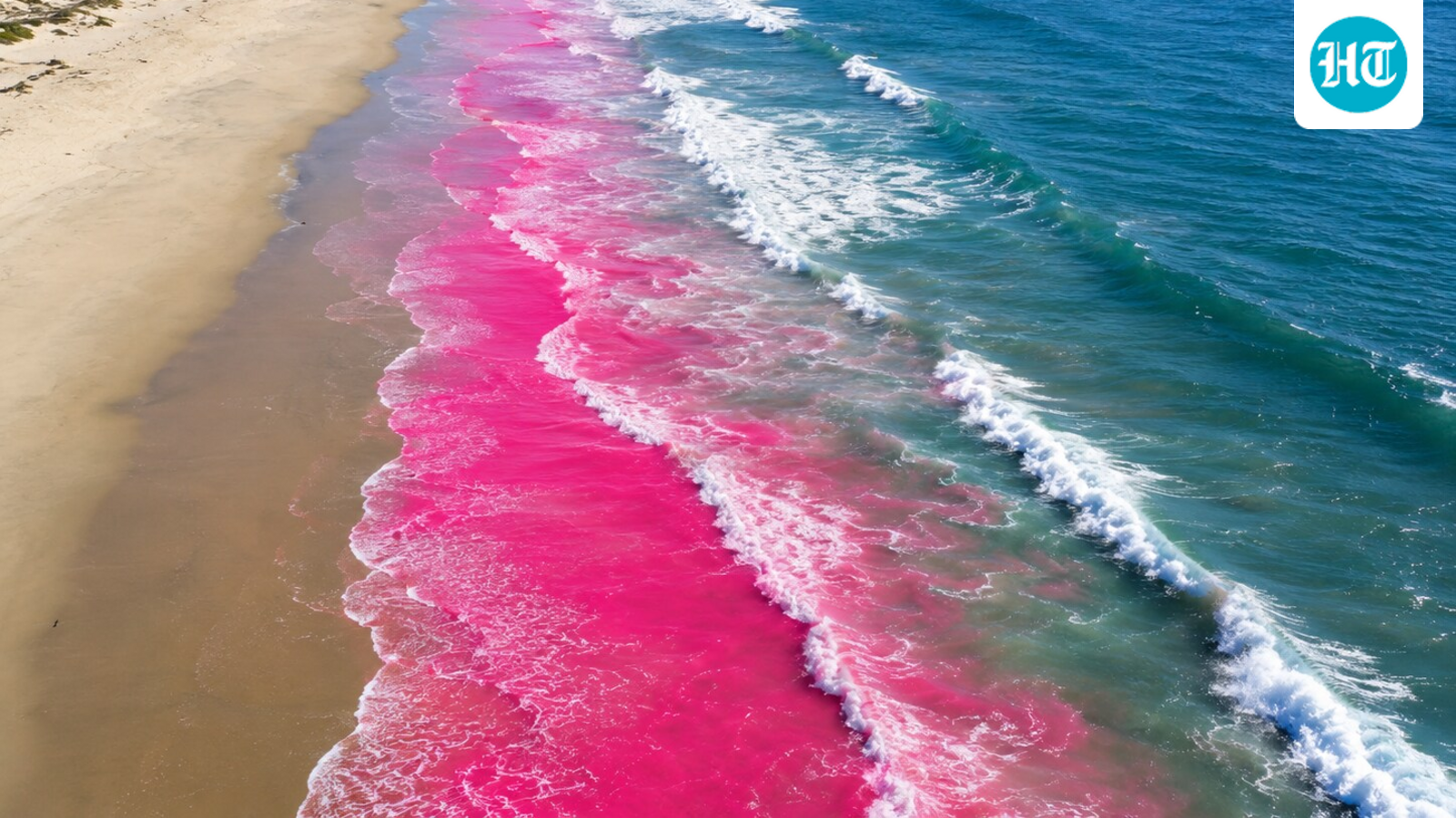
Imagine a beach where the waves suddenly turn bright pink. In 2015, scientists made that happen on purpose off Southern California. According to Scripps Institution of Oceanography, researchers conducted three experiments near Imperial Beach, releasing non-toxic, bright pink fluorescent dye to see how it moved along the coast. The dye was used to simulate pollution. Scripps reports that the dye moved north through the surf zone at nearly eight miles per day during a strong south swell.

Why scientists turned the ocean pink
Pollution is hard to track once it enters the sea, because you often cannot see it. Dye takes care of that problem. It glows, so researchers can track it with sensors in the water and imaging equipment on an airplane. The work was part of a project called Cross-Surfzone/Inner-shelf Dye Exchange, or CSIDE, funded by the National Science Foundation.
A detailed scientific account comes from a 2021 study by Derek Grimes, Falk Feddersen, and Sarah Giddings published in the Journal of Geophysical Research: Oceans. The team followed a release made on October 8, 2015, about 0.6 miles north of Imperial Beach. Over about four hours, they pumped in about 30 gallons of dye solution and tracked it for about 30 hours, with instruments covering about 4 miles of coastline. The leading edge of the dye crossed that stretch in roughly 11 hours.
How the waves carried the dye
Waves did most of the work. When waves roll toward a beach at an angle, they create a current that runs along the shore. The study found that the dye moved north in the direction predicted by the incoming waves. That matches the Scripps account of dye moving north in a strong south swell, a route that leads toward the entrance of San Diego Bay.
But the picture wasn’t simple. Beyond the breaking waves, currents moved slowly south, while water in the surf zone flowed north. This meant that dye in the surf zone and dye further out were carried differently. The dye also lingered near the coast for long periods of time.
Why the pink faded
The strongest dye reading in the surf, near the release point, was about 90 parts per billion. About 4 miles further up the coast, it was under 5. The study attributes much of that drop to rip currents, narrow, fast streams that pull water away from shore, which carried dye from the surf zone to deeper water. The authors estimate that surf-zone water was exchanged with deeper water about every 2.3 hours.
Some of that dye did not rinse out forever. The authors show that dye stored in deeper water, which drifted south more slowly than the surf zone flowed north, could later re-enter the surf zone after the main plume had passed, a process they call recirculation. This lengthened the plume over time and produced long, fading tails in the readings at points farther along the coast.
What this means for beachgoers
Exchange between the surf zone and deeper water reduces the dye in the surf zone, where most people are exposed, decreasing the downstream water quality impact of a pollution event. Scripps also says more studies and model work are needed for better real-time forecasts of where pollution is going for beaches in San Diego, Imperial Beach and Coronado.
But there are limits. The study looks at one release under one set of conditions, and the authors say similar long-range observations are needed to test whether their model holds up elsewhere. Even so, the pink water gave scientists a clear view of something normally hidden, and it helped explain how shoreline pollution may travel.