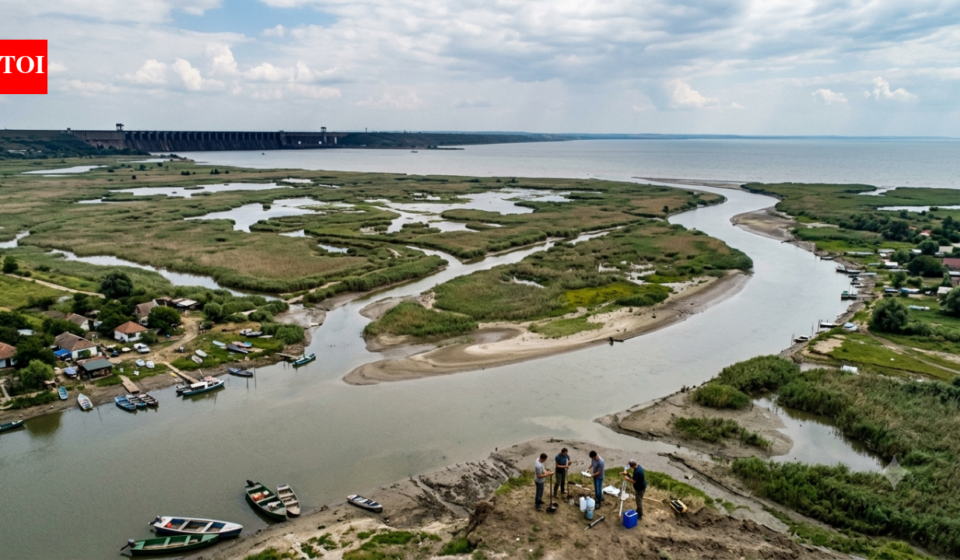
Two giant dams changed Europe’s second-longest river. Decades later, scientists found the Danube Delta was being starved of sediment

The Danube does not arrive at the Black Sea as it once did. For thousands of years, the river carried enormous quantities of sediment towards its delta, steadily building and reshaping the low-lying landscape where river channels meet lagoons and the sea. That process changed after large-scale engineering works altered the river upstream. Following the construction of the Iron Gates dams, the amount of sediment reaching the lower Danube fell sharply. By the following decades, the delta was no longer receiving enough material to maintain the balance that had helped shape it for millennia. Along parts of the Black Sea coast, erosion began to take a greater role.
How the Danube built its delta over 12,000 years
The Danube Delta is the product of a very long relationship between flowing water, sediment and the Black Sea. According to the research published in Estuarine, Coastal and Shelf Science, titled ‘Danube River Sediment Input and its Interaction with the North-western Black Sea’, over roughly 12,000 years, material carried downstream accumulated around the river’s mouth, allowing the delta to extend and change as channels shifted and new deposits formed.That process depended on a continuing supply from the river. Sediment arriving from upstream could be deposited across the delta, along its shoreline or farther out on the Black Sea shelf.Human intervention altered that pattern. Dams and other engineering works changed the movement of water and sediment through the Danube system, leaving parts of the modern delta with a much smaller supply of the material that had helped create it.
How the Iron Gates dams changed the Danube
The construction of the Iron Gates dam system on the Danube was a major change for the river. After the dams were built, sediment discharge downstream dropped to around 30–40% of its earlier level, as reported in the study.The reduction was not simply a matter of less material moving through the river. Large reservoirs can trap sediment that would otherwise continue downstream. Material settles within the impounded sections rather than travelling towards the delta.For a landscape dependent on a river to keep delivering sediment, the change was significant.The Danube Delta had spent thousands of years gaining land through deposition. With a much smaller sediment supply arriving from upstream, parts of the system were left with less material available to offset the forces continually wearing the coastline away.
Where the Danube’s sediment still reaches the sea
The effect became particularly apparent along the delta’s seaward edge. The reduced sediment supply contributed to stronger erosional processes along the deltaic coast.The north-western Black Sea shelf can be broadly divided into two contrasting areas. Closer to the Danube, the inner shelf remains strongly influenced by sediment delivered by the river. Farther offshore, the outer shelf is comparatively sediment-starved.That distinction matters because the Danube is not only important for the wetlands and channels that can be seen from the surface. Its sediment has also shaped the seabed beyond the delta.Over time, deposits from the river accumulated across the north-western Black Sea. But the modern sedimentary record indicates that the Danube’s deep-sea fan is no longer developing as it did during earlier periods.
The delta’s natural sediment cycle has been disrupted
Different parts of the delta experience different combinations of deposition and erosion. Sediment continues to move through the river and across the coastal zone, while waves, currents and changing water conditions redistribute material.After thousands of years of active growth and reshaping, much of the delta became relatively inactive during the last few decades. Human modifications to the river system were one part of that change.
Ten small dams removed to free rivers and reconnect habitat
Ten obsolete dams on the Kogilnik and Sarata Rivers have been removed within the Danube Biosphere Reserve. The rivers rise in Moldova before reaching the Sasyk Lagoon in Ukraine, and the small Soviet-era barriers had restricted their flow near their mouths for years.Removing those structures was not expected to restore the sediment supply lost at the Iron Gates. It addresses a different problem, lower down in the river network, by reconnecting sections of rivers that had become fragmented.As reported by ELSP, the intervention is about 20 kilometres of river habitat, including areas of flooded meadow. Freer movement of water should allow natural river processes to resume in places where the dams had interrupted them.
Fish and wetlands stand to benefit
Dams can interfere with fish movement as well as altering the physical behaviour of a river. They can interrupt migration routes, change how sediment travels and separate habitats that would otherwise remain connected.The Kogilnik and Sarata removal project intended to reverse some of those effects. Species such as wild carp, frogs and otters are among the wildlife expected to benefit, while the connected river sections should also provide habitat for breeding and migratory birds.For fish, the consequences may extend beyond movement. Improved water flow can help revitalise riverside vegetation and flooded areas that provide spawning habitat.
Restoration plans target fish, wetlands and flood resilience
The dam removals were carried out with input from local communities, and the town council of Tatarbunary approved the project.Fishermen were expected to benefit if fish populations recovered in the connected river sections. Healthier wetlands and more accessible natural areas could also create opportunities for nature-based tourism.Restoring more natural channels and improving water movement can influence how flooding affects surrounding farmland and infrastructure.A second phase of the project was planned around feasibility studies for clearing and restoring channels farther upstream, extending the restoration beyond the locations where the obsolete dams were removed.