
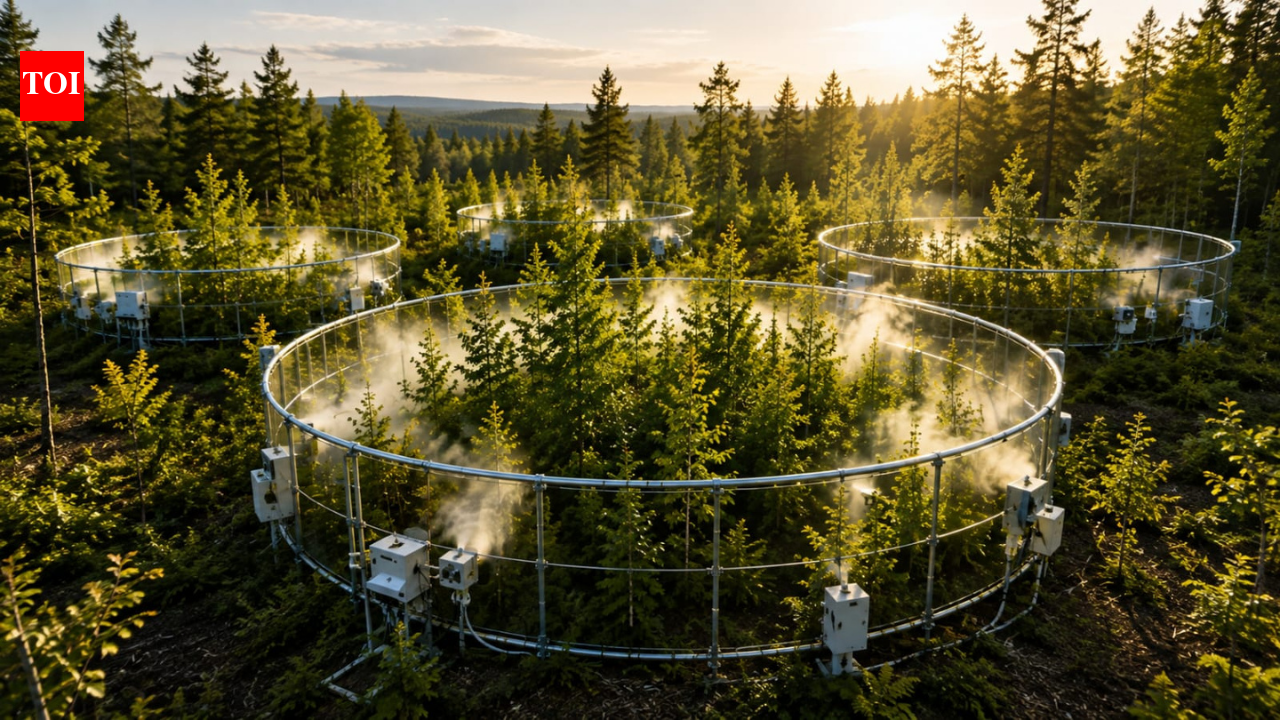
What happens when young forest communities spend more than a decade growing in air with unusually high levels of carbon dioxide and ozone? Scientists in Wisconsin set out to find the answer by changing the atmosphere around these communities and tracking how the trees responded over 11 years. The experiment, known as Aspen-FACE, was conducted in Rhinelander, Wisconsin, and exposed forest plots to elevated carbon dioxide (CO₂), elevated ozone (O₃), or both. According to the study by Alan F. Talhelm and colleagues, published in Global Change Biology, elevated CO₂ increased cumulative net primary productivity by 39% over the 11-year experiment. Elevated ozone had the opposite effect, reducing cumulative productivity by 10%. The study also found that elevated CO₂ increased total ecosystem carbon by 11%, while elevated ozone reduced it by 9%.
Changing the forest air
The Aspen-FACE experiment began in 1998 and continued until 2009, giving researchers an unusually long opportunity to observe how forests respond to changing atmospheric conditions. Scientists used large circular plots to expose trees to controlled concentrations of CO₂ and ozone under open-air conditions. The forest communities included aspen, birch and maple, representing species found in northern temperate forests. Rather than examining plants in a laboratory or greenhouse, the experiment allowed the trees to grow outdoors while researchers altered the air surrounding them. This helped scientists study atmospheric effects under more realistic forest conditions.
CO₂ boosted productivity
The strongest growth response came from elevated carbon dioxide. After 11 years, forests exposed to elevated CO₂ had 39% greater cumulative net primary productivity than forests under normal atmospheric conditions. Net primary productivity measures the amount of plant biomass produced by an ecosystem after accounting for the carbon plants use during respiration.The researchers found that elevated CO₂ also increased canopy nitrogen and nitrogen productivity. Trees accounted for approximately 95% of the cumulative productivity measured during the experiment. The increase extended to carbon storage. Total ecosystem carbon content was 11% higher under elevated CO₂. Tree carbon increased substantially, particularly in woody parts such as stems, branches and coarse roots. These findings showed that forests can maintain a significant productivity response to elevated CO₂ over a period much longer than a single growing season.
Ozone worked differently
Ground-level ozone produced a contrasting result. Elevated ozone reduced cumulative net primary productivity by 10% over the 11-year period. The researchers linked this decline partly to reduced canopy nitrogen, which fell by 21% under elevated ozone. Ozone also reduced total ecosystem carbon by 9%. Unlike atmospheric CO₂, which plants use during photosynthesis, ground-level ozone is an air pollutant that can damage vegetation and interfere with plant growth.However, the ozone effect was not equally strong throughout the entire experiment. Researchers found that its negative effect on productivity became smaller as the forest developed, showing that trees and forest communities can respond differently as they mature.
The combined effect
The interaction between the two gases was more complicated than simply adding their individual effects together. Although elevated CO₂ increased productivity by 39% and elevated ozone reduced it by 10%, the researchers found no statistically significant interaction between the treatments for cumulative net primary productivity. This means the study does not show that ozone directly cancelled a specific percentage of the CO₂-driven increase. Instead, the gases produced opposing effects, with CO₂ stimulating productivity and ozone placing pressure on forest growth. The combined treatment also produced an important result for carbon storage: ecosystem carbon under elevated CO₂ and ozone together was not significantly different from the ambient treatment.
What it means
The Wisconsin experiment offers a long-term look at how forests may respond to changing atmospheric conditions. Its findings show that rising CO₂ can stimulate forest productivity, but other atmospheric pollutants can work in the opposite direction. A later USDA Forest Service study used landscape modelling to examine how the Aspen-FACE findings could translate beyond the experimental plots. It found that CO₂ was the dominant driver of landscape response, while ozone had a significant negative effect on mean landscape biomass.The results underline why forests cannot be viewed simply as automatic carbon sinks. Their response depends on multiple environmental factors, including atmospheric composition, species, competition and forest development. After 11 years of changing the air around a Wisconsin forest, the scientists found a clear contrast: extra CO₂ encouraged productivity, while ozone limited growth and complicated the forest’s carbon response.