
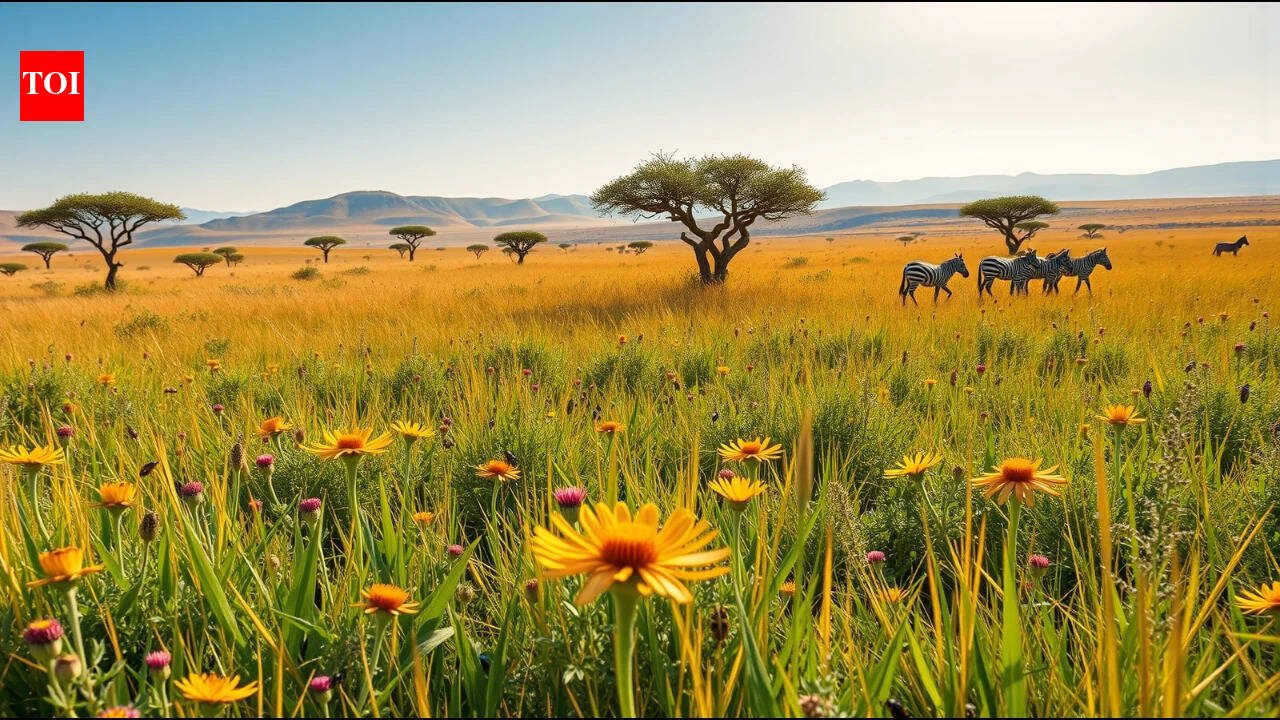
A patch of rare savanna habitat in the Ottawa Valley has recovered remarkably well after decades under a planted pine forest, according to a study examining restoration efforts at a site called The Sandhills near Constance Bay, Ontario. Researchers from Agriculture and Agri-Food Canada compared a cleared hectare, where planted pine trees had been removed and pine litter cleared away, against the surrounding Red Pine plantation still standing nearby. The clearing work itself required only about 5 people working for less than 2 weeks, after which native savanna vegetation largely re-established itself naturally, helped along by seeds drifting in from nearby remnant patches along old paths and firebreaks. Biodiversity in the restored clearing turned out to be substantially higher than in the plantation, with more flowering plants, shrubs and regionally rare species taking hold once the pine canopy and its accumulated litter were finally cleared away for good.
How researchers measured savanna restoration success at Constance Bay
To evaluate how well the native ecosystem had bounced back, researchers gathered data from quadrats laid out along transects, allowing them to directly compare vegetation in the restored clearing against the adjacent pine plantation. As described in Successful re-establishment of a native savannah flora and fauna on the site of a former pine plantation at Constance Bay, Ottawa, Ontariothe restoration process itself involved cutting and bulldozing the planted trees and stripping away accumulated pine duff and litter, work that took a small team just days to complete across roughly a hectare of land. Beyond a limited seeding effort, the researchers noted that most of the native plant recovery happened on its own, aided significantly by seed dispersal from surviving pockets of remnant vegetation scattered nearby.
Why the pine plantation struggled to support native savanna species
The comparison between the 2 sites revealed clear differences in ecological health. While the semi-open Jack Pine plantation supported a mix of species adapted to both shaded and open conditions, with diversity levels approaching those found in the clearing, some native plants fared poorly under the pine canopy. Blueberry plants growing within the plantation, for example, were generally found in poor condition and largely failed to produce flowers or fruit, a sign that the altered light and soil conditions beneath the pines were suppressing natural reproductive cycles that once defined this landscape before commercial forestry arrived.
What the results suggest about future savanna restoration efforts
The restored clearing consistently outperformed the plantation across nearly every biodiversity measure the researchers tracked, showing greater development of flowering herbaceous plants and shrubs alongside a noticeably higher number of regionally rare species. Orthopteran insects, a group that includes grasshoppers and crickets and serves as a useful indicator of overall plant feeding diversity, were also markedly more abundant and varied within the restored area compared with the surrounding pines. The researchers concluded that savanna and natural sand barren habitats destroyed by plantation forestry can be restored both successfully and inexpensively, suggesting there is little reason such efforts could not be expanded to cover much larger areas across similarly affected landscapes in the future.
Why the Constance Bay restoration matters
The results are particularly notable because the researchers achieved the recovery with relatively little intervention. Once the planted pines and accumulated duff were removed, the site was able to regain much of its native vegetation without extensive planting or intensive management. The authors suggest that nearby remnants of the original savanna, including vegetation along paths and firebreaks, provided an important source of seeds for recolonisation. That finding points to the value of protecting small surviving patches of native habitat, which can help surrounding areas recover when damaging land uses are removed. The study was also significant because it showed that restoration did not necessarily require costly replanting across the entire site. Instead, removing the conditions that had suppressed the original ecosystem allowed native plants and insects to return largely on their own. The researchers argued that similar restoration could be considered across larger areas of savanna and natural sand barren affected by plantation forestry.