

A seemingly casual social media exchange this week drew attention and criticism for highlighting deep tensions in the United States around immigration, demographic change and cultural identity. Scholar and commentator Wilfred Reilly retweeted a post claiming “Texas is 1% Indian,” in response to Korean content creator Kangmin Lee, who observed that many of the passengers on his flight to Dallas, as well as many people at the airport, appeared to be of Indian descent. The response sparked a rapid online debate about race, belonging and who gets to define “real America.”
What happened?
Using his social media handle on X (formerly twitter), Lee Kang-min posted on Thursday morning, “Just flew into Dallas and more than half of my flight was Indian, and everyone else in the airport was Indian. Am I in Texas or New Delhi? What happened in Dallas? (sic). ” Wilfred Reilly retweeted unnecessary hate, arguing, “Texas is 1% Indian and you yourself appear to be a legal immigrant of Korean descent (sic),” to which Bumrunmin replied, “And what? Is it wrong to not want parts of the United States to look like an entire foreign country? (sic).“Subsequently, a heated debate ensued in the comment area, with some people amplifying their opinions. indians While some have defended it, the exchange had a much larger context viral There is discussion about the visibility of Indian Americans in parts of Texas, particularly in the Dallas-Fort Worth (DFW) metropolitan area, where Indians form one of the fastest-growing immigrant communities. According to census data, more than 235,000 Indian Americans live in the DFW area, accounting for about 3% of the total population, mainly concentrated in suburbs such as Plano, Frisco and Lewisville, where Indian-owned businesses, cultural centers and communities have flourished in recent decades. Some commentators have repeatedly reframed viral videos showing light-hearted footage of Indian grocery stores and restaurants as evidence that the cultural landscape in parts of Texas is changing “too fast.” In one notable case last year, a viral video of a Ganesh Chaturthi celebration outside a Dallas-area Indian bazaar was repurposed by critics to support claims that Indian customs and immigrants overwhelm local culture, even though many viewed the celebration as a quintessential cultural holiday among expat communities.
Social media reactions to tweets from Korean content creators, stereotypes against Indians, and the politics of belonging in the United States
Reactions online to the tweets and videos have been wildly different. Some users were amused or identified with Lee’s comments, noting that racial diversity is increasingly visible in American cities, especially in tech and university-related communities. Others, including some fringe commentators and MAGA-aligned activists, have seized on the topic to amplify narratives of an “invasion” or cultural takeover.Recently, a conservative commentator in Texas slammed a 90-foot tall statue of Hanuman in a Hindu temple as evidence of an “invasion” by “third world aliens,” echoing similar rhetoric about Indians “taking over” Texas towns.
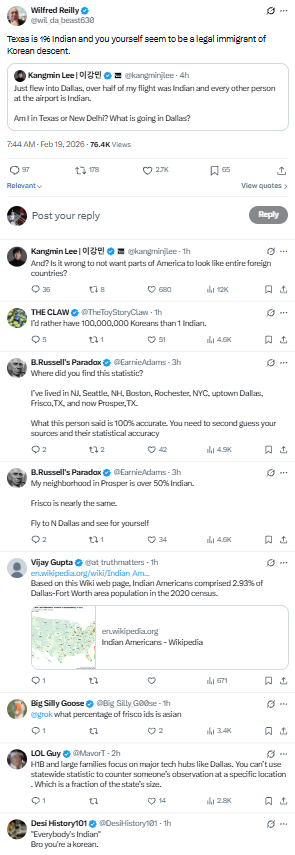
X (formerly Twitter) users react to Korean content creator’s dig at American Indians.
Critics of this framework argue that it fosters xenophobia and anti-immigrant sentiment, and point to demographic change and multiculturalism as long-standing features of American society. Indeed, the debate over H-1B visas, a highly contentious work-related immigration category in U.S. politics, often figures in these discussions, with some voices blaming foreign professionals for what they see as economic pressures on local workers, even as economists emphasize the tech and technology industries’ heavy reliance on global talent.Experts and diaspora commentators warned that what might begin as a comment on community development could quickly devolve into divisive rhetoric if taken out of context. Sree Sreenivasan, an Indian-American senior digital strategist, warned in a recent interview that “anti-India hate is happening in the United States right now,” an example of how broader anxieties about the economy and security are being targeted against immigrants on social media.
Texas, US, microcosm of wider identity debate
Texas has a rich history of immigration and cultural integration, once part of Mexico and now a fusion of Latin, Asian, African and European heritage, often at the center of broader national debates about identity and the reality of demographic change. Many Indian Americans in the Dallas-Fort Worth area work in fields such as information technology, engineering and medicine, forming a vibrant, close-knit community with its own cultural, business and civic institutions.
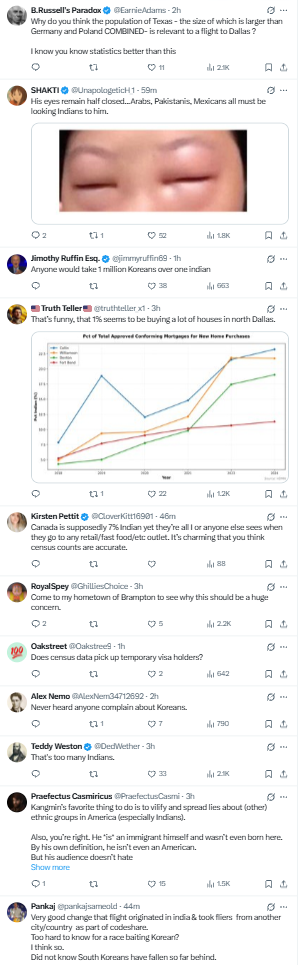
X (formerly Twitter) users react to Korean content creator’s dig at American Indians.
However, social media comments like Lee’s tweet and Riley’s reply show that such topics can be very sensitive, especially when they contain provocative language or broad generalizations. Some believe that pointing out the visibility of a community is just observation; others believe that such comments promote fear-based identity politics that can escalate into xenophobia or shame. Analysts note that while discussions about immigration are legitimate in democratic discourse, these issues must be approached with attention to nuance and awareness of how marginalized groups are affected by broad generalizations.
bottom line
Wilfred Reilly and Kangmin Lee’s exchange on “X” sparked debate about Native American visibility in Texas, touching on sensitive topics such as immigration and cultural change. The Dallas-Fort Worth area has a large Indian-American population, contributing to its multicultural character and economic growth. Some social media users and commentators have described this demographic presence in alarmist terms and linked it to debates over H-1B visas and cultural identity. Analysts warn that online discussions risk amplifying divisive narratives and that promoting context, empathy and accurate data are key to constructive discussions about immigration and community dynamics.


