
Home Blog Page 958

Orange is the new gold: How India’s influencer economy turned visibility into value | India News

0

Orange is the new gold: How India’s influencer economy turned visibility into value
The image is used for representation pupose only (AI-generated)

On a busy afternoon in Old Delhi’s Parathe Wali Gali, Darshit Singh held up his phone and did something unusual.He didn’t hype the food.He critiqued it.The reel — an “honest review” of a legacy eatery and Daulat ki Chaat — crossed 7.3 million views. Messages flooded in. Invitations followed. Cities called.That was 2024.Today, Singh calls himself India’s first “food deinfluencer”.Elsewhere, Santosh was boarding a late-night flight after wrapping up a full corporate workday.An IIT-Delhi alumnus by degree and a traveller by instinct, he refuses to choose between spreadsheets and sunsets.“I’m a traveller with a full-time job,” he says — a line that has now become his digital identity.Every month, a new state. Every trip, a vlog. Every journey, proof that passion doesn’t need permission.What once looked like just another viral reel is now part of something bigger — a creator economy projected to be worth thousands of crores, and increasingly recognised in India’s economic blueprint.This year’s Union Budget did something subtle but significant: it placed creativity inside the growth narrative.Welcome to India’s Orange Economy moment.

The Orange Economy: When creativity became economic policy

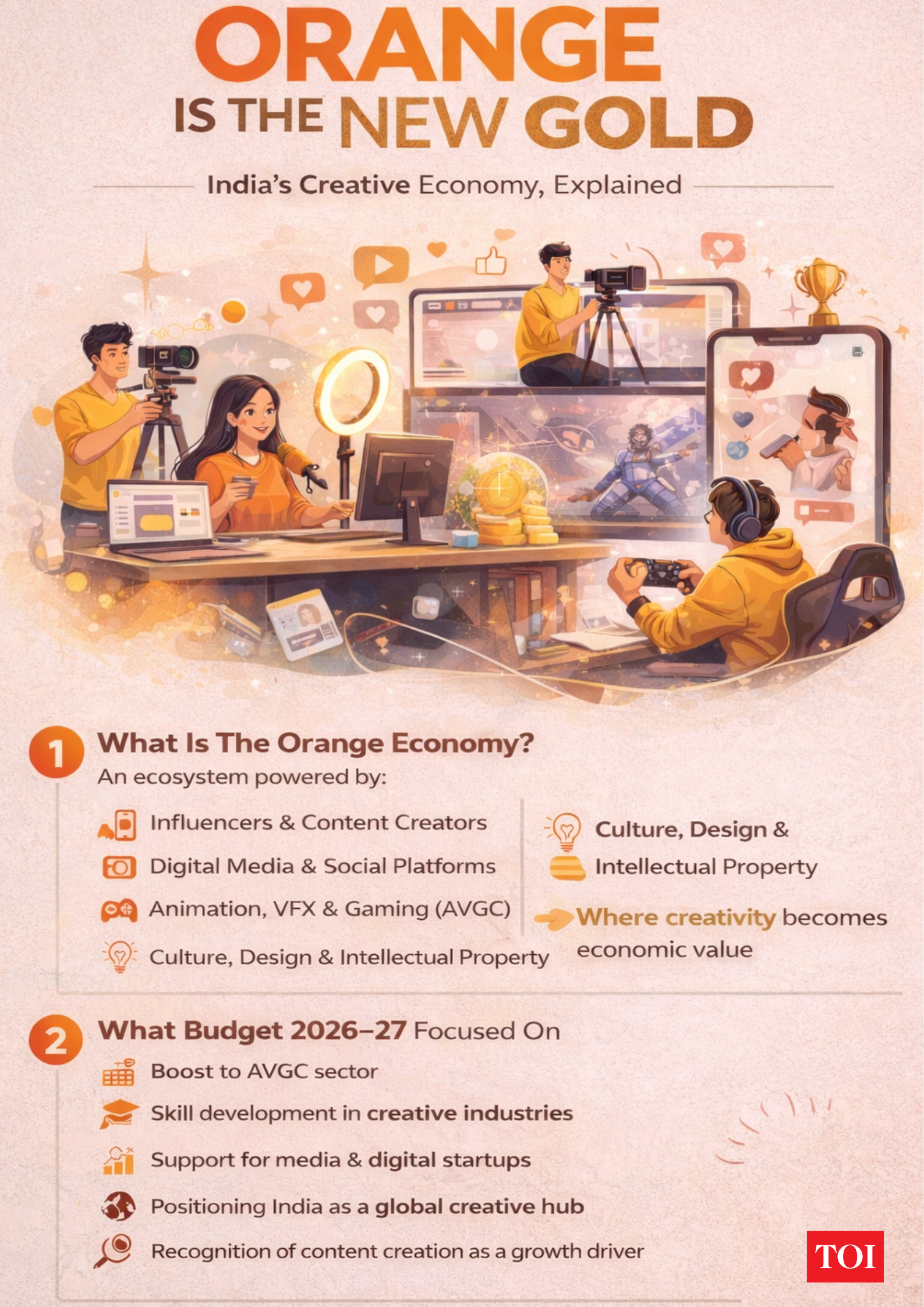
For decades, art, storytelling and digital creation lived in the margins of economic planning — celebrated culturally, rarely counted financially.That is beginning to change.The “Orange Economy” — a term popularised by the Inter-American Development Bank refers to industries that transform ideas into cultural goods and services protected by intellectual property. It includes media, film, music, publishing, animation, gaming, advertising, design, fashion, digital content and now, increasingly, independent creators.In India’s Union Budget 2026–27, finance minister Nirmala Sitharaman announced a major push for India’s creative industries — or what is increasingly being called the “Orange Economy.”
.

.

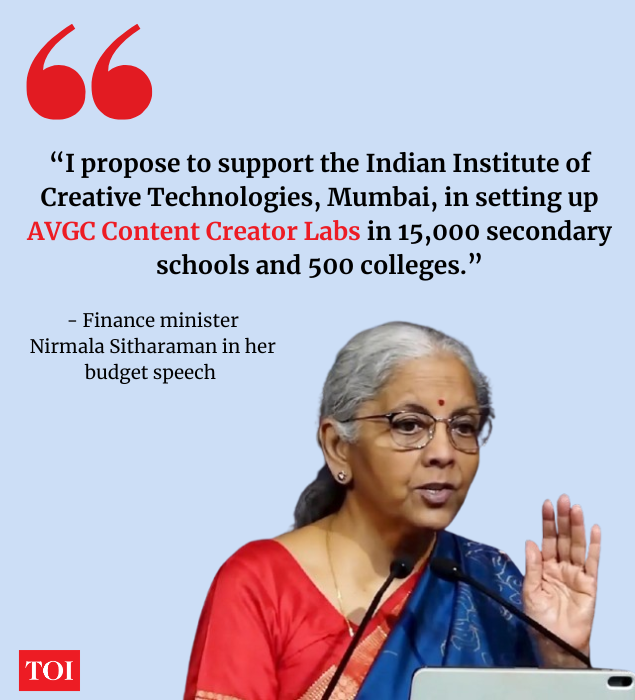
Presenting the Budget, Sitharaman emphasised that India’s creative and AVGC-XR (Animation, Visual Effects, Gaming, Comics and Extended Reality) ecosystem has the potential to generate large-scale employment and position India as a global content hub.She announced:

  • Rs 400 crore allocation for the Indian Institute of Creative Technologies (IICT) in Mumbai
  • 15,000 AVGC labs to be set up in schools
  • Integration of creative and digital skills in 500 colleges across India
  • Policy support aimed at building a workforce pipeline for the AVGC-XR sector

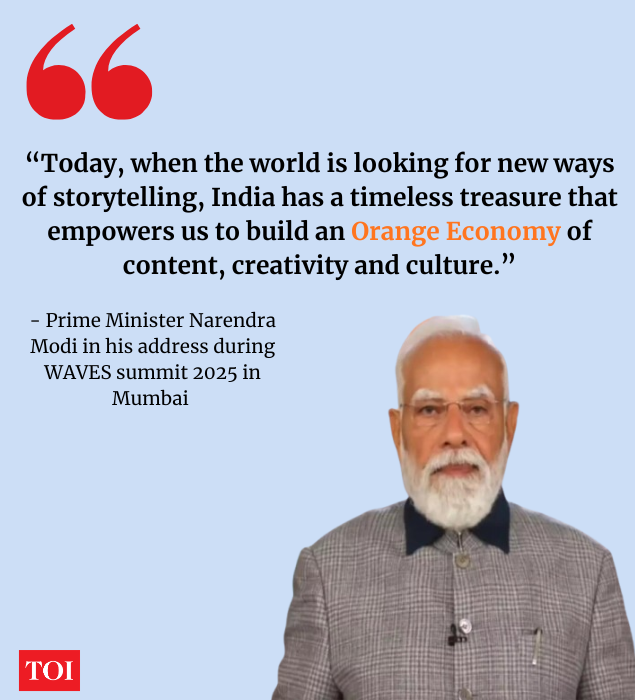
The Economic Survey projected that the AVGC sector alone could require up to 2 million skilled professionals by 2030.Sitharaman highlighted that India’s demographic dividend must be aligned with emerging sectors, particularly those driven by digital platforms and intellectual property.At the WAVES summit earlier this year, Prime Minister Narendra Modi reinforced this direction, describing India as a nation with “a billion-plus stories” and positioning the creative economy as both cultural capital and economic opportunity.
.

.

India’s creator economy is projected to grow at an 18% compound annual growth rate, rising from Rs 19 billion in 2023 to Rs 34 billion by 2026, according to Ernst & Young.

Influencer economy & marketing: From digital voices to structured media power

Influencer marketing is defined as “a collaboration between popular social-media users and brands to promote brands’ products or services.” What began as informal brand shoutouts has now evolved into a regulated, data-driven industry. The scale today is substantial. Globally, the influencer marketing economy was valued at $21.1 billion in 2023, having more than doubled since 2019 on the strength of platforms such as Instagram and YouTube. According to ET, the global influencer marketing platform market grew from $6 billion in 2020 to a projected $24.1 billion by 2025, at a CAGR of 32%.
.

.

Forbes highlighted that the broader creator economy is now a $250 billion global force, projected by Goldman Sachs to reach $480 billion by 2027. Statista reports that over 200 million creators operate globally, while social commerce is expected to touch $2.9 trillion by 2026.India’s influencer marketing sector is projected to reach Rs 3,375 crore by 2026, growing at a CAGR of 18%, according to EY’s ‘State of Influencer Marketing in India’ report. Exchange4Media estimates the core influencer market at around Rs 3,600 crore in 2024, projected to reach Rs 4,500 crore in 2025, though insiders suggest the real size may exceed Rs 10,000 crore due to direct brand-creator deals outside conventional tracking.Creator fees rose between 10–30%, while top-tier creators in India reportedly earned between Rs 10–25 crore annually through endorsements, platform monetisation, live events and equity partnerships.Types of InfluencersInfluencers are categorised by follower size:

  • Nano influencers: Fewer than 10,000 followers
  • Micro influencers: 10,000–50,000 followers
  • Medium influencers: 50,000–100,000 followers
  • Macro influencers: More than 500,000 followers
  • Mega influencers: Over one million followers

EY observes that marketers leverage both large/macro and micro/nano influencers equally. While mega and macro influencers drive awareness and brand loyalty, micro and nano influencers often deliver stronger engagement and relatability.Regional creators are becoming central to brand strategies. According to Influencer.in (Social Beat), regional creators drive 35–40% better engagement in Tier-2 and Tier-3 cities. Budget allocation for regional creators has increased from 3–10% earlier to 8–20%, with expectations of further growth.

Gen Z: The creator generation

The ecosystem is increasingly youth-driven. A 2024 YouTube India–SmithGeiger report found that 83% of Indian Gen Zers consider themselves creators, and 75% see content creation as a genuine career path. More than 55% reported gaining financial independence through digital platforms.As ET highlights, influencer marketing is seen as cost-effective and personalised. Influencers build relatability and directly shape purchase decisions. In fact, 61% of consumers trust recommendations from creators more than traditional brand advertising, according to Sprout Social cited by Forbes.Influencer partnerships typically follow two models:

  • Flat-fee brand deals per post (ranging from Rs 2,000 to Rs 30 lakh per post in India, depending on scale).
  • Affiliate commissions, where influencers earn from sales generated via links or promo codes.

Increasingly, creators are moving beyond endorsements to ownership — launching brands, seeking equity partnerships and building independent revenue streams. Exchange4Media notes a visible shift from “endorser to owner.”From hyper-local memers to pan-India gaming stars, from nano creators in Tier-3 cities to mega influencers earning crores annually, India’s influencer economy is no longer peripheral to marketing. It has become a structured, high-growth pillar of brand strategy — reshaping commerce, culture and consumer trust in the digital age.For creators like Darshit, having a mass following of 51.7K followers, the viral Old Delhi reel was only the beginning. What followed was a clearer understanding of how the influencer economy actually works. “I started making content post-COVID but it was mostly just pictures and a few videos with music. No voiceover,” he says. It was only after that breakout moment in 2024 that he began studying the platform more closely — especially the algorithm.“Instagram is fundamentally different… it thrives on recommendations,” he explains. Unlike platforms that depend heavily on follower count, Instagram pushes reels to users who may never have heard of the creator but are likely to engage. “Someone who has never made a video in their life can come to this platform and make one and get millions of views.”Uploading identical content across YouTube Shorts, Facebook and Threads, Singh says Instagram consistently delivers his highest reach. For him, discovery is not accidental — it is engineered.But growth alone was never the goal. His identity as a “food deinfluencer” is built on resisting what he sees as blind positivity in brand culture.“Our society today has a trust crisis. Be it government, institutions, or media. Everyone is facing that. So for me, my audience’s trust is paramount,” he says. Even in paid collaborations, he critiques dishes he does not like. “I wanna be the reason behind someone’s memorable meal.” His approach reflects a broader shift in marketing strategy. “Earlier brands used to only work with celebrities and movie stars but now they prefer influencers in most cases as the latter gives them higher ROI,” he observes. “Celebrities promoting a product feels like an ad. But some influencers subtly promote the brand in their organic way… audiences are more likely to purchase that product later.”A few kilometres away from Old Delhi’s food lanes, Santosh is planning his next trip — between client calls.Santosh began his creator journey not in airports or mountains but inside hostel rooms. What started as campus vlogs on YouTube, hostel stories, placement anxiety, the reality of being an IIT student slowly built a community of aspirants and peers.Then came Instagram.Reels allowed him to compress entire journeys into seconds — a new state every month, documented between office deadlines. The platform’s real-time engagement — stories, reels, DMs helped him move beyond informational content into something more personal. “You can be discovered without being famous,” he says, pointing to how a few of his travel and IIT reels travelled far beyond his existing follower base.More importantly, he has watched the industry change.“When I started, content creation felt experimental,” Santosh says. “Now brands plan structured budgets. Long-term collaborations. There’s more professionalism.” In his words, the creative economy is no longer informal hustle. It’s recognised work.

Instagram’s revenue model: The business behind the scroll

If the orange economy is the ecosystem and creators are its lifeblood, then Instagram is the marketplace — the digital high street where attention turns into advertising, and creativity converts into commerce.To understand how influencer marketing thrives, it’s important to understand how Instagram itself makes money.Founded in 2010 by Kevin Systrom and Mike Krieger as a simple photo-sharing app, Instagram was built on one idea: visuals connect people. What started as a minimalist platform for filtered photos has evolved into a billion-user ecosystem of Stories, Reels, shopping tabs and creator tools.After Meta (then Facebook) acquired Instagram in 2012 for $1 billion, the platform scaled rapidly. Today, Instagram is estimated to be worth around $400 billion, making it one of the most valuable digital assets globally.The engine driving all of this? Advertising.Instagram’s primary revenue model is advertising. What makes Instagram powerful for marketers is its algorithmic precision. Content appears based on user behavior, engagement patterns and interests.The platform’s shift toward short-form video has supercharged engagement. According to a Meta-commissioned IPSOS study:

  • 97% of Indian consumers watch short-form videos daily
  • 95% daily usage for Reels, compared to 83% for television

Meta India’s Managing Director Arun Srinivas said: “India is leading the world in video adoption, and Reels is at the center of this shift. Five years since its launch, Reels is India’s leading short-form video platform—driving massive engagement, shaping culture, and delivering real business impact.”Instagram’s model is symbiotic with the influencer economy.

  • Shoppable tags allow influencers to link products directly.
  • Affiliate links enable commission-based earnings.
  • Sponsored posts generate flat-fee income.
  • Bonuses and milestone incentives reward engagement growth.

While food reels dominate one corner of the ecosystem, knowledge-driven creators are building influence in quieter but equally powerful ways.For Bikramjeet Dutta, having a massive following of 51.9K followers, Instagram’s inflexion point came during the 2024 Lok Sabha elections. “I was attending several political rallies, press conferences etc. I started uploading that it started gaining views and followers,” he says. His content extends beyond political coverage into books, geopolitics and history. “Instagram helped me to connect with those who are experts in these fields,” he says, adding that credibility assessment feels more immediate on the platform. “In Instagram it’s quite easy to verify whether the person is credible or not.” Discovery, he believes, has fundamentally shifted the opportunity landscape. Posting book reviews led to requests from publishers. Geopolitical commentary brought invitations to panel discussions and book launches. “Yes, Instagram has made it easier for creators to be discovered,” he says.

Instagram and small businesses: Visibility, trust and the new storefront

For many small businesses in India, Instagram is no longer just a marketing add-on. It functions as a storefront, catalogue, customer service desk and storytelling space — often all at once.The shift became especially visible during the pandemic. In 2020, Instagram introduced the ‘Support Small Business’ sticker, which grouped Stories using the sticker into a shared feed so “more people can discover more small businesses.” Around the same time, it rolled out features that made it easier to discover gift cards, online food orders and fundraisers, allowing users to tap directly and purchase through partner websites. For Nidhi who runs a handmade chocolate business, Instagram became more than a display window.“Instagram didn’t just become a platform… it became the space where my creativity found its voice,” she says. She explains that unlike other platforms, Instagram allowed her “to connect, not just sell — to share stories, build trust, and grow a community that appreciates handmade details and thoughtful gifting.”Instead of simply listing prices, she moved toward behind-the-scenes reels — melting chocolate, assembling hampers, last-minute packing. The shift from static posts to process-driven video felt “more genuine for the audience.”Another small business owner Harsh in the fabric trade echoes a similar sentiment.“Instagram has played a major role in building our fabric brand identity. Through reels, product videos, and live customer interactions, we showcase our manufacturing quality, fabric textures, and latest collections in a very visual way.”Increased competition, he highlights, has pushed businesses “to become more creative by high-quality reels and by making it more realistic.”In the architecture of the orange economy, small businesses are not just beneficiaries of digital platforms. They are active participants: adapting content, tone and strategy in response to algorithmic culture and rising competition.
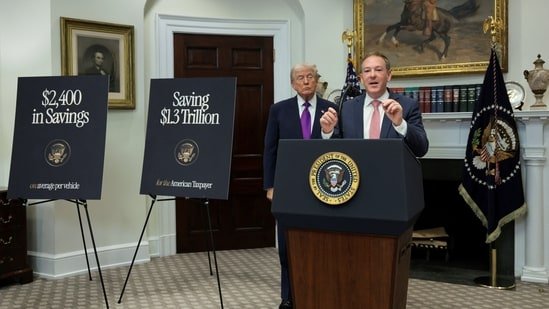
The White House said this would save Americans $2,400 on car purchases. The method is as follows

0

Trump administration says scrapping keys Climate policy in the Obama era The cost of buying a new car will be reduced by an average of $2,400: White House and the Environmental Protection Agency (EPA).

Environmental Protection Agency (EPA) Administrator Lee Zeldin speaks at the White House in Washington, D.C., accompanied by U.S. President Donald Trump. (Reuters)

The move repeals a 2009 “hazard finding” that allowed the EPA to regulate greenhouse gas emissions from vehicles starting with the 2012 model year, the New York Post reported.

What is the cancellation policy?

The hazard finding, proposed by former President Barack Obama, allows the EPA to measure and limit emissions of carbon dioxide, methane and other greenhouse gases from cars and engines.

president Donald Trump EPA Administrator Lee Zeldin announced the repeal of the rule this week, arguing that it places a heavy compliance burden on manufacturers.

“Manufacturers will no longer have the burden of measuring, compiling or reporting greenhouse gas emissions from vehicles and engines,” Zeldin said at the White House.

Also read: ‘Trump pooped his pants…’: Climate activists’ big statement after Oval event ends abruptly

How to save $2,400 per vehicle?

The government believes that removing emissions compliance requirements will significantly reduce production costs for automakers.

The EPA said “regulatory compliance costs” were avoided and “costs associated with purchasing associated equipment were avoided.” [electric vehicles]”It will help reduce car prices.

“Gas prices will stay low and car prices will go down because of this move,” Steve Milloy, a former Trump EPA transition adviser and senior fellow at the Energy and Environmental Law Institute, told the New York Post.

He added that “lower gas prices and lower car prices will impact the economy for decades to come.”

The government also said the start-stop engine function introduced under the emissions framework is no longer needed: a change that some industry figures say reduces manufacturing complexity and costs.

Also read: Trump withdraws U.S. from dozens of international U.N. entities, including key climate ones

Industry reactions and warnings

“We appreciate the work President Trump and Commissioner Zeldin have done to address the imbalance between current emissions standards and customer choice,” a Ford Motor Company spokesperson said.

However, industry leaders warned that price cuts may not happen immediately. Tim Pohanka, vice president of Pohanka Automotive Group, told the New York Post: “Are we going to see $2,400 off the price of the car immediately? Probably not.”

Auto analyst Lauren Fix added that “every car brand will be slightly different,” but she described the move overall as “a win to make cars more affordable.”

‘We have an advantage’: Varun Chakaravarthy makes bold claim ahead of T20 World Cup match against Pakistan Cricket News

0

'We have an advantage': Varun Chakaravarthy makes bold claim ahead of T20 World Cup match against Pakistan
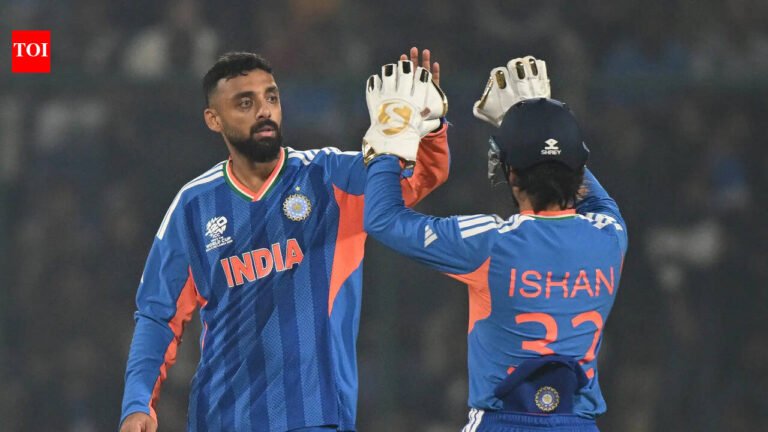
Varun Chakravarthy and Ishan Kishan. (Getty Images)

New Delhi: India’s 93-run win over Namibia not only cemented their spot at the top of Group A but also set the tone for the high-stakes clash against Pakistan scheduled for Sunday in Colombo, with enigmatic spinner Varun Chakaravarthy emerging as one of India’s biggest weapons ahead of the match.Push boundaries with our YouTube channel. Subscribe now!After the comprehensive victory, Chakravarty expressed confidence in India’s spin prowess and hinted at the psychological advantage the team has in this nail-biting match. “We have a strong spin attack and I feel we have an advantage over them,” he said, adding that belief and confidence are key going into the World Cup.

T20 World Cup | Ishan Kishan Press Conference: Fifty vs Namibia, India batting collapses

He acknowledged that Pakistan could benefit from familiarity with Sri Lanka’s conditions, but stressed that India’s preparations and recent dominance gave them momentum.India’s victory builds on explosive half-century Ishan Kishan and Hardik PandyaThe Namibia skipper powered the team to 209/9 despite taking four wickets Gerhard Erasmus. Namibia posed a threat early on in the chase, posting 57/1 in the Powerplay, but the introduction of spin decisively turned the game around. Chakaravarthy’s figures of 3/7 in two overs, supported by Axar Patel (2/20), bowled Namibia out for 116.

polling

How confident are you about India’s chances of beating Pakistan?

The Indian spinner looks back on his evolution, revealing how technical tweaks – more over-spin, higher revs and faster changes – have enhanced his threat. “In international matches, I don’t have enough space to get back into rhythm. From the first ball, I have to aim,” he said, explaining that improving existing passes rather than constantly adding new ones has been key to his recent success.Chakravarty also admitted that the pitches in Delhi and Mumbai were surprisingly subdued, forcing the bowlers to adapt quickly. He believes Dew can play a decisive role in Colombo but his IPL experience has prepared him for such challenges.“Dew does play a big role when you bowl second and sometimes it plays a big role if you have to defend. There was a lot of dew today too but we were able to do well. But we also have experience because we have played a lot of IPL and we know how to bowl if dew comes in,” he said before the Pakistan match.With two wins in two games and confidence growing within the squad, India now turn their attention to their fiercest rivals.

SC to court: Show courage to drop case before trial if evidence is not sufficient | India News

0

SC to court: Show courage to drop case before trial if evidence is not strong

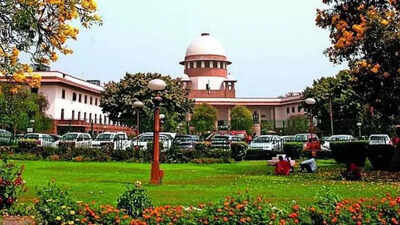
New Delhi: The Supreme Court on Thursday said criminal proceedings bring stress and social stigma, urging courts, especially trial courts, to show “clarity and courage” within the framework of the charge itself and discharge the accused when material on record fails to establish a prima facie case.Justices Sanjay Karol and NK Singh said the judicial process itself should not become a punishment and courts must always be mindful of the human consequences of their decisions and the trust placed in them by society. The court released the person under the SC/ST Act and passed the order after finding that the person did not meet the elements of the offense under the special law, but allowed the trial court to proceed with the offense under the IPC.The Supreme Court said charges will be filed only when the court forms an opinion that there is reason to presume that the accused committed an offense and said the HC should also seriously consider the plea of ​​release instead of rejecting it mechanically.“…At the stage of laying charges or considering release, the courts are not dealing with abstract legal exercises. They are dealing with real people, real anxieties and the real weight of a criminal prosecution. The duty of justice at this stage requires care, balance and honesty in treating the facts on record. The power to lay charges does not Meant to be exercised by default or simply out of caution. The law expects when material before the court, on its face, does not disclose the elements of an offence. Justice Carroll, who wrote the judgment, said: “The court must have the clarity and courage to say something like this and put this type of case aside. “ The bench said the dismissal was not a technical indulgence “but a necessary safeguard”.“Courts must consciously distinguish between genuine cases worthy of trial and cases based solely on suspicion or assumption or without any basis. Allowing a case to proceed without a prima facie case will expose a person to the stress, shame and uncertainty of criminal proceedings without the legal necessity to do so. Fidelity to the rule of law requires courts to remember that if this responsibility is not carefully discharged, the process itself can become punitive. “The judges said the trial court had the greatest responsibility. “For a litigant or an accused, the trial court is not just a level in the hierarchy. It represents the face of the judiciary itself. The sensitivity, fairness and legal discipline displayed at this stage shape the ordinary citizen’s understanding of justice. The impression created by the trial court through its attitude towards facts and law tends to become the impression one has on the judicial system as a whole. This is why at every stage, especially at the threshold, the trial court must always be alert to the impact of its judgments on people and the trust placed in them by society,” it said.

Iceland’s iconic black sand beach is undergoing a shocking transformation; here’s why | World News

0

Iceland's iconic black sand beach is undergoing a shocking transformation; here's why

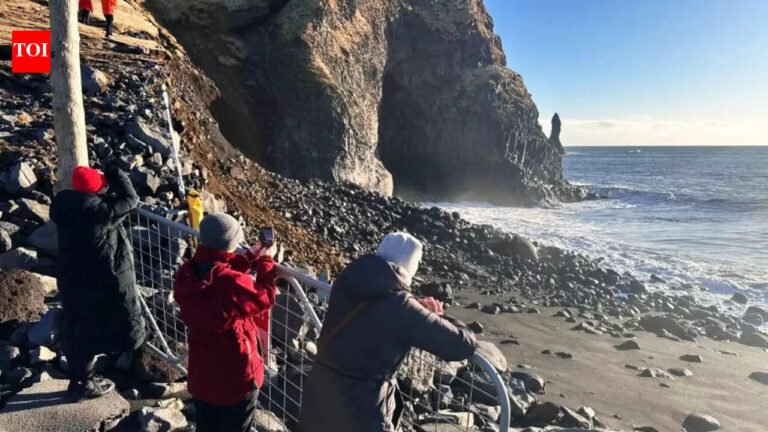
Iceland’s famous black sand beach always feels a bit unreal. It was as black as coal and surrounded by cliffs. Being buffeted by Atlantic waves doesn’t work too well. For years, tourists have stood on the shores of Reynisfjara Beach, staring at the basalt columns and taking photos that look almost unreal. It’s one of those places that seems permanent. In just a few weeks, however, much of the iconic black sand appears to have disappeared. As quoted, swept away and dragged into the North Atlantic arctic portal. The Icelandic Tourist Board has long described it as one of the country’s most dangerous destinations. Sneaker waves, those sudden and powerful waves that have swept tourists out to sea before. There have been multiple deaths over the years, including one in the summer of 2025. Now, erosion may add another risk!

Iceland’s black sand beach nears ‘extensive erosion’: report

Reports from Iceland indicate that strong winds and strong currents have blown away large swaths of the coastline from Reynisfjara Beach. According to reports, what was once a wide, dramatic expanse of black volcanic sand has now become narrow strips in places. Environmental changes have been described as “widespread erosion”. The appearance and accessibility of the beach is said to have changed dramatically.Locals say the transformation is such that the towering basalt columns that once stood high above the sand now rise almost directly out of the sea. These formations, formed by ancient volcanic activity, used to be easily accessible on foot. Now they looked closer to the crashing waves.

What could be the reason for the disappearance of sand?

Experts near Reynisfjara beach point out that this winter’s wind pattern is unusual. Sigurður Sigurðarson, a coastal engineer from the Icelandic Highway Administration, explained to the Icelandic media that easterly winds have been dominant recently. This is not typical.Typically, southwesterly winds push sand eastward along Iceland’s south coast. This winter, that pattern appears to be reversing, with reports of easterly winds pushing sand westward. Nearby Reynisfjall juts into the sea. As the sand moves westward, it hits a natural barrier and stops. In this case, Reynisfjara is unable to receive fresh sand from the east. So the beach shrunk. Experts say it’s unclear whether the sand will reappear. It all depends on future wind direction and wave patterns.

Big injury blow for Zimbabwe: Brendan Taylor ruled out of T20 World Cup Cricket News

0

Zimbabwe suffers major injury blow: Brendan Taylor misses T20 World Cup
Brendan Taylor in Zimbabwe (AP Photo)

Zimbabwe suffered a major setback in the ongoing global tournament as veteran wicketkeeper-batsman Brendan Taylor was ruled out of the tournament due to an injury sustained earlier in the week. The veteran campaigner limped out of the group stage match against Oman on February 9 when Zimbabwe won by eight wickets, but he will now no longer feature due to concerns over his fitness.Push boundaries with our YouTube channel. Subscribe now!team leader Sikandar Raza The development of the toss was confirmed ahead of the game against Australia and it was revealed that the 40-year-old will no longer feature in the game. “Brendan Taylor was injured and he was ruled out of the game,” Raza said at the time of the pitch.

T20 World Cup | Ishan Kishan Press Conference: Fifty vs Namibia, India batting collapses

Against Oman, Taylor struggled to get runs between the wickets and was eventually forced to retire after scoring 31 runs off 30 balls in the chase. The exact nature of the injury has not been disclosed, but given his importance to the team, team management has chosen not to risk further injury.Taylor’s absence has left a huge void in Zimbabwe’s batting order and leadership. The veteran has been a cornerstone of the team across formats since making his debut in 2004, playing 36 Tests, 207 ODIs and 59 T20Is. His recent injury withdrawals – including three in the last five T20 innings – have raised fitness concerns, making the latest setback particularly painful for the team.Zimbabwe forward Richard Ngarava is also not part of the Australia squad and Raza clarified that despite the positive scan, the left-armer was only resting as a precaution. With key players missing, Zimbabwe now face a challenging path as they try to maintain momentum and remain competitive against stronger opponents.

CEO Matt Shumer defends his chilling article on artificial intelligence, saying it wasn’t written to ‘scare people’

0

After his outspoken warnings about the rapid development of artificial intelligence captured the attention of millions of people, CEO Matt Schumer admitted the public reaction to his article was “much more extreme” than he expected. Schumer’s original article warned that the world was entering a chaotic phase that could dwarf the impact of the pandemic. In a follow-up, he emphasized that he did not write this article to scare people, but because he believed that everyone has the right to know in advance “so that they can at least spend a little time thinking and preparing.”

Matt Shumer's article focuses on advances in artificial intelligence. (X/@mattshumer_)
Matt Shumer’s article focuses on advances in artificial intelligence. (X/@mattshumer_)

“To be very, very clear: I’m not writing this to scare people. I just think it’s our responsibility (as people) AI space) to share what we are seeing so people can at least understand what may have happened,” Schumer tweeted.

Also read: The AI ​​model’s shayari fooled millions of viewers, with the video racking up 28 million views. It is copied from

In the next few lines, he continues, “Even if there is a small chance that things will turn out the way I and many others expect, people have the right to know in advance so that they can at least spend a little time thinking and preparing.”

He admitted that his work was more popular than he expected. “This is spreading much more quickly than I thought… and people’s reactions are much more extreme than I expected.”

“We’re likely to be entering a very strange new world in the next few years (or we may not be!), and I think it’s important for people to spend at least a moment thinking about what that means for them and how they should prepare,” he said.

He concluded his post by adding: “If nothing else, I’m glad this post got people talking about this stuff.”

Why did Matt Shumer publish his paper?

Since Schumer published his article titled “Big Things Are Happening,” many people have tagged Schumer and shared their thoughts on the article. While many agree with his views on AI disruption, others believe he is exaggerating.

The New York CEO defended his article in response to a post from a techie who called him an “AI OG” and agreed with him. Teddy on To a few thousand people in the bubble (whatever you want to call it), some of this sounds obvious. But there’s a whole different world out there that doesn’t quite understand what’s coming and how big of a deal this is. “Now the shockwave is coming. “

What is “Something Big is Happening” about?

Matt Shumer’s article “Big Things Are Happening” is a grim “weather forecast” from the AI ​​front. Comparing the current moment to the false calm of February 2020, Schumer warned of the gap between public perception and the actual capabilities of artificial intelligence.

Also read: The lingering question for OpenAI technologists: “What else can humans do when AI gets too good?”

He revealed that for top developers, “disruption” has arrived; artificial intelligence is no longer just a tool, but a colleague capable of independent judgment, complex coding, and even building the next generation of itself. Schumer urged people to adapt to this new change.

FOGSI seeks removal of NEET-PG percentile cuts, flags ‘pay to enter’ risks India News

0

FOGSI seeks removal of NEET-PG percentile cut, flags 'pay to enter' risk

New Delhi: The Federation of Obstetrics and Gynecology Societies of India (FOGSI), which represents clinicians and academicians committed to maintaining high standards of medical education and patient care, has sought an immediate review and reversal of the practice of repeatedly lowering NEET-PG eligibility percentile.In a statement released on February 11, FOGSI expressed serious concern that lowering the eligibility threshold for national merit-based examinations would weaken meritocracy and compromise academic rigor, raising concerns about the quality of specialist training and patient safety.The agency urged the National Medical Council, particularly its Committee on Graduate Medical Education, to urgently revisit the policy.FOGSI noted that the NEET-PG Information Bulletin has formulated a structured and transparent algorithm for filling vacant seats, including category conversion and sequential counseling rounds. The report said these mechanisms must be strictly adhered to and exhausted before lowering eligibility criteria can be considered.Addressing the issue of vacant seats, the federation said the root cause was not lack of strength but the “highly unreasonable and unaffordable” fee structure of several private and deemed universities. With postgraduate fees ranging from hundreds of thousands of rupees to tens of millions of rupees, professional education risks turning into a “pay-to-enter” system where finances trump ability. “Postgraduate medical education is not just about filling seats; it is about producing capable experts who can serve the country for decades,” the statement said, adding that dilution of admission standards and uncontrolled commercialization threaten academic excellence, professional dignity and public trust.FOGSI calls on the authorities to reverse repeated percentile cuts, ensure strict compliance with advisory and seat conversion rules, initiate urgent rationalization and regulation of postgraduate fee structures, and engage with professional associations and academic stakeholders before implementing policy changes with long-term implications.The Federation reaffirms its commitment to safeguarding the merit, affordability, and integrity of medical education in the greater interest of patients and public health.

Usman Tariq: How Pakistan’s mystery spinner became the biggest talking point of T20 World Cup with ‘long pause, two elbows’ | Cricket News

0

'Long pause, two elbows': How Pakistan's enigmatic spinner Usman Tariq became the biggest talking point of the T20 World Cup
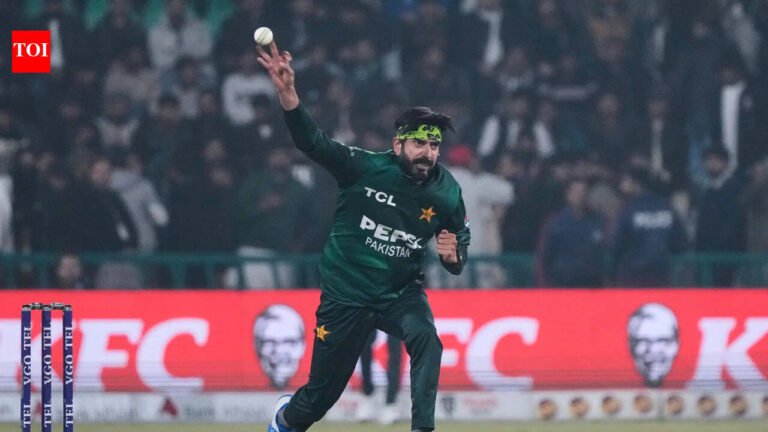
Pakistan’s Usman Tariq (AP Photo)

The focus of ICC Twenty20 World Cup 2026 has turned to Pakistan off-spinners Usman TariqHis unusual movement – a statuesque pause at the crease – sparked debate and confused batsmen. The 28-year-old’s delivery pace, with a noticeable pause before delivering the ball, has become one of the most discussed elements of the tournament, raising questions about the legality, pace and slim edge of modern spin bowling.Push boundaries with our YouTube channel. Subscribe now!Tariq’s rise has not been without controversy. Critics have revisited past reports of questionable behavior, pointing to cricket’s long-standing “15-degree elbow bend” rule, which limits how straight a bowler’s arm can be during a delivery. Although it was reported twice during pakistan super leaguehe was cleared after undergoing biomechanical tests at the National Cricket Academy in Lahore.

T20 World Cup | Ishan Kishan Press Conference: Fifty vs Namibia, India batting collapses

Addressing the issue, Tariq insisted that his behavior stemmed from natural physical characteristics. “I have two elbows on my arm…my arm is naturally bent. My bent arm is a biological problem,” he said, reiterating that the test validated his technique.What really unsettles opponents, however, are the “long pauses” that disrupt timing. Former Pakistan captain Sarfaraz Ahmed explained that short pauses can distract batsmen and even make regular deliveries unpredictable. The effect is obvious, players all like it Cameron Green Dewald Brevis was visibly confused by Tarik’s release point and change of pace.

polling

Do you think Usman Tariq’s bowling action was legal as per the rules of cricket?

Despite the review, the results support the inclusion of spinners. He announced himself on the global stage with three wickets against the United States and has put together an impressive record in early T20Is, including a hat-trick in Rawalpindi. With the game underway in spin-friendly conditions, Tariq’s unconventional moves remain Pakistan’s secret weapon and the hottest debate in cricket circles. Whether viewed as innovative or controversial, his long pauses and biomechanical uniqueness ensured that each of his pitches was treated with equal parts curiosity and suspicion.

UAE announces reduced working hours for public and private sector employees during Ramadan World News

0

UAE announces reduction in working hours for public and private sector employees during Ramadan
UAE reduces official working hours for public and private sector employees during Ramadan/Representative Photo

The UAE has announced reduced working hours for public and private sector employees during Ramadan.

federal government business hours

The Federal Government’s Human Resources Management Authority has confirmed the official working hours of various ministries and federal entities during Ramadan.Monday to Thursday, working hours are 9:00 am to 2:30 pm. On Friday, staff hours are 9:00 a.m. to noon. This schedule applies to federal ministries and entities, except for employees whose nature of work requires otherwise.In a statement posted on its official website, the agency noted that flexible working regulations can continue to apply during Ramadan, provided that the approved daily working hours are adhered to.It also further clarified that federal entities can grant employees the flexibility to work remotely on Fridays. However, remote working must not exceed 70% of the entity’s total workforce and must comply with approved regulations and controls.

private sector working hours

For the private sector, the Ministry of Human Resources and Emiratization announced that daily working hours will be reduced by two hours during Ramadan.Employees in the UAE typically work eight to nine hours a day. During Ramadan, the schedule will be reduced by two hours each day in line with the Islamic holy month.The ministry said private businesses can implement flexible or remote working arrangements within the scope of reduced daily working hours. These arrangements must be consistent with the commercial interests of the company and the nature of its operations.Any additional hours worked after the shortened Ramadan hours will be considered overtime. Employees are entitled to additional compensation for overtime work in accordance with labor regulations.

Flexible remote working provisions

In both areas, authorities have provided room for flexibility while maintaining operational continuity.Federal entities can continue to apply approved flexible working systems during Ramadan working days. Additionally, they may allow remote work on Fridays, subject to a 70% cap.In the private sector, companies can adopt flexible or remote schedules as long as they stay within a reduced daily work time frame.The revised timing is designed to accommodate the spiritual and social rhythms of Ramadan, while ensuring that government services and business operations continue without disruption.