
Home Blog Page 9

BBC’s 72-year Commonwealth Games era ends as Channel 5 secures Glasgow 2026 highlights deal

0

随着第 5 频道获得格拉斯哥 2026 年精彩节目交易,BBC 72 年英联邦运动会时代结束

BBC exits after 7 years, Channel 5 moves into Commonwealth Games coverage / Picture: File

The BBC will not broadcast the Commonwealth Games for the first time since 1954, marking one of the biggest shifts in British sports television in decades. Instead, Channel 5 has secured the rights to broadcast daily highlights from the Glasgow 2026 Commonwealth Games following a sub-licensing deal with TNT Sports.The decision officially ends the BBC’s 72-year unbroken partnership with the multi-sport event, which has endured through generational changes, broadcasting revolutions and the rise of streaming platforms. The move is widely seen as a symbolic moment in the changing landscape of UK sports media.Last year, TNT Sports reportedly outbid the BBC to win live rights to the 2026 Glasgow Olympics. The broadcaster, owned by Warner Bros. Discovery, will now offer more than 600 hours of live coverage on television and streaming platforms, including HBO Max.The Commonwealth Games kick off in Glasgow on July 23, with organizers hoping to spark renewed interest in the event after years of uncertainty surrounding the event’s future.

Why did the BBC walk away?

Behind the decision is a deeper financial crisis facing the BBC and a major shift in its sports strategy.The broadcaster recently announced plans to cut between 1,800 and 2,000 jobs as part of a £500m efficiency plan aimed at dealing with increasing financial pressures. Sports budgets are expected to take a major hit, forcing the company to reconsider which events it can continue to afford.BBC executives reportedly chose not to pursue a highlights package after discussions with TNT Sports. The broadcaster is now prioritizing digital clips and young online audiences over expensive traditional rights deals.BBC director of sport Alex Kay-Jelski is reportedly focused on a digital-first content strategy, specifically football clips and streaming-friendly rights packages. Over the past year, the BBC has pivoted to invest in Bundesliga football, Women’s Champions League coverage, home country World Cup qualifiers, Six Nations rugby and Champions League coverage.Changes in the company’s priorities are already showing up elsewhere. The BBC recently stopped broadcasting university rowing matches, switching to Channel 4, while its upcoming coverage of the 2026 FIFA World Cup will reportedly be broadcast from its Salford studios rather than live in North America.Critics say the loss at the Commonwealth Games raises questions about whether the BBC is slowly retreating from its traditional public service broadcasting role in sport.

Channel 5 expands sports programming portfolio

For Channel 5, the deal represents another big step for mainstream sports broadcasting.Over the past year, the network has aggressively expanded its sports programming portfolio, acquiring rights to England’s men’s T20 cricket internationals, Club World Cup coverage and weekly NFL games. Commonwealth Games highlights further cement its growing position in free sports television.TNT Sports, meanwhile, sees Glasgow 2026 as a major win after losing a number of key assets in recent years, including some international rugby and Champions League broadcast rights. The company currently controls a strong portfolio of Olympic and multi-sport events, including the 2026 Winter Olympics in Milan and the 2028 Summer Olympics in Los Angeles.The Glasgow Olympics itself faces significant uncertainty. Australia was originally scheduled to host the event but withdrew due to rising costs, forcing Glasgow to step in as an alternative host. Despite ongoing financial support from the Australian state of Victoria, the scaled-down campaign is operating under tight financial conditions.Nonetheless, Commonwealth Sports executives insist the event’s future is stabilizing.Chief executive Katie Sadleir described the broadcast partnership as a “landmark moment” for the Games. She also pointed to the recent decision to award the 2030 Commonwealth Games to India as proof that the event still has long-term momentum.

Glasgow 2026

The BBC lost the Commonwealth Games as more than just a sporting event.It reflects a rapid shift in the way UK sports rights are bought, sold and consumed. It is increasingly difficult for traditional public broadcasters to compete financially with global media giants and streaming-focused companies willing to invest heavily in premium sports properties.Broadcasters, meanwhile, are reaching younger viewers through clips, streaming subscriptions and digital engagement rather than long-form TV coverage.However, for millions of British viewers, the Commonwealth Games have long been associated with the BBC’s familiar presentation style, iconic theme music and free viewing across the country. Glasgow 2026 will now test whether audiences are willing to embrace a new era of broadcasting.

Is Iran hacking into U.S. fuel systems? Cyber ​​breach hit gas station tank monitors across states, report says

0

Iranian hackers are suspected of sabotaging fuel tank monitoring systems at gas stations in several U.S. states, CNN reported, citing U.S. officials.

Iran is suspected of hacking into U.S. systems that monitor fuel storage tanks. (generated by artificial intelligence)

Attackers reportedly compromised an automated tank gauging (ATG) system, which was connected to the internet and had no password protection. although hacker Despite being able to manipulate the numbers displayed on some screens, officials said they were unable to change the actual fuel levels in the tanks.

Cyberattacks could hide major natural gas leaks

Security experts and U.S. officials warn that if hackers gain control of these tracking systems, they could theoretically Hide a real gas leak. This is also undetectable.

“Gas stations, tank readers, water systems and industrial controllers may not sound impressive, but they provide attackers with a way to turn technical vulnerabilities into public disruption and operational stress,” Nick Tausek, principal security automation architect at Swimlane, told Security Magazine.

He added that common weaknesses in many of these attacks are “exposed operational techniques and weak remote access.”

Ross Filipek, chief information security officer at Corsica Technologies, said fuel systems have become attractive cyber targets because they directly impact public confidence and supply chains.

“You don’t need to destroy the entire energy sector to create panic,” Filipek told Security magazine. “If fuel acquisition is slowed, stored readings are manipulated, or operators are forced into manual processes, the impact can quickly shift from a technical inconvenience to a real-world operational risk.”

He warned that if such cyber activity spread across the country, it could cause severe supply chain disruption and economic stress. “Operators should view these systems as critical infrastructure rather than back-office equipment,” Filipek added.

Why is Iran viewed with suspicion?

Investigators said Iran was the prime suspect because of its history of targeting these specific gas tank systems, CNN reported. They also said the U.S. government may never be able to formally prove who did it because the hackers didn’t leave enough digital evidence.

If Iran’s involvement is confirmed, it would be Tehran’s latest attempt to target critical U.S. infrastructure in the current situation. US and Israel’s war on the country. Earlier, a group with ties to Iran Handala allegedly used Telegram channel Compromise Gmail accounts associated with senior U.S. officials.

Cyber ​​incidents could also pose a political challenge to Donald Trump’s administration by turning more attention to high oil prices. Strait of Hormuz blockade.

“This is on the verge of a dynamic cyberattack,” Exabeam chief information security officer Kevin Kirkwood told Security Magazine. He said the incident “had nothing to do with the gas station actually,” but instead showed that cyberattacks are increasingly focused on real-world operating systems rather than just data theft.

“As organizations adopt more artificial intelligence, agents and digital workers to automate decision-making and operations, the risk increases that compromised data or manipulated systems could trigger larger-scale operational disruptions at machine speeds,” Kirkwood said.

Iran’s growing cyber capabilities

Since the United States and Israel War against Iran begins on February 28U.S. officials say hackers linked to Tehran caused a series of disruptions.

Yossi Karadi, director of Israel’s National Cyber ​​Directorate, told CNN that Iran’s cyber activities during the war “increased significantly in terms of scale, speed and integration between cyber operations and psychological warfare.”

Experts say Iran’s tactics are evolving rapidly. Allison Wikoff, director of PwC’s threat intelligence team, told CNN that Iran’s cyber operations are “now iterating at an accelerated pace, with more layered hacktivist roles and an expansion of reconnaissance and phishing that may be powered by artificial intelligence.”

She added that they were rapidly creating “good enough” harmful software and launching campaigns to steal and exfiltrate civilian infrastructure and media data.

Gabrielle Hempel, security operations strategist at Exabeam, said modern conflicts are increasingly moving to cyberspace. “A large part of the next war will be fought online,” Hempel said. “You no longer have to use power to ‘blow something up’ to create instability.”

She added that attacks on fuel monitoring systems fall in a “grey area between nuisance and lawful sabotage”.

UN event highlights India-Oman maritime ties with maiden voyage of stitching sailboat

0

United Nations, Indian Navy The maiden voyage of the Indian Navy’s traditional stitched sailing vessel INSV Kaundinya from Porbandar to Muscat was highlighted at a United Nations event, with speakers highlighting centuries-old maritime traditions and cooperation amid tensions affecting global shipping routes.

UN event highlights India-Oman maritime ties with maiden voyage of stitching sailboat

The Permanent Mission of India to the United Nations and the Permanent Mission of Oman to the United Nations co-organized an event titled “Ancient Trade Routes: A Journey to INSV Kaundinya” at the United Nations Headquarters on Friday.

Indian Navy Commodore Amit Srivastava, captain Lieutenant Colonel Vikas Sheoran and expeditionary officer Lieutenant Colonel Y Hemant Kumar attended the event and delivered speeches.

India’s Permanent Representative to the United Nations, Parvatanini Harish, said in her speech: “This is an important moment. Every day we talk about some kind of maritime crisis that affects us, our countries and our citizens, but we also have a centuries-old maritime tradition of peaceful trade and commerce, and centuries of exchanges.”

Although Ambassador Harish did not mention this directly, his remarks appeared to refer to concerns about the chaos surrounding the Strait of Hormuz during the ongoing conflict in West Asia. About one-fifth of the world’s energy supply passes through narrow waterways.

The Indian Navy sailing ship “Kaundinya” is an indigenously built traditional stitching sailing ship of the Indian Navy. It made its first overseas voyage from Porbandar, Gujarat to Muscat, Oman on December 29, 2025.

The Permanent Mission of India to the United Nations said the voyage of the INSV Kaundinya, a quilted plank sailing ship inspired by ancient Indian shipbuilding traditions, highlights India’s ancient maritime trade routes across the Indian Ocean, connecting India with the Arabian Peninsula and East Africa.

“These ancient trade routes highlight India and Oman’s long-standing role as responsible maritime civilizations,” the report said.

Stressing that India and Oman’s maritime ties go back centuries, Harish said the event highlighted that “the ocean connects us as it always has”.

“As the world debates how to manage and protect shared ocean spaces, it is worth remembering that the peoples of our region were doing so through trade, trust and regular exchanges and contacts long before modern international law and the law of the sea really took shape,” he said.

Harish further said that the United Nations Convention on the Law of the Sea provides a legal framework for governing the world’s oceans today, “but a framework works best when it is based on genuine common purpose and trust.”

“Events like this help build that sense of purpose. They remind us that the ocean is a common space that belongs to us all and must be protected by all of us,” he added.

INSV Kaundinya sailors shared details of a recent expedition tracing ancient Indian Ocean trade routes with United Nations envoys, officials and dignitaries.

Omar Saeed Omar Al-Katiri, Permanent Representative of the Sultanate of Oman to the United Nations, said, “Through INSV Kaundinya’s extraordinary voyage, we are reminded of the deep-rooted and cherished relationship between our two countries, which has flourished for centuries in the heart of the Indian Ocean.”

“Our maritime history provides valuable lessons for current and future ocean governance. The cooperative spirit of Oman-India relations inspires us to work together and manage ocean resources and protect biodiversity,” he said.

Alkatiri said the ship was greeted with enthusiasm and admiration when it arrived in Omani waters, “reminding us of our shared history” and laying the groundwork for renewed cooperation.

He said the voyage highlighted the importance of cultural exchange and fostering trust, innovation and resilience.

“It honors the legacy of our ancestors by inviting us to work together to protect the ocean for future generations,” Alkatiri said.

This article was generated from automated news agency feeds without modifications to the text.

Future megadroughts could be worse than we thought – New Zealand’s past shows why

0

HAMILTON: For an agricultural country like New Zealand, severe drought is one of the most ominous consequences of a warming planet.

Future megadroughts could be worse than we thought - New Zealand's past shows why
Future megadroughts could be worse than we thought – New Zealand’s past shows why

The Committee on Climate Change’s latest national risk assessment notes that these events are becoming more severe over time, particularly in the country’s drier north and east.

Recent events have given us a glimpse of what it all looks like: brown paddocks, shrinking reservoirs, dry riverbeds and farmers struggling for feed. They also illustrate the severe economic damage that drought can cause.

An ongoing drought in 2007-08 hit the Waikato particularly hard, causing feed shortages and quadrupling silage prices, costing the national economy billions of dollars.

Another drought four years later covered the entire North Island and was later estimated to have reduced national economic output by up to 0.7% of GDP.

The Reserve Bank has since considered the 2012-13 event as a possible worst-case drought scenario in some agricultural lending risk assessments.

But looking further back in history, we find evidence of more severe meteorological droughts (long periods of abnormally low rainfall) that occurred in the early 20th century.

Our new research shows that some of New Zealand’s most extreme drought history has actually been ignored in modern policymaking.

Reconstructing New Zealand’s drought history

When scientists and planners assess the severity of droughts, they often rely on data sets called virtual climate station networks. It uses rainfall, temperature and other weather observations to provide a detailed look at climate conditions across New Zealand.

While this is an invaluable tool, reliable data on many variables only date back to the 1970s. This means that many modern drought assessment methods are less useful for understanding the severe events that occurred in the early 20th century.

To get a clearer picture of these early droughts, we focused on a reliable indicator: the rainfall deficit. Thousands of rain gauges across New Zealand were recording this data as early as the 1860s.

Next, we selected weather stations with long-term reliable records, including at least 70 years of data and observations before 1914. This creates a nationwide network of 97 high-quality weather stations.

Finally, we compare historical rainfall data to long-term averages to understand how drought conditions develop over weeks, months, and longer periods of time.

Contrary to the belief that New Zealand’s most severe events have occurred in recent decades, the results show that the three most extreme meteorological droughts in the instrumental record all occurred before 1950.

Forgotten Daqian

The most widespread and severe drought began in the winter of 1914 and lasted until at least February 1915. Most weather stations recorded the worst rainfall deficits on record between July and October, with severe shortfalls continuing throughout much of the North Island and eastern South Island throughout the summer.

Nationally, no other eight-month period can compare. More than half of the sites recorded one of the five driest periods on record, with the following July-February period ranking second, suggesting an unusual multi-year drought sequence.

New Zealand has experienced similar late-winter droughts recently, particularly in 1993, when Auckland’s reservoir capacity dropped to about a third during the city’s water crisis. But a drought on the scale of 1914-15 could have a more serious impact.

Looking specifically at summer droughts, the period from July to February 1908 saw the most widespread extreme rainfall deficit in recorded history.

Many weather stations in the South Island are experiencing the driest conditions on record, with more than double the number of stations recording extreme drought compared to the second worst summer drought in 1945/46.

[1945-46年的干旱在北岛北部和东部也很突出,许多气象站都出现了有记录以来最严重的降雨短缺。这些地区的降雨量短缺比人们记忆最深刻的2012-13年干旱期间增加了约22%。

被低估的风险

最近的干旱经历与这些早期历史极端事件之间的差距是惊人的,这凸显了超越过去几十年的重要性。

新西兰气候历史上已经存在过比近期记忆中经历过的严重得多的干旱。

然而,许多现代风险评估仍然严重依赖最近发生的事件,可能低估了该国可能经历的干旱变化的真实规模。

气候变化增加了另一层风险,气温上升预计将进一步导致土壤干燥,并在长期干旱期间增加蒸发,从而加剧影响。

所有这些都意味着最近的干旱可能不再为未来的情况提供可靠的指导。

气候变暖可能会使新西兰陷入人们记忆中从未经历过的干旱状况——未来的规划和风险评估需要紧急考虑这一点。 GRS

GRS

本文是根据自动化新闻机构提要生成的,未对文本进行修改。

Who is Amber Randolph Vargas? Gypsy Rose donates to laid-off Spirit employee slammed by James Charles

0

gypsy rose Blanchard sparked another online controversy this week when she donated to a former donor. spirit airlines staff. Employee publicly mocked by beauty influencer james charles Request via GoFundMe.

Gypsy Rose Blanchard donated more than $500 to Amber Lendof Vargas, the former Spirit Airlines employee once mocked by James Charles. (X and (Photo by LISA O'CONNOR/AFP))
Gypsy Rose Blanchard donated more than $500 to Amber Lendof Vargas, the former Spirit Airlines employee once mocked by James Charles. (X and (Photo by LISA O’CONNOR/AFP))

According to TMZ, Blanchard donated more than $500 to former Spirit Airlines employee Amber Lendof Vargas, who lost her job after the budget airline shut down earlier this month.

Vargas was laid off along with more than 17,000 other people when the famous low-cost airline shut down earlier this month. After his layoff, Vargas created a GoFundMe page to support himself financially.

Read more: Twitch star ExtraEmily takes indefinite break after viewbot controversy

What is the James Charles controversy?

The controversy began after Vargas, an operations agent at Boston’s Logan Airport, allegedly sent Charles a direct message asking him to share or donate to her GoFundMe campaign after he was fired following the collapse of Spirit Airlines operations.

In a TikTok video that went viral, Charles mocked the request. He called the woman “lazy” and “entitled” to help instead of finding another way out.

He also questioned why he would help her and accused her of thinking celebrities and influencers should be supporting her. Charles later deleted the video and publicly apologized, admitting his reaction was “privileged” and “completely unnecessary,” TMZ reported.

Vargas later said publicly that she did not accept the apology. She also noted that the backlash against James Charles has dramatically increased attention on her fundraising efforts and social media accounts. Just Jared said her GoFundMe donations surged after the controversy erupted online.

Read more: Did Candace Owens raise the idea that Trump might have murdered Charlie Kirk?

Why is Gypsy Rose donating to the GoFundMe for former Spirit employees?

The controversy gained attention and reached Gypsy when TMZ reported that she donated to GoFundMe.

In a $500 note to Vargas shared by the outlet, Gypsy wrote: “Hi my name is Gypsy Rose Blanchard and I am an influencer on TikTok. I have 9.3 million followers and I am very sorry for what happened and I am sending out a lot of positive messages.”

To get her followers to donate, Gypsy also posted a GoFundMe link on her page.

Gypsy later clarified to TMZ that she initially believed her donation information would remain private between her and Vargas. “At the end of the day, I don’t want it to be about me because it’s not about me,” she said.

After seeing James Charles’ reaction online, Gypsy told TMZ, “The point I make is, just because someone has a large following, it doesn’t mean they have the right to bully other people.”

Gypsy said she has personally helped struggling followers before and believes that having a big platform comes with responsibility. In a video shared online, Gypsy said she tried to “see the humanity” behind those who sent her messages asking for help.

Hunter Rivera: Weld County Republican Chairman arrested 5 in child predator operation

0

Weld County Republican Party Chairman Hunter Rivera was one of two people arrested from upstate. colorado allegedly attempted to purchase sexual behavior from children. They were arrested on Thursday.

Hunter Rivera had to resign as chairman of the Weld County Republican Party. (Larimer County Sheriff's Office)
Hunter Rivera had to resign as chairman of the Weld County Republican Party. (Larimer County Sheriff’s Office)

The Larimer County Sheriff’s Office said investigators were posing as minors to sell sex acts on local websites and forums. Several people responded to the listing, and two of them arrived at the agreed-upon location to solicit prostitution. Deputies arrested them and booked them into the Larimer County Jail statement notes.

In addition to Rivera, the other person arrested was Ismaaeel Abdur-Rahmaan, 22, of Fort Collins. Larimer County Court issued a $7,500 cash-only bond. The statement further stated that he was charged with soliciting a child prostitute (F3), Internet luring of a child (F4), cybercrime – solicitation and arranging of an underage prostitute (F5), and attempted sexual assault of a child (F5).

ALSO READ | Who will replace Eric Swalwell and Tony Gonzalez? Everything we know about sexual misconduct allegations

Sheriff John Feyen firmly stated “Children are not property to be bought and sold. Human beings” trafficking This is modern day slavery and we will not tolerate it in Larimer County. I hope this operation sends a strong message. No matter who you are, if you try to harm the children of our community, you will be held accountable. “

Colorado House and Senate Republicans also called on Rivera to resign, calling the accusations “disgusting, horrific and undeniable.” “There is no defence, no excuse for anyone who preys on children and there is no place in our party anywhere close to public life where this would be tolerated,” they said, adding: “There is no room for such accusations in our party.”

Here’s everything you need to know about Hunter Rivera.

Hunter Rivera: 5 things to know

  1. Rivera is a second-generation Weld County native. He is 24 years old and from Windsor.
  2. Rivera’s passion for politics and conservative leadership began in high school, when state Sen. John Cook dropped in to take a political science class there, according to a profile on the Weld County Republican Party page. He has since visited the state Capitol, cementing Rivera’s commitment to public service and the Republican Party.
  3. At 17, Rivera joined the Northern Colorado Young Republicans and quickly assumed a leadership role. During the 2020 election cycle, Rivera worked for Weld County Sen. Cory Gardner’s campaign while volunteering for numerous state and Senate races. Soon after, state Sen. Barbara Kirkmeyer hired Rivera as a legislative assistant, which helped him gain first-hand experience in policy development at the Colorado Statehouse.
  4. Since then, Rivera has worked for Republican leaders including Mike Lynch and Ryan Armagost. In 2022, he worked for the Colorado Republican National Committee as a field organizer for the state’s 8th Congressional District. In 2024, he served as campaign manager for State Board of Education Yazmin Navarro’s campaign, campaign manager for Ryan Gonzalez’s House District 50 campaign and chief strategist for Dan Woog’s Healing Project. Before resigning, Rivera served as national committee member of the Colorado Young Republican Federation in addition to serving as chairman of the Weld County Republican Party. According to his bio, “In these positions, he focused on expanding grassroots participation, strengthening the party’s presence and ensuring that Weld County remained a Republican stronghold.”
  5. Rivera faces multiple charges such as solicitation of a child prostitute (F3), Internet luring of a child (F4), cybercrime – solicitation of an underage prostitute (F5), and attempted sexual assault of a child (F5). He was given a $6,500 cash-only bond.

Trump returns from China; holds talks with Xi Jinping as “G-2”

0

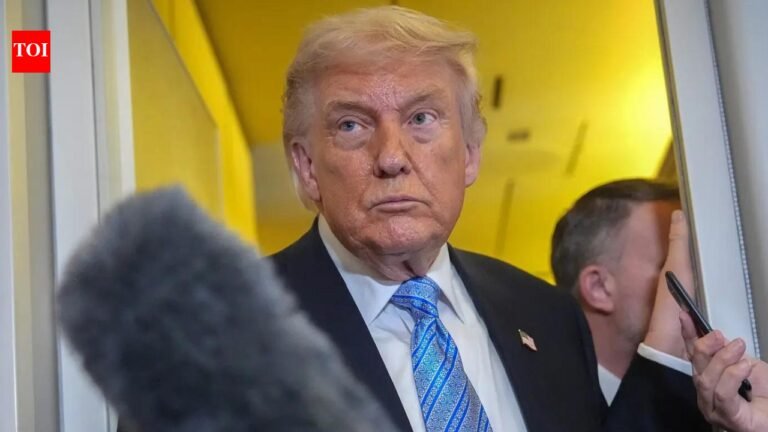
WASHINGTON: US President Donald Trump, returning from a visit to China, described his talks with President Xi Jinping as a meeting between the leaders of “two great countries.”

Trump returns from China; holds talks with Xi Jinping as
Trump returns from China; holds talks with Xi Jinping as “G-2”

On Friday night, Trump landed at Joint Base Andrews in Maryland, a suburb of the U.S. capital, claiming important trade deals had been reached, including China’s purchase of 200 aircraft from Boeing and a commitment to buy 750 more planes, as well as agreements that would benefit the U.S. agricultural sector.

The President of the United States arrived here after a brief refueling stop in Anchorage, Alaska.

“These are two great countries. I call it the G-2. This is the G-2. I think this is going to be a very important moment in history,” Trump told Fox News in an interview after meeting with Xi Jinping on Thursday.

The Washington Post reported that Trump’s speech put China and the United States on equal footing, which is the purpose of Xi Jinping’s visit.

“The two-day meeting, with carefully choreographed pageantry and gestures of friendship and respect between the two most powerful men in the world, showcased a geopolitical dynamic that the Chinese have long desired and Americans have resisted,” the Washington Post said.

Trump told Fox News that the relationship with Xi Jinping is important and suggested that China may not take any aggressive action against Taiwan, at least until he takes office.

“This is not a takeover. They just don’t want to see this place – we call it a place because no one knows how to define it – but they don’t want to see it independent,” Trump said.

“When I’m here, I don’t think they’re going to do anything. When I’m not here. To be honest, I think they’re probably going to do anything,” Trump said.

“I hope they calm down. I hope China calms down,” he said.

“We don’t want a war and if the status quo remains, I think China will accept it,” he added.

The US president said he has invited Xi Jinping to visit Washington in September.

“Xi Jinping has done what Chinese leaders have been trying to do for decades — bring an American president to Beijing as an undisputed peer,” said Julian Gewirtz, who served as China director on the National Security Council under President Joe Biden.

“Xi Jinping used the gorgeous visuals of this visit to show the world that China and the United States are two dominant and evenly matched superpowers. There is no turning back.”

The New York Times quoted John Drewry, a senior fellow at the Asia Society, as saying that Trump’s friendly remarks about Xi Jinping and the Chinese people were amplified in Chinese state media, sending the message that “we get along better with Americans.”

The New York Times quoted Nicholas Burns, the ambassador to China during the Biden administration, as saying that it is understandable that Trump wants to be polite to Xi Jinping, but the US president’s garrulous approach “weakens Trump and the United States.”

“Xi Jinping did not hesitate to warn Trump about Taiwan. Trump should also not hesitate to confess our concerns,” he said.

Trump and Xi Jinping are expected to meet at least three times this year.

The US president has invited Xi Jinping to visit the White House in September.

Trump may travel to Shenzhen, China, to attend the Asia-Pacific Economic Cooperation Conference in November. Xi Jinping is likely to attend the G20 summit in Miami in December.

“This is yet another summit that is more symbolic than substantive – focused on managing issues rather than resolving the problems that exist between the United States and China,” said Rush Doshi, the former deputy senior director for China and Taiwan on the National Security Council in the Biden administration.

“The way both leaders are talking about the future suggests that this is going to be part of the process that’s going to unfold this year,” said Kurt Campbell, a former deputy secretary of state in the Biden administration.

This article was generated from automated news agency feeds without modifications to the text.

Is Operation Epic Wrath coming back? Donald Trump considers new strikes on Iran after China visit: report

0

Is Operation Epic Wrath coming back? Donald Trump considers new strikes on Iran after China visit: report
File photo: U.S. President Donald Trump

President of the United States Donald Trump Returning from China on Friday, top aides, facing mounting pressure over the war with Iran, are preparing options for new military action against Tehran if diplomacy fails.Pentagon officials have drafted plans for possible resumption of strikes in new military operations after suspending Operation Epic Fury during a ceasefire in April, The New York Times reported. However, Trump has not yet made a final decision.“I look at it and if I don’t like the first sentence, I’m going to throw it out,” Trump told reporters aboard Air Force One, referring to Iran’s latest peace proposal.The United States, Israel and regional officials are trying to reach a compromise that could lead to Iran reopening the Strait of Hormuz, allowing Trump to claim a diplomatic breakthrough amid growing domestic criticism of the costly conflict.

Pentagon prepares upgrade options

War Secretary Pete Hegseth told lawmakers this week that the U.S. military “plans to escalate operations if necessary” while also retaining the option of scaling back deployments.The Pentagon has prepared a variety of military scenarios, including an intensified bombing campaign targeting Iranian military and infrastructure sites, the report said.Another option is reportedly to deploy U.S. special operations forces to protect highly enriched uranium believed to be stored deep underground at Iran’s Isfahan nuclear facility.According to the New York Times, hundreds of special operations personnel were deployed to the Middle East earlier this year to prepare for such emergencies. However, officials acknowledged that any ground operation would carry a “significant risk of casualties” and would require thousands of support troops.At the same time, Iran said it was ready to resume hostilities. “Our armed forces are ready to respond appropriately to any aggression,” said Iranian Parliament Speaker Mohammad Bagher Ghalibaf.

The Strait of Hormuz remains the center of attention

The Strait of Hormuz remains at the center of the crisis, with Iran refusing to fully reopen the main oil shipping route and the United States maintaining a blockade.After talks with Chinese President Xi Jinping, Trump said both Washington and Beijing agreed the strait must be reopened.“We don’t want them to have nuclear weapons, we want the straits open,” Trump said in Beijing.Trump said his patience with Iran had “run out” and warned Tehran to “make a deal.”However, China has not publicly stated that it will directly pressure Iran.Iranian Foreign Minister Abbas Araqchi said Tehran remains open to diplomacy but no longer trusts Washington after air strikes followed previous talks.

There remains a large military presence in the area

More than 50,000 U.S. troops, two aircraft carriers, several destroyers and multiple fighter jets remain stationed in the area.U.S. Gen. Dan Kaine said military officials “reserved and continue to maintain a range of options for our civilian leaders,” the report said.Despite weeks of attacks, U.S. intelligence assessments indicate Iran has restored access to most of its missile launch facilities and underground military infrastructure.The report also states that Tehran has regained operational access to 30 of the 33 missile bases along the Strait of Hormuz.Oil prices continued to rise amid fears of escalating tensions. Brent crude rose about 3% to nearly $109 a barrel, while concerns about prolonged disruptions to Gulf shipping routes pushed U.S. Treasury yields to their highest levels in about a year.

Candace Owens slams reports that Charlie Kirk picked Erika Kirk as TPUSA successor before his death; ‘That’s ridiculous’

0

podcast Candace Owens Slammed a report that Turning Point USA founder Charlie Kirk chose his successor days before his assassination. According to the Daily Mail, Kirk responded in August 2025 in Aspen, Colorado, about what would happen to TPUSA if something happened to him.

Candace Owens has slammed reports that Charlie Kirk chose his TPUSA successor before his death. (Facebook/Candace Owens)

The slain conservative group founder reportedly named his wife, Erica Kirk, as the person who will continue to advance the mission. “If anything happened to me, I would appoint my wife to run Turning Point USA. Erica would do a great job,” he reportedly said. A month later, Kirk was shot and killed while attending an event at Utah Valley University. Utah native Tyler Robinson has been charged with murder in the case and is facing trial.

ALSO READ | Kobe Hall: Colorado Gov. Victor Marx wants to accuse Candace Owens show guest of trying to kill him

However, Owens, a former TPUSA member who had numerous conspiracy theories after Kirk’s assassination, had no idea about the Daily Mail report. In an already ongoing feud, she attacks TPUSA again.

Candace Owens slams reports of TPUSA successor

Owens wrote on

“The second reason they didn’t release it? Because apparently Turning Point no longer remembers how to black out the body in edits. Or mute its voice. They wanted to protect the person who asked the question,” Owens further said. Owens also slammed TPUSA, continuing: “Yes, Turning Point America now wants you to believe the experts! They still have zero respect for the public.”

However, she reserved her harshest criticism for the Daily Mail’s reporting itself. Speaking about the article being behind a paywall, Owens wrote: “They are putting this article behind a paywall because its content is so ridiculous that even journalists are too embarrassed to make it permanent.”

Owens wasn’t done yet and expressed her feelings in the comments. It has been suggested that the video may not exist, as the Daily Mail’s report only mentioned it and did not embed said video into the story. “Yeah. It’s totally legal, though, Mel. The company that plastered Charlie’s name on hats, T-shirts, books, and selfies taken under the recreated tent where he was assassinated is suddenly a little shy about sharing old footage of him. Trust the science,” Owens wrote. When it was pointed out that the Daily Mail’s report stated Owens was unavailable for comment, she claimed the publication was lying.

“This is completely made up. They have never contacted us for comment but they have @BCC_Mitchell’s email. This is a PR article. They always pretend they can’t reach people for comment in these situations,” Owens said, without providing any evidence that she had not been contacted by the Daily Mail.

Elizabeth I refused to go to bed before she died – a stubborn final act that reflected her reign

0

London, March 1603. Elizabeth I refuses to go to bed. For several days she sat on a cushion in her room at Richmond Palace, silent and withdrawn, while her courtiers awaited the end. These are the final moments that can be understood not only as the failure of her body but also as the final expression of a life defined by the pursuit of control.

Elizabeth I refused to go to bed before she died - a stubborn final act that reflected her reign
Elizabeth I refused to go to bed before she died – a stubborn final act that reflected her reign

Elizabeth’s energy had always been central to her image, so her retreat marked a significant change. The Venetian envoy Scaramelli and the courtiers John Clapham and Robert Carey described her long absences from court, insomnia and refusal of food. Clapham noted that Elizabeth stayed awake for six days, intent on death.

I believe Elizabeth I’s refusal to go to bed before her death was a calculated final act, shaped by a lifetime of political maneuvering, emotional restraint, and pending reckoning.

Elizabeth’s childhood shaped her formative need for survival. Her mother, Anne Boleyn, was murdered by her father before Elizabeth was three years old, influenced by an elite education and emotional neglect in her childhood. It shows her directly the dangers of female proximity, intimacy, and marriage at court.

The ill-fated stepmother followed. Neglected and politically vulnerable, Elizabeth learned to watch carefully and speak carefully. Her position was precarious, and her survival depended more on the careful management of palace politics than on the anticipation of future rule.

As historian Helen Custer has argued, these skills became the core of her subsequent authority. In fact, her childhood friend and long-time favorite Robert Dudley, Earl of Leicester, later recalled that Elizabeth told him at the age of eight that she would never marry. It is an important memory of the man who was most closely associated with her adult emotional life.

After experiencing the reputational risks of a scandal involving her husband Thomas Seymour, Catherine Parr was imprisoned by her sister Mary I at the age of 15. She survived through strength of character and circumstances.

Elizabeth witnessed the reign of her sister Mary I, the first reigning Queen of England. She used the underestimation they faced in a political culture wary of female dominance to examine what worked and what didn’t, and quietly shaped her own approach to power.

Women rulers of this period operated in a political system not designed for them. Elizabeth evoked her motto “semper eadem” and ruled by tightly controlling her image.

She cultivated the image of a “virgin queen,” carefully managing her contacts and intimacy and using her courtship tactics strategically. Writing after her death, the philosopher and statesman Francis Bacon described Elizabeth as “her own mistress.”

Further crises, from would-be assassins to outbreaks of smallpox to the threat of the Spanish Armada, reinforced the claims to rule. Towards the end of her life, the costs of longevity began to show. Ordering the execution of her cousin Mary, Queen of Scots, in 1587 has long been considered a moment of enormous personal and political consequence.

We may never know whether Elizabeth’s supposedly last, innocent lament over her cousin’s death was an expression of genuine emotion or an act of political showmanship.

In a world where people believe in eternal judgment, this dying protest seems designed to convince herself and anyone who hears.

cost of rules

Elizabeth’s treatment of other contenders for the throne and relatives reflects the fragility of dynastic security and the cruelty required to maintain it.

Elizabeth felt an unparalleled attachment to Dudley, but the political realities in which she found herself meant that this relationship could not be fully realized.

On the deathbed of her closest lifelong adviser, William Cecil, Elizabeth said she “did not want to live any longer than she had with him.” This aptly shows the extent of Elizabeth’s dependence on him.

For the rest of her life, her lady-in-waiting Elizabeth Southwell recalled that when Cecil’s son and heir Robert urged her to go to bed, the Queen replied: “Little man, little man, ‘must’ is not a word fit for a prince. Your father, had he lived, would not have dared to use such a word; but you know I must die.”

Elizabeth outlived those closest to her, including Dudley, whose death in 1588 was a great loss. In 1601 she ordered the execution of his stepson, Robert Devereux, Earl of Essex, for his treasonous rebellion. This behavior is said to have had a profound impact on her.

Essex is a vague echo of his stepfather and a stark reminder of his absence. The death of Catherine Carey, her loyal female relative and long-time lady-in-waiting, at the end of February 1603, marked Elizabeth’s final downturn. The Queen withdrew.

Elizabeth’s reign is often seen as a triumph of stability and strength. Her final days, however, hint at something more complex: a code built on the pursuit of control, sustained through sacrifice and marked by isolation. Her story resonates not only because of what she accomplished, but also because of the price she paid.

Carey’s husband, the Earl of Nottingham, is summoned and only he can convince Elizabeth to sleep with her. Three days later, she left. In her final moments, the performance is lost, and what remains is not the carefully managed image of Gloriana, but a woman faced with the absence of those she depends on and the cumulative weight of the choices that maintain her dominance.

Elizabeth’s refusal to go to bed can be read not only as a defiance of the inevitable but, at her most vulnerable, as a last-ditch attempt to maintain control. SKS

SKS

This article was generated from automated news agency feeds without modifications to the text.