Home Blog Page 490

Who is Sean King? ‘Fraudulent’ Black Lives Matter activists attacked for supporting Jamaat-e-Islami in Bangladesh elections World News

0

Who is Sean King? 'Fraudulent' Black Lives Matter activists attacked for supporting Jamaat-e-Islami in Bangladesh elections

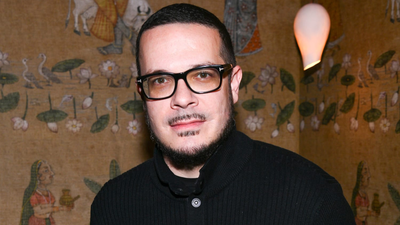
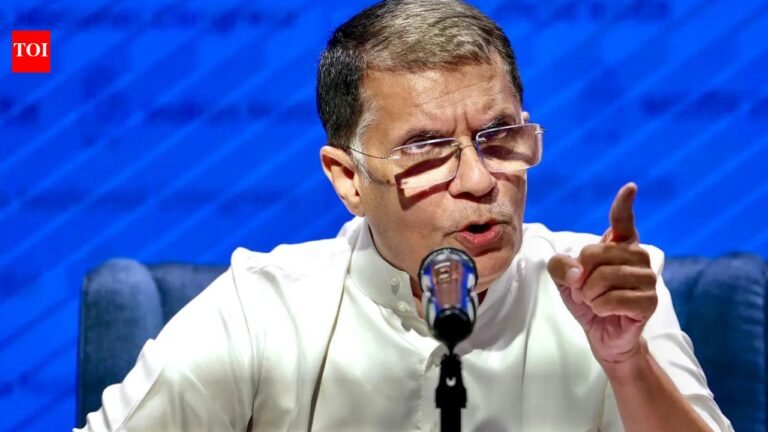
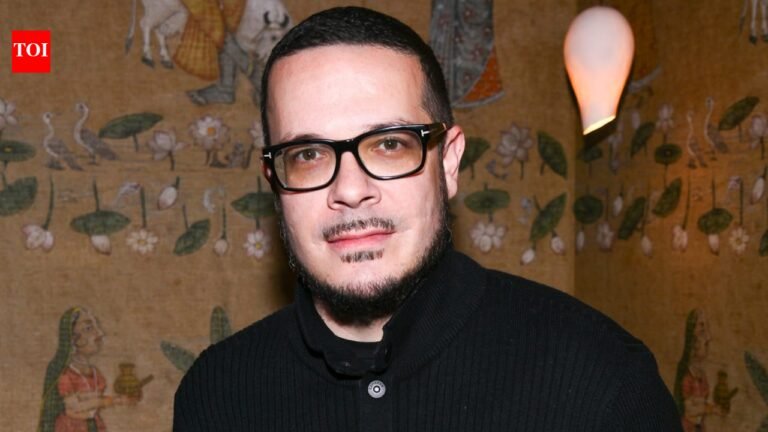
Shaun King, a self-described American civil rights activist who has long been associated with Black Lives Matter, is facing fresh backlash after publicly supporting the Jamaat-e-Islami in Bangladesh during the recent election. Netizens called him a “liar” and again accused him of repeatedly intervening in complex political movements without sufficient understanding or accountability.King has previously been criticized for factual inaccuracies, controversial fundraising efforts and shifting positions on global causes. His support for the Jamaat-e-Islami party, which rejects secular governance and advocates political authority rooted in Islamic law, has further fueled doubts about his credibility, especially since it has downplayed violence against Hindus in Bangladesh and adopted a softer stance.

‘Bangladesh rejects Pakistan-backed rally’: Experts interpret BNP Paribas’ historic return to power

King, who publicly converted from Christianity to Islam in 2023, has been criticized for aligning himself with a party that adheres to a hardline religious ideology, opposition to secularism and a controversial historical role that clashes sharply with his self-image as a progressive human rights activist.

The rise and controversial record of Shaun King

Shaun King rose to prominence in the mid-2010s through social media activism focusing on issues of racial justice, policing and inequality in the United States. He has gained a large following by highlighting cases of alleged police brutality and systemic discrimination. His work brought him national attention and influence, particularly among progressive audiences.Although King is often described as a Black Lives Matter activist, he never held a formal leadership role in the devolution movement. Over time, he has remained a polarizing figure. He has been accused of exaggerating, making factual errors, and prioritizing online activism over sustained organizing. Allegations about fundraising transparency have also dogged him for years and led to doubts about his role in progressive politics.In a widely shared social media post addressed to his “brothers and sisters in Bangladesh,” King praised the student-led uprising that ultimately led to the ouster of former Prime Minister Sheikh Hasina in 2024. He described the 2026 elections as a hard-won moment for democracy and urged voters to participate and vote early.King subsequently publicly supported Dr. Shafiqur Rahman and the Jamaat-e-Islami. He expressed hope that Bangladeshis would support the party in the elections. The support immediately raised eyebrows due to the Jamaat-e-Islami’s ideological stance and political history in Bangladesh.

Why this post sparked outrage

Much of the backlash stems from the Jamaat-e-Islami’s past and its ideological stance. Critics point out that the party opposed Bangladesh’s independence in 1971 and accuse some of its leaders of colluding with Pakistan during the liberation war. The party has also been accused of being linked to political violence, which it denies, and is known for its opposition to secular state principles.To many Bangladeshis, the king’s support seemed to ignore this historical and ideological context. Critics question how an American activist known for her advocacy of human rights and social justice can support a party seen as socially conservative and religiously hardline.The election is Bangladesh’s first national vote since Hasina’s ouster. The Bangladesh Nationalist Party won an overwhelming victory with 209 seats. Jamaat-e-Islami won 68 seats and became an important ally in the new opposition-led parliament. This outcome marked a decisive shift from former ruling institutions to coalition politics.

Why is Sean King famous?

King became a hot topic not because of the election results but because his support reignited debate about his credibility and role as an activist. Critics again accused him of selectively supporting causes without fully understanding local history or consequences. Others question whether foreign activists should openly interfere in elections outside their home countries.Online reactions also reflected broader frustrations with performative global activism. Many believed that King’s position reduced Bangladesh’s complex political history to a simplified narrative of resistance and change.

The birth of New Delhi: From a durbar bombshell to Seva Teerth, 95 years later | India News

0

PM Modi Unveils Seva Teerth, A New PMO Hub Marking Governance Shift In National Capital Delhi

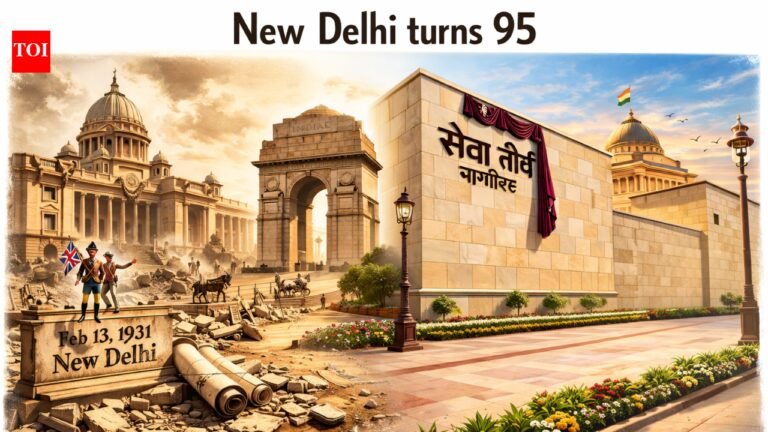
95 years of Delhi (Representative Image: Created with AI)

New Delhi turned 95 today, a milestone that binds two moments of power separated by nearly a century. On this date in 1931, the British formally inaugurated New Delhi as the imperial capital. Ninety-five years later, Prime Minister Narendra Modi on Friday marked a symbolic departure from that legacy by shifting the Prime Minister’s Office from South Block to ‘Seva Teerth’, a move framed as the final “unlinking” of the capital from its colonial inheritance.But New Delhi was neither born overnight nor unveiled through a simple ribbon-cutting ceremony. Its making was the culmination of two decades of planning, political calculation and imperial ambition, set against centuries of Delhi’s own recurring rise and abandonment.

PM Modi Unveils Seva Teerth, A New PMO Hub Marking Governance Shift In National Capital Delhi

The decision itself was announced on December 12, 1911, when King George V stunned the Delhi Durbar by declaring that the capital of British India would move from Calcutta to Delhi. What followed was a slow, deliberate process that finally culminated in February 1931 with a week-long series of ceremonies inaugurating the new city.During those ceremonies, the then Viceroy dedicated the All India War Memorial Arch — now India Gate — on February 12, honouring soldiers who died in the First World War and the Third Anglo-Afghan War, their names etched into its stone. Three days later, another ceremony at the Government of India Camp recalled the moment two decades earlier when King George V and Queen Mary had laid the foundation stones of the new capital, each bearing the simple inscription: “15 December 1911.New Delhi’s creation was shaped as much by political necessity as by urban design. After the Swadeshi movement and the violence following the 1905 partition of Bengal turned Calcutta into a centre of unrest, the British Raj sought both administrative control and symbolic authority. It returned to a familiar strategy: anchoring power in Delhi, a city steeped in imperial memory.By doing so, the British were not creating something entirely new, but adding an eighth layer to a city that had already been built, abandoned and rebuilt seven times before. Modern New Delhi thus rose atop the ruins of earlier capitals and civilisations — and it was precisely this historical gravity that made Delhi the empire’s chosen seat.

The Bombshell at the Durbar

On a sunny, windy day, the Delhi Durbar that sprawled across 25 square miles near Burari had over 84,000 spectators. It was the coronation of King George V and Queen Mary as Emperor and Empress of India, following their crowning in Britain earlier that year.He also became the first reigning monarch to set foot on Indian soil. And it was for a reason.“We are pleased to announce to our people that, on the advice of our ministers, tendered after consultation with our Governor-General-in-Council, we have decided upon the transfer of the seat of the Government of India, from Calcutta to the ancient capital of Delhi,” George V announced, as mentioned in Sam Miller’s Delhi, Adventures in a Megacity.Why? Bengal’s agitation made Calcutta a powder keg. Delhi’s central location astride rail networks, Punjab’s military recruits, and the Afghan frontier made it strategically superior for administration and defence.It also served as a power statement symbolically. Emperors from Pandavas to Mughals ruled here.King George V laid the foundation stones for the Viceroy’s House, which is now Rashtrapati Bhavan and the Secretariat, which are the North and South Block buildings, adjacent to the Rashtrapati Bhavan, during the Delhi Durbar week.This grand gesture symbolised Britain’s long-term commitment to ruling India amid growing nationalist unrest.

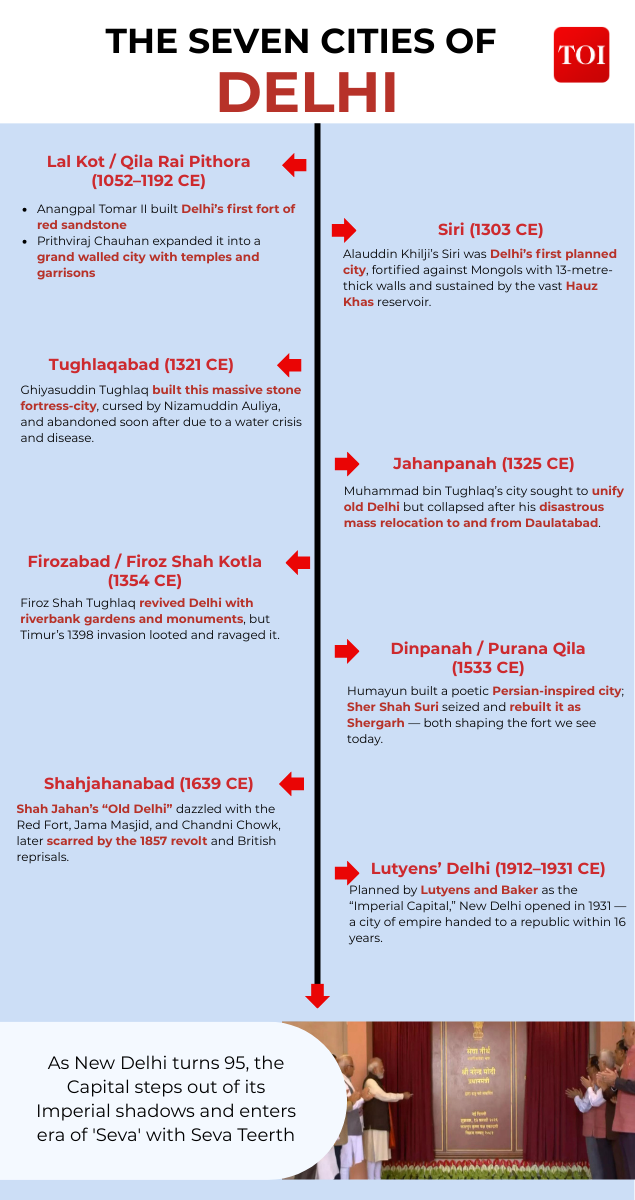
Delhi’s eternal game of thrones: The seven cities

The tale of Delhi’s seven cities isn’t some neat stack in one spot, but a history revolving around a central high point called the Aravalli Ridge.From Purana Qila to Mehrauli, the central Yamuna-facing plateau commanded rivers, trade routes, and monsoons. It was the “magnetic North” for power.Whoever held Delhi held India.In essence, Delhi’s foundation began as a mythical forest settlement of Indraprastha and eventually grew into a medieval capital named after its rulers.

Lal Kot/Qila Rai Pithora (1052 CE)

Anangpal Tomar II and Prithviraj Chauhan turned Delhi from a series of scattered settlements into a fortified superpower known as the First City of Delhi.Lal Kot (The Red Fort of its time): Built by Anangpal Tomar II around 1060 CE, these were the original high walls of red sandstone. It was strategically placed on the rocky Aravalli ridge to make it nearly impossible to climb.Qila Rai Pithora: When the legendary Rajput hero Prithviraj Chauhan took over, he didn’t tear it down; he expanded it. He wrapped the original fort in massive new walls, creating a sprawling urban centre that could house a massive army and 27 grand temples.

Siri (1303)

Enter the Delhi Sultanate’s first true urban innovator, Alauddin Khilji. He didn’t just build a city; he built a fortified machine designed to survive both Mongol invasions and starvation.Facing constant threats, he shifted the capital to Siri, the second of the seven cities, and turned it into a logistical marvel.He built massive, 13-meter-thick stone walls to stop Mongol horsemen.To solve the water crisis, he excavated the Hauz-i-Alai, now known as Hauz Khas, a massive tank that captured rainwater to sustain the city through the dry season.This would later go on to become a poetic rivalry that history would remember.

Tughlaqabad (1321)

Ghiyasuddin Tughlaq was a man of stone and war. Unlike the previous rulers who built for beauty, he built Tughlaqabad, the third city, as a grim, sloping fortress meant to withstand the end of the world. While the ruler carried forward the legacy of the grand vision for Dilli, the beloved Sufi saint Nizamuddin Auliya was building a community well.The drama with Sufi saint Nizamuddin Auliya reached its peak here. Ghiyasuddin was so obsessed with finishing his city that he banned all labourers from working on the Saint’s stepwell or his baoli.And thus came the popular curse, “Hunooz Dilli door ast” (Delhi is still far off). But this was not all, he also allegedly whispered a second, darker curse regarding the city itself:“Ya base Gujar, ya rahe ujar.” (May it be inhabited by nomads, or remain a wilderness.)And thus, the city was abandoned almost as soon as it was finished.While returning from a campaign, Ghiyasuddin died when a wooden pavilion built by his own son, Muhammad bin Tughlaq, “accidentally” collapsed on him. He never spent a single night in his completed palace. Delhi was, indeed, too far.Despite the massive reservoirs, the area lacked a sustainable groundwater source. The water turned brackish and undrinkable. Disease and drought forced the population to flee back to the older cities. Within five years, the “impregnable” capital was a graveyard.

Seven cities of Delhi

Jahanpanah (1325)

Muhammad bin Tughlaq is history’s ultimate “cautionary tale.” He was arguably the most learned man of his age—a mathematician, physician, and philosopher—but his brilliance lacked a pulse for human reality.He didn’t just build the fourth city, Jahanpanah; he tried to re-engineer the entire concept of an empire.He built madrasas and hospitals, and famously, the Begumpur Mosque.But, in 1327, the Sultan decided that Delhi was too far north to manage his growing southern territories. He picked Daulatabad, today in Maharashtra, as the new centre of India. Most kings would just move their court. Muhammad bin Tughlaq ordered the entire population of Delhi to move.Old men, women, children, and even the sick were forced to walk as thousands perished during the journey, and Delhi became a ghost town.Two years later, he admitted defeat and ordered everyone to march back to Delhi. Thousands more died on the return trip. Those who made it back found a city that had been looted and reclaimed by the jungle.

Firozabad/Firoz Shah Kotla (1354)

Firoz Shah Tughlaq was the “calm builder” of recovery. He established Firozabad, the fifth city of Delhi, and shifted the capital’s focus to the riverbanks. The heart of this city was the Firoz Shah Kotla, where today stands the Arun Jaitley Stadium.But the “idyll” of Firozabad didn’t last. A few years after Firoz Shah’s death, the Central Asian conqueror Timur swept into Delhi.Timur’s forces systematically looted the city for days.He was so impressed by the architecture of Firozabad’s Jama Masjid that he spared the stone-masons, only to take them back to Samarkand as prisoners to build a similar mosque for him there.

Dinpanah/Purana Qila (1533)

The transition from the Tughlaqs to the Mughals brought a new aesthetic to Delhi: the Persian style. This era was defined by a bitter rivalry between the Mughal Emperor Humayun and the Afghan lion Sher Shah Suri. They essentially “co-authored” the sixth city of Delhi, known today as Purana Qila.When Humayun took the throne, he wanted to create a city that reflected his love for astronomy, poetry, and Persian elegance. He began building Dinpanah, the Sixth City, in 1533. He chose the high ground near the Yamuna, supposedly the same spot where the ancient city of Indraprastha once stood.But his dream was cut short after Sher Shah Suri defeated him in 1540 and chased him into exile in Persia.Sher Shah didn’t just conquer the city; he renamed it Shergarh. He tore down Humayun’s incomplete structures and rebuilt the fort with massive, “masculine” stone walls.Eventually, Sher Shah died in a gunpowder accident, and Humayun returned from Persia 15 years later to reclaim his throne. However, his “return” lasted only six months.

Shahjahanabad (1639)

This is the seventh city, the Delhi that most people still recognise today as Old Delhi.While previous cities were forts or strategic outposts, Shahjahanabad was a masterpiece of urban planning, designed to be the most beautiful city in the world.Shah Jahan moved the capital back from Agra to Delhi in 1639, bringing with him the peak of Mughal architectural refinement.He built the Red Fort, Jama Masjid and Chandni Chowk. However, the glory didn’t last. Shah Jahan’s son, Aurangzeb, spent the last 27 years of his reign fighting endless wars in the Deccan.The final blow came during the revolt of 1857.Indian rebels took over Shahjahanabad, declaring the elderly Bahadur Shah Zafar their leader. The British besieged the city for months. When the British finally broke through the Kashmere Gate, they cleared a “shooting space” around the Red Fort, demolishing nearly 80% of the exquisite palaces and gardens inside the fort and the city to build ugly brick barracks.

Lutyen’s Delhi: The eighth city

Following the 1911 announcement, Edwin Lutyens and Herbert Baker were tasked by the 1912 Delhi Town Planning Committee with a mad four-year deadline for 6,000 acres. What started as a then Rs 10 crore budget ballooned as World War I diverted materials and money to the front lines.The shift cost the British approximately £4 million at the time — estimated to be around £610 million today, or roughly Rs 7,528 crore in current value.Ironically, by the time the city was officially inaugurated in 1931, the British Empire was already crumbling. They built a “City of Kings” only to hand the keys over to the Indian Republic just 16 years later.The grand inauguration: Rain, sun, and imperial pompAfter 20 years’ toil, festivities erupt in February 1931.The timing was almost cinematic. After three days of torrential rain, the clouds famously parted on February 10th. At exactly 11:00 AM, the sun struck the red sandstone of the Secretariats, signalling the start of the ceremonies.Standing in the Great Court of the Viceroy’s House, Lord Irwin and Lady Irwin unveiled the four Dominion Columns.The celebrations turned the city into a theatre of military and social might. The 2-mile stretch of Kingsway, the now Kartavya Path, saw the thunder of the British Indian Cavalry. Above, the Royal Air Force performed flypasts—a relatively new and terrifying display of modern power to the crowds below.Once the fireworks faded, the “Paper Empire” began its move. This was one of the largest bureaucratic shifts in history. Thousands of files, desks, and Babus (clerks) were moved from the humid streets of Calcutta to the dry heat of Delhi via special trains.By 1932, the “Viceroy’s House” was fully operational. The British had finally occupied their “eighth city.”Today, the “eighth city” is no longer the city of Lutyens or the British. It belongs to the millions who migrated here in 1947, the dreamers from across the subcontinent, and the ghosts of the Pandavas whispering beneath the Purana Qila.As the Urdu poet Zauq once famously said, “Kaun jaye Zauq, Dilli ki galiyan chhod kar?” (Who would ever leave the streets of Delhi?)

The top 10 risks the world could face in the next 10 years and how they will change everything | World News

0

The top 10 risks the world could face in the next 10 years and how they could change everything

Will 2026 be gentle? this world economic forumIts global risks report says the world is in what experts call an “age of competition.” In the short term, leaders worry about trade, misinformation and social divisions. In the longer term, climate, technological and environmental threats loom. People are taking notice, too, with rising prices, job relocation, political tensions, and more. With the focus of the Davos Forum annual meeting on the “spirit of dialogue,” everyone knows that dialogue is necessary, even if it may be difficult. Check out the top ten risks during expected storm times, according to the report. Risk is divided into two parts: short-term (2 years) and long-term (10 years).

Global risks in 2026: Experts warn of stormy year ahead

The World Economic Forum’s Global Risks Report 2026, based on a survey of more than 1,300 global leaders and discussions with risk experts, says we are entering an “age of competition.” Cooperation and trust seem fragile. Confrontation appears to be taking hold and the old rules of global interaction may no longer apply.The report notes that the future is yet to be determined. The survey shows that 68% of the leaders surveyed believe that the world will become more multipolar and fragmented. Only 6% expect multilateral institutions to fully recover.Small choices may matter more than we think. Uncertainty seems to be the main theme. About half of respondents expect the next two years to 2026 to be “turbulent” or “stormy.” Looking forward another ten years, this proportion will rise to 57%. Nearly one in five even expect catastrophic risks globally.

Short-term risks: next two years

  • geoeconomic confrontation is the most important. This is no longer just about tariffs. Experts say this could escalate into port blockades, export restrictions or contract cancellations. Even ordinary life may feel the impact on employment, prices, and supply chains.
  • Misinformation and disinformation follow closely behind. Social media, deepfakes and fake news are shaking society. Trust in government and institutions reportedly declines when misinformation spreads. It could affect elections, public health, and even markets.
  • Social polarization remains serious. Ranked third and ranked in the top ten for five consecutive years. Inequality, health stress, economic stress and misinformation all exacerbate divisions. Experts warn the situation could worsen over the next two years if left unchecked.
  • Economic risks are rising rapidly. Inflation, economic downturns and asset bubbles all soared up the rankings. Coupled with geoeconomic frictions, the combination could destabilize businesses and communities.
  • The number of armed conflicts in the country has decreased slightly but remains a cause for concern. While less immediate than trade or misinformation, the risk of conflict is still imminent.

Long-term risks: the next decade

  • Environmental threats dominate here, including extreme weather events, biodiversity loss and ecosystem collapse. Pollution and natural resource shortages are also severe. While less urgent today, these risks may define life in 2030 and beyond.
  • adverse consequences Artificial intelligence and cutting-edge technology The ranking jumped significantly from 30th in the short term to 5th in the long term. Job losses, social instability and military risks from automated systems are real concerns. Experts say preparation, education and governance will be key.
  • Even a decade later, social polarization still exists, although it has dropped to ninth place. Inequality, economic recession, health problems and disinformation remain interconnected factors.
  • Economic risks remain important. Over time, poor debt management, market instability and volatility in frontier technologies could exacerbate global instability.
  • Interestingly, short-term concerns such as geoeconomic confrontations have declined over the longer term (19th), but they remain part of a larger competitive, fragmented global landscape.

‘Bring your own coffin’: Death of 37-year-old man at Vijay rally in Salem sparks new political crossfire India News

0

'Bring your own coffin': Death of 37-year-old man at Vijay rally in Salem sparks fresh political crossfire

New Delhi: The death of a 37-year-old man at a rally of Tamilaga Vettri Kazhagam (TVK) chief Vijay in Salem on Friday triggered a heated political exchange with rival political parties attacking the organization over crowd safety concerns.The man, Suraj, a Maharashtra native living in Salem, complained of chest pain while waiting at the rally venue and then collapsed and was rushed to a private hospital where doctors declared him dead, the Press Trust reported. Preliminary investigations revealed that Suraj was a heart patient and had previously undergone angioplasty.Police said the incident took place even before Vijay arrived for a meeting of district officials. The death prompted a swift response from political opponents. All India Anna Dravida Munnetra Kazhagam spokesperson Kovai Sathyan lashed out at TVK in a post on X and said anyone attending TVK rallies in future “will have to bring their own coffin”.The Bharatiya Janata Party also joined the chorus of criticism, with Shabaab leader Vinoj P Selvam claiming that the incident highlighted a lack of concern for cadre safety. “It doesn’t matter if it happens accidentally the first time. But this kind of mistake happens again and again,” he said in a post on X.Ruling Dravida Munnetra Kazhagam also expressed similar concerns. DMK spokesperson A Saravanan questioned how many more lives would be lost ahead of the assembly elections and claimed that arrangements such as shelter and drinking water were inadequate at the rally.However, TVK denied all these accusations and said that the rally was prepared in advance as required. TVK general secretary CTR Nirmal Kumar said, “We are saddened by this. We learned from the family that he suffered a cardiac arrest today. We provided all first aid and sent an ambulance. But unfortunately, he passed away. We are certainly saddened. Our cadre is with the family and supporting them.”“We have permission for 4,998 people but we are allowing less than that. There are more than 30 doctors on site. Several small clinics have also been set up. All ambulances are reserved for emergencies. We have permission from 12 to 3 p.m. After the leader’s speech, we ended the event at 1:10 pm. We are of course very concerned about public safety… There were no other incidents or anything else going on,” he told news agency ANI.Subsequently, a scuffle broke out between TV reporters and officials. Journalists said the cadres tried to attack them while reporting on the incident.However, a source in TVK told PTI that the party had appealed to unwell cadres and members of the public not to attend the meeting, adding that the death was unfortunate and had nothing to do with any scheduling blunder.Earlier, 41 people died in TVK events since the stampede in Karur in September 2025.

‘Don’t get the wrong idea about America’s reality’: Indian-American groups react to Seattle’s $29 million donation to Jaahnavi Kandula’s family

0

“不要对美国的现实有错误的认识”:印裔美国人团体对西雅图向贾纳维·坎杜拉 (Jaahnavi Kandula) 家人捐赠 2900 万美元的反应

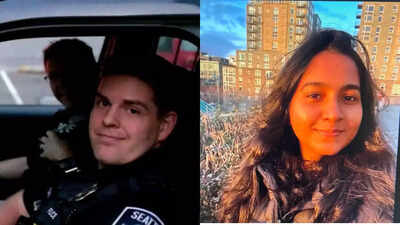
In 2023, former police officer Kevin Dave was speeding on a Seattle street and hit Jaahnvi Kandula.

The founder of the Indian American Advocacy Council talked about the $29 million settlement Seattle authorities recently reached with the family of Jaahnavi Kandula, an Indian student who was run over by a speeding police car in 2023, and said there was more to the story. The settlement agreement should not reflect the reality in the United States. “The police officer who ran over and killed her joked that her value was ‘limited’. He wasn’t even fired at the time. We have spoken many times about the massive injustice faced by Janavi and her family,” IAAC founder Sidharth posted. “After relentless public pressure, we are finally starting to see some measure of justice for Janavi Kandula. Please don’t get the wrong idea about the reality in America,” Sidharth added. The comment was a reaction to social media users’ response to Seattle’s largesse compared to what might happen in India. “Every day in India, people fall into cesspools and die like insects. Forget about compensation – no one ever goes to jail!” Sidharth’s post said in response.

Who is Janavi Kandula?

In January 2023, 23-year-old Jaahnavi Kandula was run over and killed by a police car while returning from the campus of Northeastern University, where she was studying for a master’s degree in information systems. Seattle’s South Asian community pursued the case after the ruthless police officer was caught joking about Kandula’s death. As the lawsuit continues, Seattle authorities have agreed to pay the family $29 million.

Kevin Dave Fired in 2025, Odley says his comments were taken out of context

Officer Kevin Dave was fired in January 2025, two years after hitting Kandula. That night, Dave was speeding on his way to a possible overdose victim. Another officer, Daniel Auderer, was dispatched to the scene to determine if Dave was under the influence. Odler laughed and joked about Kandula’s death and said authorities should write a check. He forgot to turn off his body camera when he made these comments, which was captured. Odler, who was also fired following the investigation, has challenged the decision and said his comments were taken out of context, that he was mocking the city attorney and did not downplay the deaths.

‘Umar bhar yahi bhool karta raha…’: Yogi Adityanath turns to Mirza Ghalib to attack Samajwadi Party at rally – Watch | India News

0

'Umar bhar yahi bhool karta raha...': Yogi Adityanath turns to Mirza Ghalib to attack Samajwadi Party at rally - Watch

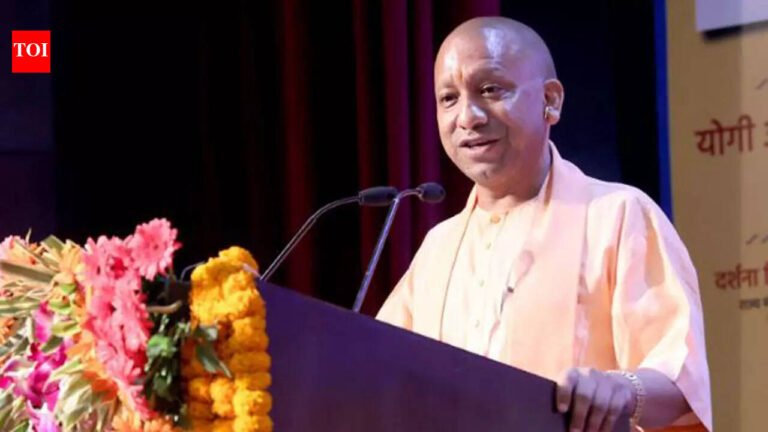
New Delhi: Chief Minister of Uttar Pradesh Yogi Adityanath Urdu poet Mirza Ghalib was quoted on Thursday sajwadi party in the assembly. The chief minister said the image of fear and chaos in Uttar Pradesh did not emerge overnight but was the result of an early political culture that “frightened the daughters and forced businessmen out of business”.Replying to the debate on the Governor’s speech, Adityanath said that during the proceedings in the House, including during the division, one could still see past actions. “I don’t think anyone in the state will accept it under any circumstances,” he said, accusing the opposition, particularly the Samajwadi Party, of repeatedly hurting the sentiments of the House through its conduct.

‘That day will never come…’ Yogi Adityanath warns those dreaming of Babri structure

The First Minister said that while the opposition leaders’ remarks sounded “practical”, their hands appeared “tied”, prompting him to respond point by point. Adityanath quotes poet Mirza Ghalib: “Ghalib Umar is here keeping the dust clean… dust on his face, mostly cleaning his face.. [Kept wiping the mirror while dust remained on the face]”. The Chief Minister said that attempts to pass the buck would not undo the governance failures of the past.Adityanath also defended the functioning of the Assembly, pointing out that the disruption caused in the past nine years was limited. “Most of the time, members were interested, raised their points effectively and ministers responded,” he said, adding that a range of issues from development and security to welfare were addressed without discrimination.Citing figures provided in the Governor’s address, the Chief Minister said the sustained efforts of the “dual-engine government” had lifted over six crore people above the multi-dimensional poverty line in the last eight years. He said the figures were based on the assessment of NITI Aayog and reflected the impact of development-oriented and welfare schemes.Adityanath stressed that benefits will not be withdrawn. “Rationing facilities, health services and all other government support will continue as is,” he assured, adding that the focus now was on achieving self-reliance and long-term prosperity rather than mere dependence.

Gold surprise: Saudi primary school students bring gold from home to give to classmates | World News

0

Gold surprise: Saudi primary school students bring gold from home to give to classmates
A Saudi primary school student took out gold jewelry from a drawer at home and distributed it to his classmates, surprising them/Representative picture

A quiet day in Riyadh takes an unexpected turn when a primary school student arrives at school with something more valuable than homework. according to a report gulf newsThat day, the child brought some gold jewelry from home and started distributing them as gifts to his classmates.Teachers first became aware of the situation after noticing students receiving gold coins during class. The discovery immediately attracted the attention of the school administration, prompting staff to question the children about the origin of the jewelry.The student reportedly told school officials he took the pieces from his mother’s drawer at home. The government subsequently contacted the family, who confirmed the gold items belonged to them. The jewelry was recovered from the student and returned to the family and the matter was resolved without further incident.Educators said the situation was handled promptly and coordinated with the child’s guardian.The incident comes as incidents involving children and valuables draw wider attention in the region. Just a few days ago, a schoolboy was lured into handing over jewelery in exchange for unlimited free mummies in Deoria’s Uttar Pradesh state, a case that later led to an arrest and recovery of the stolen items. While the situations are very different, both situations highlight how easy it is for children to make impulsive decisions involving items whose value they may not fully understand.However, Riyadh officials confirmed there was no criminal element. The jewelery was recovered safely and the matter was dealt with internally by the school and family. What started out as a puzzling classroom moment ended up being a reminder of how quickly schools and parents must respond when unusual circumstances arise during the school day.

World’s largest snake den in Canada: More than 100,000 red-sided garter snakes come alive every spring | World News

0

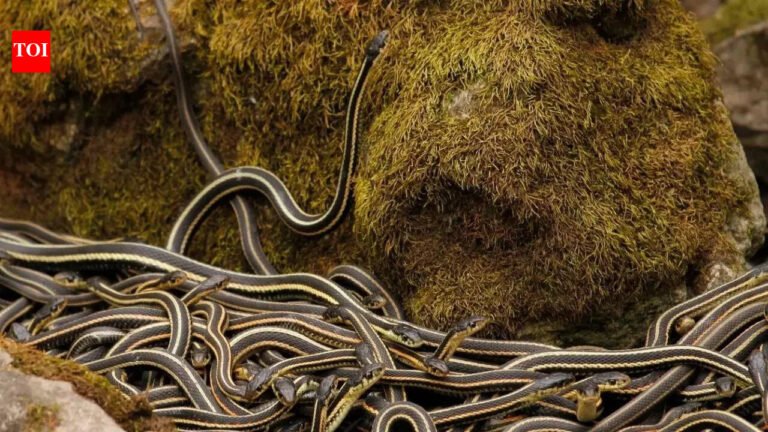
The world's largest snake den is in Canada: more than 100,000 red-sided garter snakes come alive every spring

In the Canadian province of Manitoba, Narcisse Snake Den is a provincial wildlife management area located in the rural municipality of Armstrong. These nests are the winter home for approximately 100,000 red-sided garter snakes. These sinkholes are thought to be the largest concentrations of this species on Earth. Their winter refuges lie deep in caves carved out of water-smoothed limestone beneath the surface. When spring arrives, snakes emerge from these underground dens and gather in pits to mate. Once the breeding season is over, they gradually disperse into the surrounding marshes, where they spend the summer months feeding and roaming.

Narcisse Snake Dens: 100,000 snakes spend the cold winter here

According to BBC Wildlife, Narcisse Snake Den is located in the rural municipality of Armstrong, where meadows meet forests and the soil is porous limestone. At several meters deep, these cracks are below the frost line but still above the water table. This detail is important. Ground temperatures can plummet to -30°C in winter. Inside the cave, however, the temperature never drops below freezing. It’s the perfect winter refuge for the red-sided garter snake (scientifically known as Thamnophis Sirtalis parietalis).They start arriving in late September or early October. Sliding underground and gathering into tight clusters, they then wait for five to six months.

Why snakes rely on external warmth

Snakes rely on external warmth to fuel their metabolism. So when winter seals the land in ice, they stop functioning. Experts say that together they may help reduce water loss and stabilize body temperature. Males are reported to emerge first, usually while the snow is still clinging to the ground. They gather near the entrance to the nest. Female garter snakes release pheromones, which are chemical signals that the male detects with the vomeronasal organ, an odor-sensitive structure on the roof of the mouth. It leads them unerringly to the source. One female can attract dozens or even hundreds.The process that follows is called mating the ball. A group of writhing snakes, all vying for position. It looks like a single, pulsing organism. Visitors step back. The camera is out. Somewhat obsessed. Some people are clearly rethinking their life choices. The male rubs his chin against the female’s back in an attempt to adjust his body. When one succeeds, he uses one of his two hook-shaped reproductive organs, called a hemipenis, to transfer the sperm. A gelatinous mating plug is left behind, which appears to reduce the chances of competitors mating with the same female.

Red-sided garter snake facts

  • venom: The red-sided garter snake is nonvenomous and generally harmless to humans, but it can be surprisingly brave when cornered.
  • size: Adults usually grow to about three or four feet in length, are stocky, and have an olive-brown to almost black body.
  • color: Most people have clear yellow stripes on their backs, while stripes on the sides may look clear or blurry, depending on the individual. The yellowish belly often shows a dark edge along the scutes. The famous red stripes on the sides may appear between or spread across the scales, giving each snake a slightly different appearance.
  • scales: They have 19 rows of keel-shaped scales and are ovoviviparous, meaning the female gives birth to live young rather than laying eggs. Newborns are similar to adults in being smaller, but just as varied.
  • Habitat: They are found near ponds, swamps, canals, or slow-moving bodies of water, where they feed primarily on amphibians, but also worms and the occasional small rodent.

Does Pakistan force the United States to delete Indian maps? Congress shares video, targets Middle East and Africa | India News

0

Pakistan and Aksai Chin on India map: US trade deal forces Pakistan to urge Washington to correct

Pawan Khera (PTI Photo)

NEW DELHI: India’s Congress on Friday came down heavily on External Affairs Minister S Jaishankar, accusing him of failing to safeguard India’s diplomatic interests after the United States removed India’s map.After Pakistan’s foreign ministry spokesperson alleged that the US had deleted an Indian map depicting the entire Jammu and Kashmir region, including Pakistan-occupied Kashmir (PoK), as part of India, Congress leader Pawan Khera questioned the government’s silence.

Pakistan and Aksai Chin on India map: US trade deal forces Pakistan to urge Washington to correct

Elaborating on his criticism, Khera wrote: “Pakistan Foreign Ministry spokesperson claimed that the US had deleted an Indian map depicting the entire Jammu and Kashmir region, including Pakistan Occupied Kashmir (PoK), as part of India. But we haven’t heard anything from the Ministry of Foreign Affairs about this. “Addressing Jaishankar directly, he added: “I’ve asked this question before and I’ll ask it again: What exactly does a ‘Forum Minister’ do? Is his job limited to speaking at international forums, or does it also include doing some substantive work for the benefit of India?”In an earlier post, Keira also criticized the minister’s external activities, saying: “Once again we will see a ‘Forum Minister’ speaking from a pulpit in some new forum in the world. Taxpayers are footing the bill for his lavish travels while he has a giant zero to show for his efforts.”Listing out his concerns further, he wrote: “In a recent interview, Trump once again claimed that he was using trade and tariffs to bully Modi into stopping Operation Sindoor. India has been bullied into stopping buying Russian oil. We continue to lose the narrative war against Pakistan – the U.S. Trade Representative’s office removed a map showing the entire Jammu and Kashmir (including Pakistan-occupied Kashmir) as part of India. What is Jaishankar doing? What on earth is he doing?”The controversy stems from a map released by the United States Trade Representative (USTR) while announcing the framework of an interim trade agreement between India and the United States.

.

Screenshot of the map shared by the Office of the United States Trade Representative

The map shows that the entire Jammu and Kashmir region, including Pakistan-occupied Kashmir, is part of India. It also depicts Aksai Chin in India.Some analysts believe the release of the map differs significantly from previous U.S. descriptions, which often labeled the areas as disputed. However, opposition leaders questioned the Centre’s response after Pakistan claimed the map was later deleted.India has always maintained that Jammu and Kashmir is an integral part of the country and does not require external confirmation of its sovereignty.

Hit, treat, repeat: Natthakan Chantham bleeds for perfection icon Suryakumar Yadav’s ‘Supla’ shot | Exclusive | Cricket News

0

Hit, treat, repeat: Natthakan Chantham bleeds for perfection icon Suryakumar Yadav's 'Supla' sequence | Exclusive
Suryakumar Yadav and Natthakan Chantham

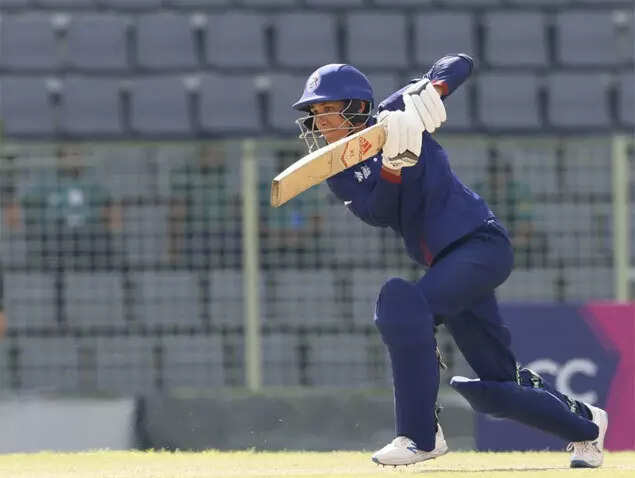
New Delhi: Thailand women’s team cricketer Natthakan Chantham suffered a series of bruises, all in pursuit of mastery Suryakumar YadavDuring net drills, he performed his signature “Supra shot” – kneeling on one knee and scooping the ball over thin or square leg.During practice, Chantam was hit multiple times while trying to shoot. She took the hit, was treated by a physical therapist, got back on her feet, and went straight back to rehearsing her shot, determined to perfect it.As the saying goes, practice makes perfect and Chatham’s dogged dedication reflects her desire to finish Supra’s shot with the same skill and fearlessness as her idol Suryakumar.Chatham, who is nicknamed “Jeans” by her teammates, is expected to showcase a variety of innovative shots, including her favorite Suriya-inspired shot, in the upcoming 2026 ACC Women’s Asia Cup Rising Stars tournament, which kicks off in Bangkok on Friday. Thailand will face Malaysia on Saturday.

Natthakan Chantham (ACC Photo)

In addition to Thailand and Malaysia, India, Pakistan, United Arab Emirates, Nepal, Sri Lanka and Bangladesh are participating in the competition. India, Pakistan, United Arab Emirates and Nepal are placed in Group A, while Group B includes Sri Lanka, Bangladesh, Malaysia and Thailand.India are the defending champions, having won the title for the first time in 2023 after defeating Bangladesh in the final.“I am 100 per cent ready for the Asia Cup as I have been waiting for such a big event. Our team is fully prepared and ready to go,” Chatham told TimesofIndia.com in an exclusive interview.“I admire Suryakumar Yadav. He is a fearless batsman. I love his batting at square leg and fine leg – those are my favorites. He plays with great freedom, without any pressure; you don’t see any fear in his eyes. I am an attacking batsman too. I like to come out of the crease and get on with the game, I don’t like to put pressure on myself. I also like Brendon McCullum and Chris Gayle. As a kid, I always tried to copy Suryakumar Yadav. I got hit a lot, and sometimes bled, trying to hit the ball perfectly, but I never gave up,” she said.“I would really like to meet Surya one day. If I meet him, I will say only one thing – ‘Please give me your bat’ (laughs),” the batsman added.

Natthakan Chantham (ICC Photo)

Chantam started playing cricket when he was nine years old. Her father, a teacher, initially encouraged her to focus on her studies but later supported her wholeheartedly after recognizing her passion for the sport.“I fell in love with cricket by accident. I used to bat with a plastic bat. Later, my father gave me a wooden bat and helped me practice. He was a teacher but he played a huge role in my career. My mother ran a beauty salon. I just wanted to go out and win this game for both of them,” said Chatham.Chantham has played 14 ODIs and 114 T20Is in her career so far.watch 2026 Asian Cup Women’s Rising Stars on Sony Sports Network