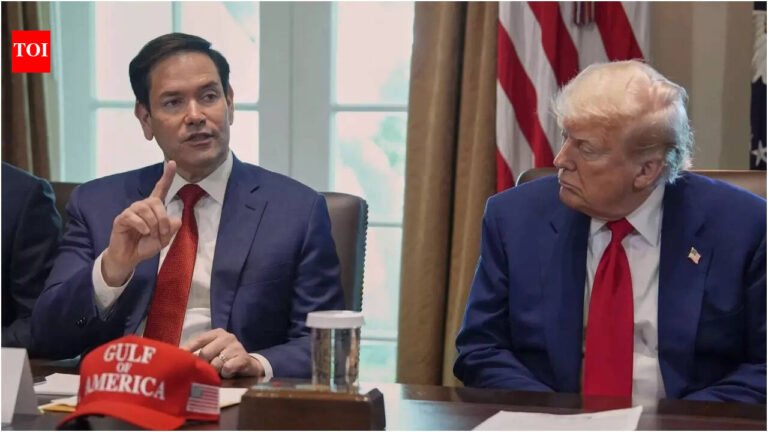

There’s a joke going around the internet that goes like this: “Marco Rubio knows he has to be the new ____.”The whitespace varies based on the date. Sometimes the internet names him the next pope, sometimes it names him the manager of Manchester United, and sometimes it even names him the ayatollah of Iran. Like all good memes, it exaggerates a simple fact: Rubio keeps emerging as the guy expected to fill the next big role in Washington’s increasingly chaotic politics.Now, the meme may have received its biggest promotion yet.In the wonderful world of political prediction markets, Marco Rubio has quietly emerged as the early favorite to win the 2028 U.S. presidential election. Traders on the platform like Kalshi have recently pushed Rubio’s odds above several high-profile rivals, including Vice President J.D. Vance and California Governor Gavin Newsom.It’s ridiculously early in the election calendar. With the next presidential election still years away, the battle for Republican succession after Donald Trump is just beginning. Yet prediction markets, which allow people to bet on political outcomes, are already pricing in the future.Right now, the Internet’s favorite “next thing” appears to be inching closer to the most important job in American politics.
what happened
Prediction markets operate like a stock exchange for political events. Traders purchase contracts based on outcomes such as election winners, policy decisions, or geopolitical developments. The price of a contract reflects the market’s estimate of the likelihood of an event occurring.Among markets predicting the winner of the 2028 US presidential election, Marco Rubio recently climbed to the top of the list on Kalshi. His contract briefly surpassed that of other major politicians, putting him ahead of contenders in both parties.Rubio’s rise is particularly notable because speculation in the space remains high. No major candidates have yet officially announced their intentions to win the White House in 2028, but traders are already betting on who might end up in the White House.Prediction markets are not polls. They don’t measure voter preferences. Rather, they reflect the collective judgment of people who are willing to risk money on what they think will happen.Still, these judgments can sometimes capture emerging political narratives before they manifest in traditional polls.
Why Rubio?
Rubio’s prominence in the market reflects a combination of political positioning and timing.As secretary of state in the Trump administration, Rubio currently has one of the most high-profile roles in the U.S. government. Foreign policy crises and diplomatic negotiations naturally put the office holder at the center of global attention, which tends to enhance perceptions of the president’s credibility.Rubio also holds an unusual position within the Republican Party.He began his career as a Tea Party conservative and established himself as part of the insurgent right in the early 2010s. After losing the 2016 presidential bid, Rubio gradually realigned his politics to align more closely with the populist direction of the Republican Party under Donald Trump.This evolution has given him a rare bridging position within the party. He retained his establishment credentials while also speaking with ease about the populist themes currently dominating Republican politics.In a party still reeling from the Trump political movement, traders believe this balancing act could be exactly what gives Rubio an advantage.
competitors
Rubio’s market leadership is far from decisive. Instead, the forecast board shows a crowded field of potential contenders.Vice President J.D. Vance frequently appears among the Republican hopefuls. Vance’s political identity is closely tied to the populist nationalism that emerged in the Trump era, making him a natural contender for the party’s post-Trump leadership.On the Democratic side, Gavin Newsom has been listed as one of the most likely candidates. As California governor, Newsom built a national profile by positioning himself as one of the most outspoken critics of Republican governance and conservative cultural politics.Other names pop up periodically. Governors, senators and political outsiders often appear in these markets as traders speculate on future possibilities.The result is less a clear-cut race than a shifting ranking of potential presidential candidates.
overall view
Prediction markets occupy an unusual place in political forecasting.Unlike opinion polls, they do not measure public opinion. Instead, they aggregate the expectations of thousands of traders who believe they have useful information about the future.Proponents argue that markets can be highly accurate because economic incentives encourage participants to absorb as much information as possible. Critics counter that hype, small trading volumes or sudden bursts of online enthusiasm can distort markets.They do, however, shed light on the stories shaping up around the next political cycle.For now, the story suggests Marco Rubio has quietly joined the conversation about America’s post-Trump future. A politician once dismissed as a failed presidential candidate is now being discussed, at least in speculative markets, as a legitimate occupant of the Oval Office.Whether such speculation can survive the harsh realities of American presidential politics is another question entirely.After all, if recent history has taught Washington anything, it’s that the path to the White House rarely follows the script anyone expected.