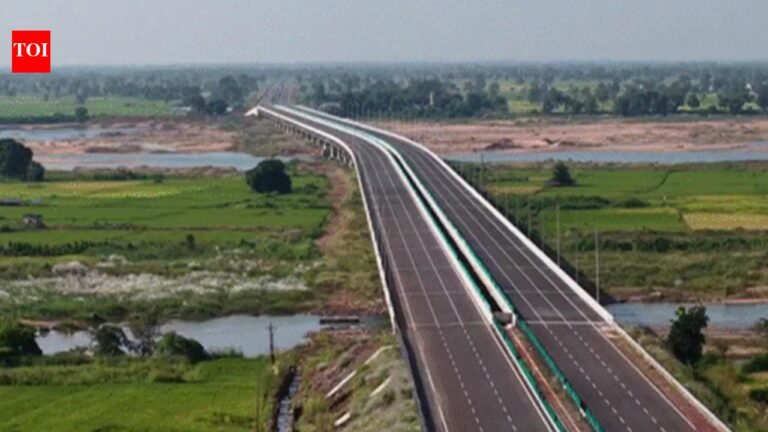
NEW DELHI: Over 50 million highway auto users have purchased FASTag annual passes in the last six months since the launch of the scheme and paid tolls of Rs 26.5 crore using the pass at Rs 15 each at plazas. Figures show car users who typically make up to 100 trips a year have taken 50 per cent more trips, showing how annual passes encourage people to travel more on the motorways.NHAI officials said that about 28 per cent of the total car transactions recorded on the NH network are currently conducted through FASTag annual passes. The increased penetration of annual passes among private car users will also help highway authorities better implement the multi-lane free-flow (MLFF) or barrier-free tolling system that is being rolled out, they added.“A district-wise analysis shows that Chandigarh leads in terms of usage, accounting for 14 per cent of the total annual pass transactions in the country, followed by Tamil Nadu at 12.3 per cent and Delhi at 11.5 per cent. These figures indicate widespread adoption of annual passes in different regions, from urban centers in the north to states in the south,” NHAI said.According to Expressway Authority Bijwasan Toll Plaza data, the toll plaza in Delhi-NCR recorded the highest number of passing vehicles using annual cards at about 57%, followed by Mundka in Delhi-NCR and Jhinjholi Square in Sonipat, both of which recorded about 53% of the number of non-commercial vehicles using annual cards.The annual pass is valid at 1,150 toll plazas on national highways and national highways without the need for frequent recharges of FASTag and requires a one-time payment of Rs 3,000 for validity of one year or 200 toll plaza crossings. Annual pass fees will increase in April with toll adjustments.Upon payment of a one-time fee through the Rajmargyatra app or the NHAI website, the annual card will be activated on the existing FASTag associated with the vehicle within two hours.
Why the Netherlands is building houses on water: The global climate solution no one expected World News
The Netherlands has been symbiotic with water since ancient times. Much of the country is below sea level. Rivers, canals and coastlines influence people’s daily lives. For hundreds of years, the Dutch have built dikes, dams, and drainage systems to protect their land. But the problem has become more severe in the past few years as sea levels rise, rainfall increases and flooding occurs more frequently. At the same time, the country does not have enough housing.There are millions of people looking for affordable housing, but there is not much land left. Many Dutch communities are learning to live with water rather than fighting against it. Once considered unusual, floating homes are now becoming part of modern city planning. According to the BBC, these water towns communities are growing in number and influence. What started as a small experiment is now shaping international projects in vulnerable coastal areas. From Europe to island nations, the Dutch floating housing model could be a way to combat climate change and housing shortages simultaneously.This is the story of how floating homes transformed from a niche project into a global paradigm for climate adaptation.
Why floating homes in the Netherlands are getting attention
The Netherlands is one of the most flood-prone countries in the world. Storm surges, heavy rainfall and rising sea levels all increase the risk of damage. Climate scientists warn that these threats will intensify in the coming decades.At the same time, the country needs new housing. Officials estimate that about one million new homes will be needed over the next decade. However, suitable land is scarce. Many areas are already heavily built up or protected from agriculture and nature.Floating homes offer a way to utilize water instead of land. Canals, lakes and ports can become housing sites without taking up farmland or green space.For years, water was viewed primarily as a hazard. The goal is to keep it out at all costs. Today, city planners are taking a different approach. They try to work with the water, not against it.This change in mindset is critical to the development of mobile communities. Instead of building taller walls and stronger barriers, some cities are building houses that rise and fall with changing water levels.
How Dutch floating houses are built: Not houseboats, but real houses
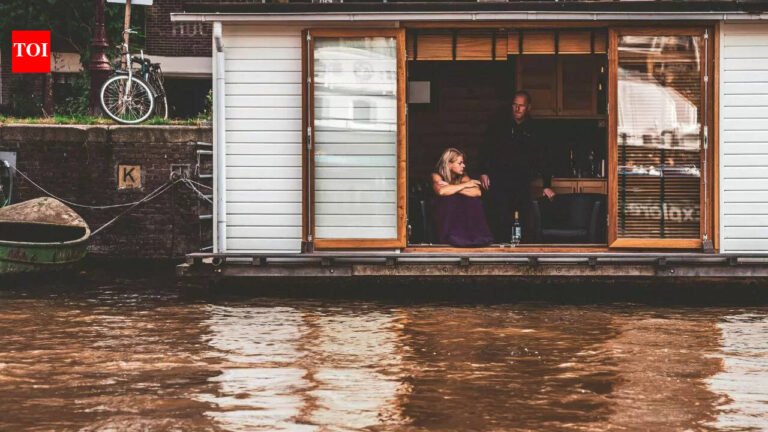
Dutch floating homes are not traditional houseboats. They are permanent structures built with modern building materials. Most are built on concrete platforms that act as floating foundations.These platforms are attached to steel poles driven into the water bed. The poles allow the houses to move up and down but keep them in place. This system helps the home remain stable during storms and changes in water levels.The buildings are also connected to electricity, water, sewage and internet networks. From the inside, they look a lot like regular houses on land.A concrete hull beneath each house acts as a counterweight. This keeps the structure balanced. Even in bad weather, activities are often limited.Siti Boelen, a resident of a floating community, told the BBC she felt safer during storms because her home floated rather than resisting water pressure. This sense of security is one reason more people are interested in water-based housing.
Schoonschip: a floating community in Amsterdam
Amsterdam’s Schoonschip is one of the most famous floating districts. The project was launched in 2009 by Dutch television director Marjan de Blok. Her idea was to create a sustainable aquatic community. After years of planning and collaboration with authorities, Schoonschip became a reality. Today it consists of 30 floating houses, including duplexes. They are located in a former industrial canal area.The residents of Schoonschip share many systems. They operate combined heat pumps for heating and cooling. Solar panels cover approximately one-third of each roof. Energy is shared within the community.Rainwater harvesting, waste management and electricity transport are also part of daily life. These features reduce environmental impact and lower costs.According to the BBC, Schoonschip shows how floating housing can combine climate adaptation with sustainable living.
local government support
Amsterdam city officials are currently adjusting planning laws to support more floating projects. Nienke van Renssen, a city councilor from the Green Left party, told the BBC that floating homes would enable a multi-functional use of space and meet long-term sustainability goals.By updating zoning regulations, the city hopes to make it easier for developers and residents to build homes on the water.Rotterdam is another major city in the Netherlands that has been working on climate adaptation for more than a decade. Most of the city lies below sea level.Since 2010, floating buildings have been part of its climate protection and adaptation strategy. Rotterdam is home to Europe’s largest floating office building and a floating dairy farm.Arnoud Molenaar, the city’s chief resilience officer, told the BBC that Rotterdam now sees water as an opportunity, not just a threat.
How a Dutch water house could become a global climate solution
Dutch architects and engineers are now applying their knowledge abroad. Waterstudio, led by Koen Olthuis, has designed around 300 floating structures worldwide.A major project is underway in the Maldives. It aims to create a floating area that can accommodate about 20,000 people. The Maldives faces serious risks from rising sea levels, so floating homes are particularly important.Another company, Blue21, is developing plans for floating islands in the Baltic Sea that could house up to 50,000 residents.Orshuis told the BBC that floating houses are no longer seen as strange experiments. Instead, they are becoming part of what he calls “blue cities” where water is used as a planning tool.This approach is currently influencing coastal development in areas such as French Polynesia and Southeast Asia.
Challenges of living on the water
Floating homes are not without their problems. Severe storms can still cause discomfort. Although the building is stable, movement of the building can still be felt during severe weather. Special infrastructure is also required. Utility connections, waste systems and emergency access require careful design. Maintenance costs may be higher than land-based housing.Building large floating communities requires significant investment. Materials, technology and engineering expertise are expensive.Blue21’s Rutger de Graaf told the BBC that large-scale development is crucial as rising sea levels by the end of the century could displace hundreds of millions of people. Reaching this scale, however, will take time and political support.
Floating homes and the housing crisis
The Netherlands needs 1 million new homes, and floating housing can play a supporting role. It won’t solve the shortage alone, but it can add valuable capabilities. By utilizing water spaces, cities can expand without destroying green spaces.Floating homes are likely to become increasingly important for low-lying countries and island nations. Where land is disappearing, building on water may be one of the few options.BBC reporting shows Dutch-led projects have impacted planning in vulnerable areas.
Adapting lifestyles to climate change
Floating homes in the Netherlands represent more than just a housing trend. They reflect a deeper shift in the way society responds to environmental change.Rather than trying to completely control nature, these communities adapt to it. Houses were raised from the ground due to flooding. The community is designed with flexibility in mind. Energy and water systems are shared.From the canals of Amsterdam to projects in the Maldives, this model is spreading. It combines engineering, environmental awareness and social cooperation.As climate risks increase and land becomes increasingly scarce, living on water may become less of an exception and more of a necessity. The Dutch experience, documented by the BBC, shows how innovation, planning and long-term thinking can transform a natural threat into a livable place.

Drama at Pappu Yadav’s home: Police arrive to arrest Bihar MP; he claims plotting ‘to kill’ | India News
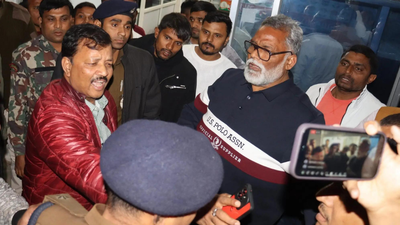
New Delhi: Police reached the residence of Patna Purnia MP Pappu Yadav late on Friday night in connection with an old case.Meanwhile, Pappu Yadav resisted arrest and accused the Bihar police of hatching a plot to kill him, saying policemen in civilian uniforms came to his residence like criminals.“I suspect these people may have killed me. I will go directly to the court. I will not go to the police station. If they want, they can put me under house arrest. The court will call me tomorrow,” Pappu Yadav said.“The police came here in civilian clothes like criminals. I thought they were here to kill me. Is this a criminal’s house?…A case was registered about 35 years ago and the police came to arrest me in connection with the case,” he added.In X’s social media post, Pappu Yadav claimed that police were present at his residence as he was protesting against the student’s death.“Fantastic Bihar Police. We fought for justice for the NEET girl students and the Bihar Police feel the pain deep inside,” he said.“They showed up at Patna residence to arrest us. But that will not make Pappu Yadav surrender or shut up. We will continue to expose the wrongdoings of dishonest people! Send us to jail, or give us a noose – Pappu will not stop,” he added.(This is a developing story)
‘I want to give you Rs 2 alms’: Owaisi slams Himanta Sarma over ‘Troublesome Miya Muslims’ remarks India News
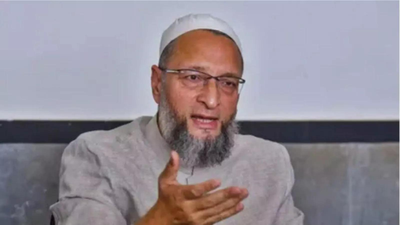
New Delhi: Chairman, AIMIM Asaduddin Owaisi Sharp attack on Assam chief minister on Tuesday Naimanta Biswa Sarma for his controversial remarks about the “disturbing Muslims of Mia”, calling them unconstitutional and divisive.Owaisi mocked the chief minister and said: “I want to give you Rs 2 as a charity” and accused him of reducing constitutional governance to bias and intimidation. In a lengthy response, Owaisi said the Indian constitution guarantees equality and non-discrimination irrespective of religion or community. “The Constitution says that everyone is equal. There should be no discrimination, whether it is the chief minister or anyone else,” he said.Owaisi alleged that Bengali-speaking Muslims in Assam were being scapegoated for issues such as immigration and rising prices. “If vegetable prices go up in Assam, Miya Muslims are blamed. If anyone wants to vote, they are told to go to Bangladesh,” he said, adding that such rhetoric amounted to targeting a community for political gain.The AIMIM leader’s remarks came after Sarma issued a statement encouraging action against the “Miya Muslims” in Assam. “Create trouble for Miya Muslims in any way. If they get into trouble, they will leave Assam… We are directly against Miya Muslims. We will not hide anything,” Sarma said.The comments sparked a political storm in the election-bound northeastern state, with opposition parties accusing the BJP of exploiting communal polarization to consolidate votes. However, the BJP has long maintained that its focus in Assam is on tackling illegal immigration and protecting indigenous rights. Bengali-speaking Muslims are often labeled as “illegal infiltrators” in political discourse, an issue that remains at the heart of Assam’s electoral politics.
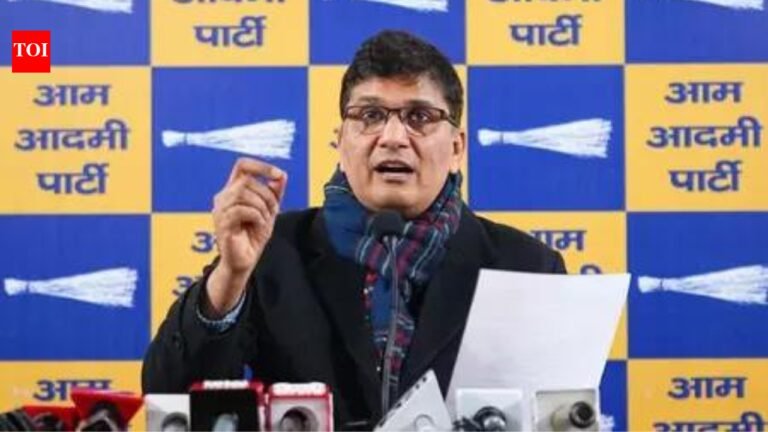
‘Shameless government and police’: AAP’s Saurabh Bhardwaj slams BJP over Janakpuri youth’s death | News India
Seven Naxalites, including top leader, killed in Gadchiroli; Special Forces Jawan dies of injuries India News
New Delhi: At least seven Naxalites were killed in clashes with police special forces in Maharashtra’s Gadchiroli on Friday.Prabhakar, the top Naxalite leader from Telangana state, was also among the seven Naxalites killed, officials said. A bounty of Rs 25 lakh is being offered on Prabhakar’s head, officials addedThree days ago, the Maharashtra police launched an operation in Phodewada village on the Gachiroli-Narayanpur (Chhattisgarh) border after receiving information about the presence of cadres of Maoist Company 10. According to officials, the incident involved 14 C-60 aircraft owned by the SDPO.On Wednesday, police busted two Naxalite camps and on Thursday morning they deployed four more C-60s and a QAT (Quick Action Team) unit of the Central Reserve Police Force for reinforcements.C-60 is a special operations force of the Maharashtra Police tasked with combating Naxalism in Gadchiroli and Gondia districts.During the operation, Deepak Chinna Madavi, a soldier of the Special Forces, also died of his injuries. According to police, Deepak was airlifted to Bamragad after being injured in an anti-Naxal operation earlier and died during treatment.Another injured, Joga Madavi, was also airlifted to Bhamragad. He is out of danger and will be rushed to Gadchiroli soon, police said, adding that the operation was still on.
Zubayar Bakush: 5 key things to know about the suspect in the 2012 Benghazi consulate attack
Attorney General Pam Bondi said on Friday that Zubaar al-Bakoush, the main suspect in the deadly 2012 attack on a U.S. military base in Benghazi, Libya, had been arrested. Bundy added that Bakush landed at Joint Base Andrews in Maryland at 3 a.m. local time. “We never stop seeking justice for crimes against our country,” she said.

5 things you need to know about Zubaar al-Bakoush
Killed 4 Americans
Zubayar Bakush was part of the 2012 attack that killed four Americans in Benghazi. The attack on the night of September 11 included at least 20 militants armed with AK-47s and grenade launchers who broke through the gates of the consulate compound and set fire to the building.
Ambassador Chris Stevens and State Department employee Sean Smith
The fire killed Stevens and Smith. Other State Department personnel fled to a nearby U.S. facility known as the Annex.
Zubayar Bakush faces serious charges
Attorney Jeanne Pirro revealed that an eight-count indictment charged Al Bakush with crimes including the murders of Stevens and Smith.
First photo of Zubayar Bakush surfaces
A photo shows Zubayar Bakush being carried on a stretcher at Joint Base Andrews on Friday.
Contact with planners
A Libyan militant suspected of being the mastermind of the attack, Ahmed Abu Khatala, was captured by U.S. special forces in 2014 and taken to Washington to face prosecution. He was convicted and is serving time in prison.
Barack Obama, Hillary Clinton slam
The 2012 Benghazi attack quickly became a deeply divisive political issue. Republicans have repeatedly criticized President Barack Obama and then-Secretary of State Hillary Clinton for lapses in facility security, the military’s response to the violence and the administration’s changing narrative about who was responsible and why.
A final report released by a Republican-led congressional panel concluded that the Obama administration was responsible for security shortcomings at the Libyan outpost and a slow response to the attacks.
However, the same report found no wrongdoing by Clinton.
Clinton dismissed the report as an echo of previous investigations with no new findings and said “it’s time to move on.”
Other Democrats denounced the Republican report as a “conspiracy theory on steroids.”
(With inputs from The Associated Press)