
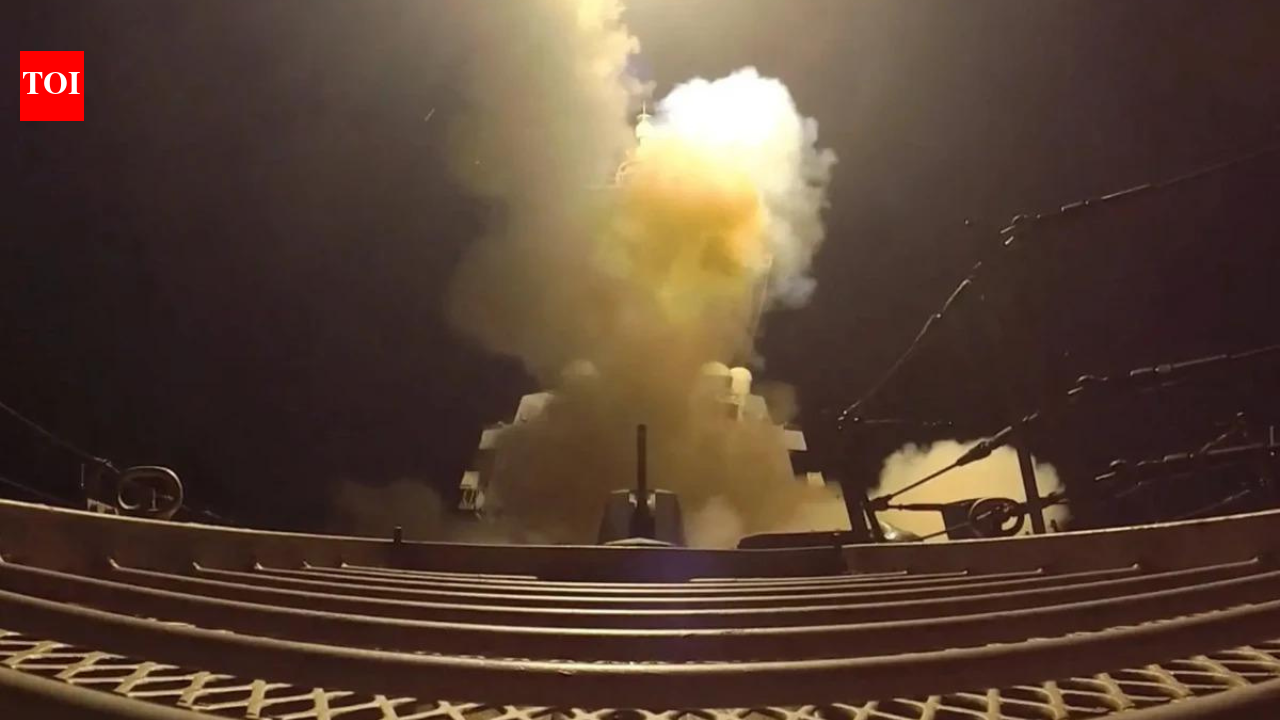
The United States carried out another round of air strikes against Iran on Wednesday (local time), targeting coastal defense systems and missile infrastructure linked to attacks on commercial shipping in the Strait of Hormuz, as Washington stepped up military action for a fifth day.U.S. Central Command (Centcom) said the latest attack was aimed at degrading Iran’s military capabilities used to threaten ships passing through the strategic waterway.“At 3pm EST today, U.S. Central Command forces began launching a new round of strikes against Iran,” Central Command posted on X.“The new focus is on Iran’s military capabilities used to threaten ships traveling freely through the Strait of Hormuz,” the statement added, adding that the U.S. military was “holding Iran accountable at the direction of the Commander-in-Chief.”
Explosions occur in southern Iran
Iranian media reported that explosions occurred in multiple locations after the US attack.Iran’s Mehr News Agency said that US artillery shells hit a location near Bandar Abbas Port and three explosions were heard in Chabahar. The agency also reported an explosion in Ahvaz after Central Command announced a new wave of attacks.There was no immediate official assessment from Tehran of casualties or the extent of damage.
Big Tunbu Island is one of the key targets
The latest attack follows a wave of attacks launched on Wednesday morning.The attack on Grand Tunb Island began at 6 a.m. ET (1100 GMT), targeting Iranian coastal defenses and cruise missile storage and launch sites.Centcom said the operation was completed in approximately 90 minutes.The U.S. military said: “The purpose of these attacks is to further weaken the military capabilities of the Iranian military to attack commercial shipping in the Strait of Hormuz.”Greater Tunb is one of a group of strategically important islands near the Strait of Hormuz that analysts say form part of Iran’s “Arch Defense.”
Confrontation between US and Iran deepens
The latest escalation comes after the United States on Tuesday reinstated a naval blockade of Iranian ports and continued strikes aimed at weakening Tehran’s military presence around the Strait of Hormuz.Washington is targeting Iran’s military capabilities, which it believes must be suppressed before any broader action can be taken to reopen the strait.Confrontations have intensified since Iran announced over the weekend that it would close the Strait of Hormuz. The Strait of Hormuz is one of the world’s busiest energy chokepoints, with about a fifth of global oil and gas shipments passing through it before the conflict.Shipping volumes in the waterway have since fallen sharply, while Brent crude closed at a one-month high of $84.95 a barrel on Wednesday, Reuters reported.
Iran calls conflict ‘survival war’
In response to the latest U.S. attack, Iranian parliament speaker and chief negotiator Mohammad Bakr Qalibaf described the conflict as a “fundamental and existential war” with the United States.“We are engaged in a critical existential war with the United States,” Qalibaf said in a statement.He added that Iran’s security depended on maintaining what he called the “Iranian arrangement” in the Strait of Hormuz.Iran’s Islamic Revolutionary Guard Corps also threatened to expand the conflict by targeting other regional energy export routes, warning the United States “must be prepared to close all other export corridors that benefit the United States and its allies.”Reuters quoted analysts as saying that Tehran appeared to be signaling that it could use its Houthi allies in Yemen to threaten shipping through the Bab el-Mandeb Strait, another important global trade route connecting the Red Sea to the Gulf of Aden.
Trump again puts pressure on Tehran
The latest military action comes as U.S. President Donald Trump continues to pressure Iran to return to talks.On Tuesday, Trump warned that the United States could target Iranian energy infrastructure and bridges if Tehran refuses to resume talks.“I’ll save the energy goals for last, but eventually we’re going to get there,” Trump said.Asked on Wednesday if Iran had a deadline before the United States could begin attacking bridges, Trump responded: “I don’t like giving deadlines, but they pretty much know, they know the story… They better behave better. “U.S. negotiators have told Iranian negotiators “you better make a deal.”However, Iranian Foreign Ministry spokesman Esmail Baghaei said that Tehran has no plans to return to negotiations and remains focused on defending the country.Iran’s Tasnim news agency quoted Baghaei as saying: “We have no negotiation plans at the moment and the focus is national defense.”The new wave of attacks further undermined hopes of reviving a temporary ceasefire signed last month to pave the way for wider talks over Iran’s nuclear program and a permanent end to hostilities.