

New Delhi: In another strong assertion of ‘one nation, one law’, the Supreme Court on Tuesday said the Uniform Civil Code (UCC) is the most effective tool to eliminate widespread discrimination against women in marriage, inheritance, succession and property rights under Muslim personal law and other customary laws.The statement – “The most valid answer is UCC” – came from a bench of CJI Surya Kant, R Mahadevan and Joymalya Bagchi after lawyer Prashant Bhushan said the inferior inheritance rights conferred on women under the Shariat Application Act, 1937, violated their rights to equality and non-discrimination and therefore must be struck down as unconstitutional, just like triple talaq.Bhushan, appearing for PIL petitioner Poulomi P Shukla, said it was unimaginable that Muslim women in Uttarakhand, where the UCC was enacted, would have equal rights to property inheritance with their male brothers and sisters, but Muslim women in Delhi or other states in India would be deprived of the same.
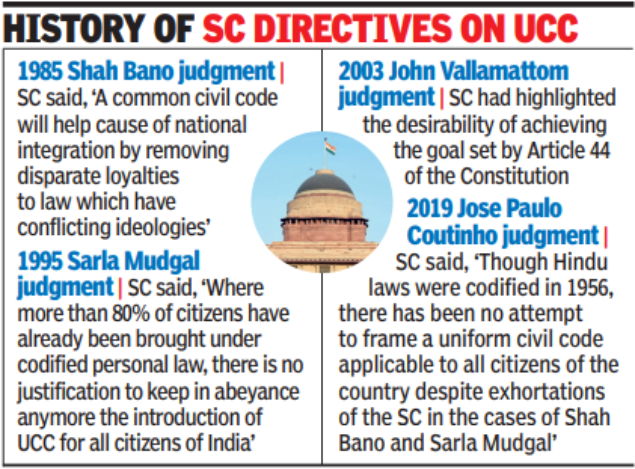
The bench said that even in Hindu undivided families (HUF) and tribal societies, there is inequality in inheritance rights of women compared to their male siblings. “This court has suggested in its judgment the guiding principles of state policy under Article 44 (UCC),” the bench said.The SC told Bhushan that he had made a good case of discrimination against Muslim women but abrogation of an independent provision would not remove the inherent discrimination in Muslim personal laws.“Triple talaq was declared unconstitutional (and subsequently prohibited by legislation enacted by Parliament). But the grounds for divorce in Muslim marriages remain asymmetric. The right of a Muslim woman to dissolve a marriage remains restricted under the 1937 Act. But the grounds for a Muslim man to file for divorce are much wider,” Justice Baqi said. CJI Kant said: “As Justice Bagchi elaborated, the most valid answer is UCC.“Bhushan said this was the ideal situation, but until then, the question remains whether Muslim women’s right to equal inheritance will continue to be violated because the right to equal inheritance under Article 14 is not a fundamental religious custom but a civil right. “What about the marriage rights and inheritance rights of Scheduled Tribes? There is a lot of such discrimination in the society,” Justice Bacchi asked.Referring to Section 2 of the 1937 Act which allows Muslim men to practice polygamy, Justice Baqi said, “Has the basic equality of monogamous marriage been achieved across the country? Can we declare all bigamy or polygamy under personal law to be unconstitutional as it violates the right to equality under Article 14?”“All these must appeal to the conscience of the legislature to achieve the objectives of Article 44 of the Directive Principles of State Policy Chapter of the Constitution,” the SC said.When the bench said the situation would have been different if some Muslim women or the Wakf Committee had filed a petition, Bhushan responded that he could bring in as many Muslim women as petitioners to challenge the discriminatory provisions of the 1937 law on inheritance. “A large number of Muslim women are outraged by this discriminatory practice,” he said.The judges said that if the court struck down the inheritance provisions of the 1937 Act, it would create a vacuum and deprive Muslim women of everything they could get. Bhushan said the Supreme Council could say that the inheritance rights of Muslims would be governed by the secular Hindu Succession Act. The SC asked him to consider all possible scenarios and file a revised petition.