
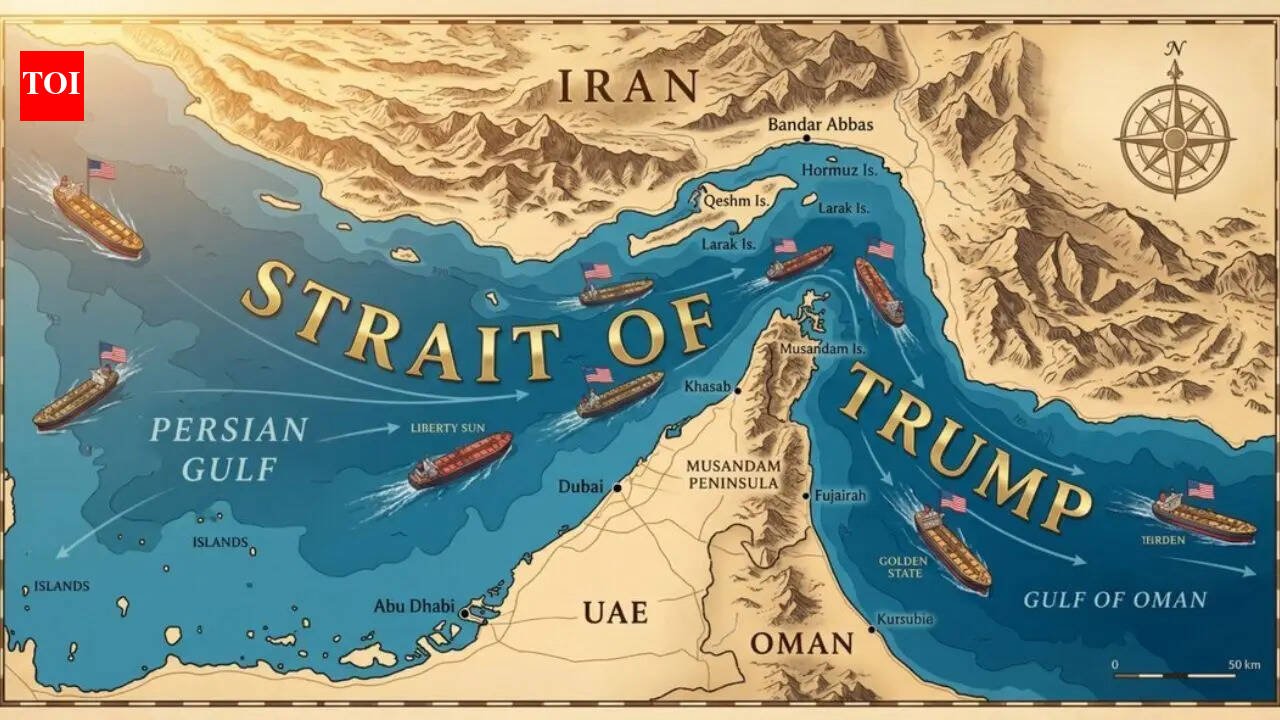
President of the United States Donald Trump On Thursday, a revised map was shared renaming the Strait of Hormuz the “Trump Strait” after claiming a naval blockade on Iran could last for months.Trump posted the image on his Truth Society account, labeling the strategic Strait of Hormuz the “Trump Strait” but without any caption. The image was originally posted by an account named “IStandWithTrump47.”
This is not the first time Trump has made such remarks. In an earlier statement, he appeared to mix up the name, saying Iran needed to “open the Trump Strait, I mean the Strait of Hormuz.”“I’m sorry. I’m sorry. It was a terrible mistake. The fake news is going to say, ‘He said that by accident’ – no, I didn’t have any accident, not much. If it had, we would have had a big story,” he added.The development comes as Trump said the U.S. naval blockade of Iran could last for months. A blockade in place since mid-April targeting ships entering and leaving Iranian ports has sent global oil prices soaring, recently hitting their highest level in more than four years.Earlier, a report from the Institute for the Study of War indicated that Iran was unlikely to back down. Analysis shows that Ahmed Vahidi’s hard-line approach has become dominant among Tehran’s leadership.Reports say Iran is unwilling to negotiate its nuclear program until the United States lifts its blockade and is exploring other strategies to maintain influence.These include a possible plan with Oman to impose tolls on ships passing through the Strait of Hormuz, allowing Tehran to make “new proposals” without compromising its core demands. The report also pointed out that Iran may encourage Yemen’s Houthi armed forces to attack ships in the Bab el-Mandeb Strait, thereby indirectly putting pressure on the United States.Previously, U.S. Treasury Secretary Scott Bessant said that the combined impact of sanctions and maritime blockade would cause long-term damage to the Iranian economy.“Treasury, through Economic Fury, targeted Iran’s international shadow banking infrastructure, cryptocurrencies, shadow fleets, weapons procurement networks, funding of terrorist proxies in the region, and independent Chinese ‘teapot’ refineries that support Iran’s oil trade. These actions disrupt tens of billions of dollars in revenue that would be used to fund terrorism,” Scott said.“Iran’s main oil export terminal, Khargah Island, will soon approach storage capacity, which will force the regime to reduce oil production, causing an estimated $170 million in additional lost revenue per day, and causing permanent damage to Iran’s oil infrastructure. The Treasury Department will continue to apply maximum pressure and any person, vessel or entity that facilitates illegal flows into Tehran may be at risk from the United States.” Sanctions,” he added.Iran, however, has denied the U.S. claims and criticized the strategy. Parliament Speaker Mohammad Bagher Ghalibaf dismissed Bessant’s remarks, calling his suggestions “rubbish.”“Three days later, no wells exploded. We could expand to 30 and livestream the wells here. This is the rubbish advice the US government is getting from the likes of Bessant, who are also pushing the blockade theory and pushing oil above $120. Next stop: $140. The problem is not theory, but mentality,” Ghalibaf said in a post on X.