
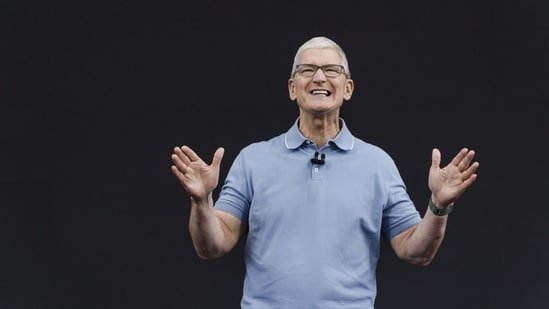
Apple CEO Tim Cook’s decision to step down after nearly 15 years in the job has sparked widespread reaction across the tech industry, with many focusing on his legacy and the company’s next phase.


Cook confirmed that John Ternus, Apple’s senior vice president of hardware engineering, will take over as CEO in September 2026, and Cook will transition to executive chairman. In a message to the Apple community, Cook emphasized that the move marked a transition, not a departure, writing: “This is not a farewell… I want to take this opportunity to say thank you.”
The reflective and unusually personal memo quickly became the focus of reactions across the tech industry.
The message resonates beyond Apple
Cook’s notes no longer speak corporate language, instead focusing on day-to-day user stories and his connections with Apple customers.
“In every email, I feel the beating heart of our common humanity,” he wrote, referring to the messages he read from users around the world.
He also described the position as “the best job in the world” and viewed his exit as a sign of gratitude, not closure.
That tone dictates how industry leaders react, not just to the leadership change but to how Cook chooses to label it.
Industry leaders highlight leadership legacy
Executives and investors generally view Cook’s tenure as stable and transformative, especially given the challenges of succeeding Steve Jobs in 2011.
Former Apple CFO Peter Oppenheimer said,
“He stepped into the biggest shoes in the world — the biggest shoes that anyone on Earth has ever had to step into — and he did an incredible job.”
OpenAI CEO Sam Altman said, “Tim Cook is a legend. I am very grateful for everything he has done, and I am very grateful to Apple.”
“He’s a very successful CEO, but you think he would have been difficult to replace before,” said Rick Meckler, a partner at Cherry Lane Investments, according to Reuters. “I hate to see him leave the CEO position as an investor.”
“He’s never going to leave if the numbers are bad, so I think that’s the important thing. They’re about to report numbers and you know they’re going to be good,” said Art Hogan, chief market strategist at B. Riley Wealth Management.
Not all reactions were serious. Oculus founder and Anduril CEO Palmer Luckey struck a lighter tone, posting “RIP Tim Apple” on the X — a tongue-in-cheek nod to the viral nickname once used by Donald Trump.
An era of leadership that defined modern Apple
Cook, who succeeded Steve Jobs in 2011, is credited with transforming Apple into one of the world’s most valuable companies. His calm, operations-oriented leadership style stood in sharp contrast to Jobs’ product-first approach, but proved equally influential.
Several industry leaders highlighted this shift. Silicon Valley executives praised Cook for building Apple’s services ecosystem, strengthening its supply chain, and expanding globally while maintaining continued growth.
Many point to Cook’s greatest strength being stability. At a time when technology companies have faced volatility, Apple has maintained predictable performance and a disciplined strategy under his leadership.
As the company prepares for its next chapter, Cook’s words seem to best capture the broader sentiment: It may mark the end of an era, but the end of his influence on Apple’s future.