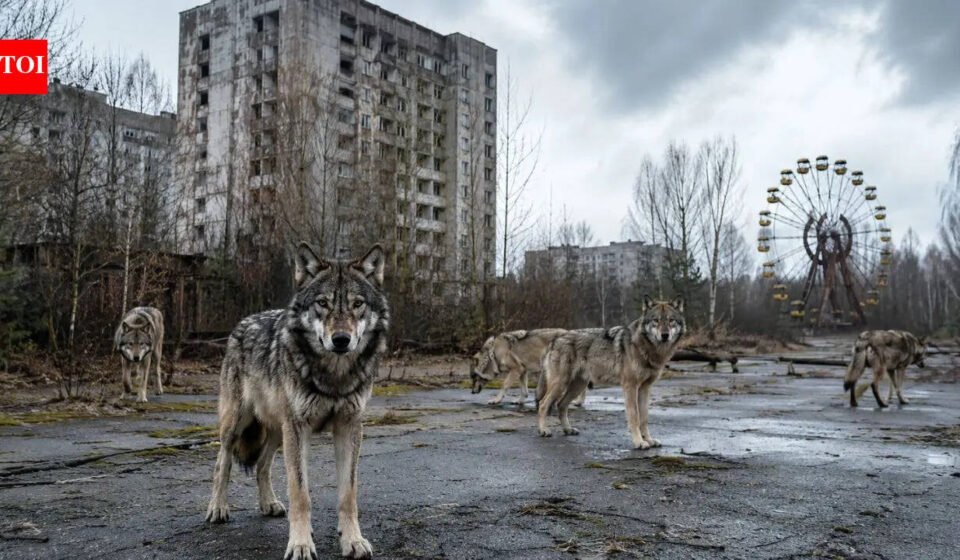
The Chernobyl nuclear power plant was evacuated in 1986 and now wolves are once again dominating the radiation exclusion zone, with an unexpected wildlife recovery |

The first impression of the Chernobyl landscape is not dramatic but rather quiet and feels a little unfinished, as if something stopped in the middle and never came back to complete it. Roads that once carried daily traffic now disappear into grass and saplings, and the silhouettes of Pripyat’s buildings take on a reluctant silence. Within the wider Chernobyl exclusion zone, uninhabitability has become its defining condition, affecting everything from forest growth to the movement of animals on abandoned land. What’s most striking, however, is not the emptiness but the activity that doesn’t seem to belong in a place filled with disaster. Wolves moved across the land with unusual ease, deer wandered across the open land, and the land had settled into a rhythm that was both ordinary and slightly out of place.
how Chernobyl disaster Reshaping land use and wildlife patterns
According to National Geographic, when evacuation orders were issued in 1986, human footprints around the reactors did not fade away. It broke quickly. Farms are no longer tended, roads are no longer maintained, and hunting pressure disappears almost overnight. What remains is a landscape free of daily distractions.Over time, vegetation recovers in an uneven manner. Pine trees grow thickly in some places, while others remain open due to soil conditions and lingering pollution. Having no regular interruptions is as important as anything else. Where human activity once shaped the terrain, nature began to fill in the gaps in its own uneven way, without any clear plan or direction.In that space, animals that were once confined to the margins began to move more freely. Some species increase in abundance not because conditions are ideal but because familiar constraints are removed.
How gray wolves expanded throughout the world Chernobyl abandoned landscape
One of the most closely observed changes is the emergence of gray wolves. The number of people in the restricted area is believed to be significantly higher than before the evacuation. It’s not that the environment is getting easier in the traditional sense, it’s that the environment is getting quieter, which is more important to them.Without hunting pressure or continued human disturbance, wolves have expanded their range into forests and former farmland. Camera traps and field tracking show them crossing ancient roads and through villages now reduced to just wooden structures and weeds, and stalking prey that return in equally large numbers.There is nothing abnormal about wolf behavior, either instinctively or structurally. What has changed is their operating space. The territory is less disturbed. Movement is less restricted. In some areas, they appear to be occupying turf that was previously too risky or too fragmented to be of sustained use.
Chernobyl radiation Impact on wildlife: What wolf research reveals
Animals in this area are exposed to higher levels than in most natural habitats, but exposure varies by location and behavior. Collar-based monitoring shows that wolves encounter doses higher than those acceptable to humans in controlled environments. Despite this, the population did not collapse. They continue to reproduce, move and maintain stable social structures.Biological sampling adds another layer of complexity. In some wolves, changes in gene activity have been documented, particularly in areas related to immune response and cell repair. Certain genetic markers associated with cancer resistance have attracted attention, but interpretation remains cautious. These are not signs of immunity or adaptation in any simple sense, but rather suggest that natural selection may act differently on individuals under long-term environmental stress. It is also worth noting that this pattern does not appear to be consistent across species. What seems manageable for large mammals does not necessarily apply to smaller or shorter-lived animals.
What genetics might suggest
Genetic work in the region focuses on determining whether long-term exposure leaves measurable traces on wildlife populations. Changes in thousands of genes were observed in the wolves compared to a reference group from less polluted areas.Many of these changes are centered around systems that deal with inflammation and DNA damage. Although no single gene serves as a clear explanation for survival or resistance, a few genes stand out in cancer-related pathways.One gene often discussed in research notes is related to immune regulation. Its behavior in Chernobyl wolves raises questions about whether generations of repeated exposure are developing subtle biological differences. The evidence is not conclusive in any respect. It suggests pressure, not determination.The idea that wild animals might have adapted to radiation in clear evolutionary lines remains speculative. What is clearer is that survival in this environment is not uniform and cannot be reduced to a single biological response.
How Chernobyl’s abandoned landscape is reshaping mammal and bird populations
While wolves have taken center stage, they are part of a broader, more uneven return of wildlife within the exclusion zone. Large mammals such as wild boar, elk, and deer have recolonized many areas. Some have taken advantage of reduced human activity and regrowth of vegetation to increase their numbers.Smaller species tell a different story. Some bird populations show signs of stress, including reproductive abnormalities and physiological stress. Insects and soil organisms also appear to fluctuate more dramatically depending on pollution levels and habitat conditions.The contrast is stark. In some places, the forest gives a vibrant, lush feel. In other ways, it remains in the doldrums, as if the recovery is partial and still negotiating its limits. Human absence does not produce a single outcome. It produces multiple overlapping ones that don’t always line up.