
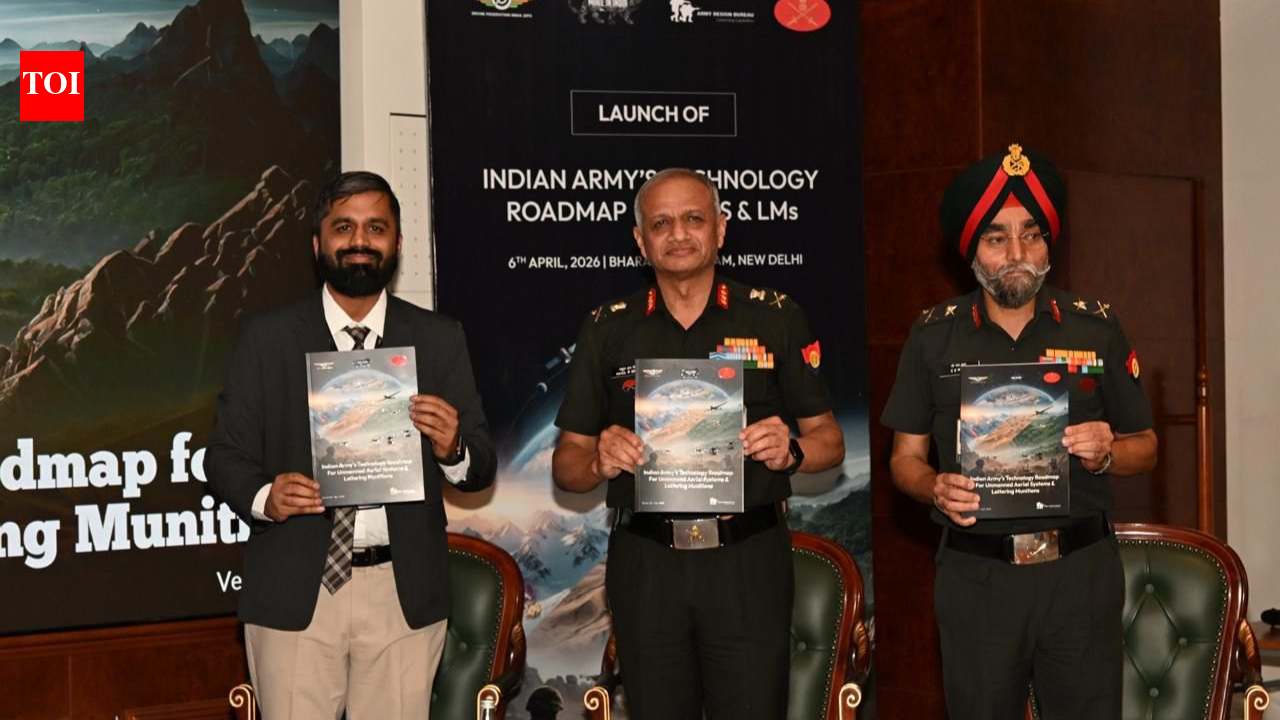
New Delhi: The Indian Army has released its first-ever comprehensive technology roadmap for unmanned aerial systems (UAS) and loitering munitions, aiming to provide long-term visibility of the force’s requirements in the UAV domain. On April 6, Lieutenant General Rahul R. Singh, Deputy Chief of Staff (Capability Development and Sustainment) of the Indian Army, released the nearly 50-page document “Indian Army Unmanned Aircraft Systems and Loitering Munitions Technology Roadmap” in New Delhi, providing clear, actionable visibility to industry, academia and research and development institutions, allowing them to direct investment, time, energy and technical efforts to priority areas identified by the Army. The Indian Army’s roadmap lists 30 types of drones and loitering munitions divided into five categories: surveillance, loitering munitions, air defense role, special role and logistics.It is designed as a forward-looking strategic document to leverage indigenous capabilities to meet the evolving needs of modern warfare. It also integrates lessons from recent conflicts such as the Russia-Ukraine war and conflicts in West Asia, where unmanned systems have had a significant impact. By clearly setting out technical and operational priorities, the document seeks to serve as an important bridge between operational requirements and technological developments, ensuring that India’s drone ecosystem evolves in a structured, demand-driven manner. The initiative is also expected to promote greater participation from start-ups, MSMEs and academia, while encouraging long-term investment in this critical emerging technology.At the event, Lieutenant General Rahul R. Singh warned about the sensitivity of the document and urged stakeholders not to share it with unauthorized persons. He said Pakistan and China might want to get their hands on the document and urged extreme caution.He cited the conflict in West Asia as an example, pointing to the deployment of Iranian-made Shahed-136 drones and the United States’ “reverse-engineered” cheap drones LUCAS (Low-Cost Unmanned Combat Attack System), aimed at countering Iranian attacks. “We all need to be aware of this and make sure that in the event of conflict, we are able to act as a well-oiled machine,” Lieutenant General Singh said. He described services, industry and academia as a “troika” and claimed that engagement between the military and industry has grown over the past few years.Major General CS Mann, deputy commander-in-chief of the Army Design Bureau, said this is the first time the Army has shared such specifications related to the unmanned aerial vehicle and loitering munitions fields, reflecting the emphasis on these capabilities.The document mentions details like device name, type, expected life cycle, approximate quantity and its variant information.