
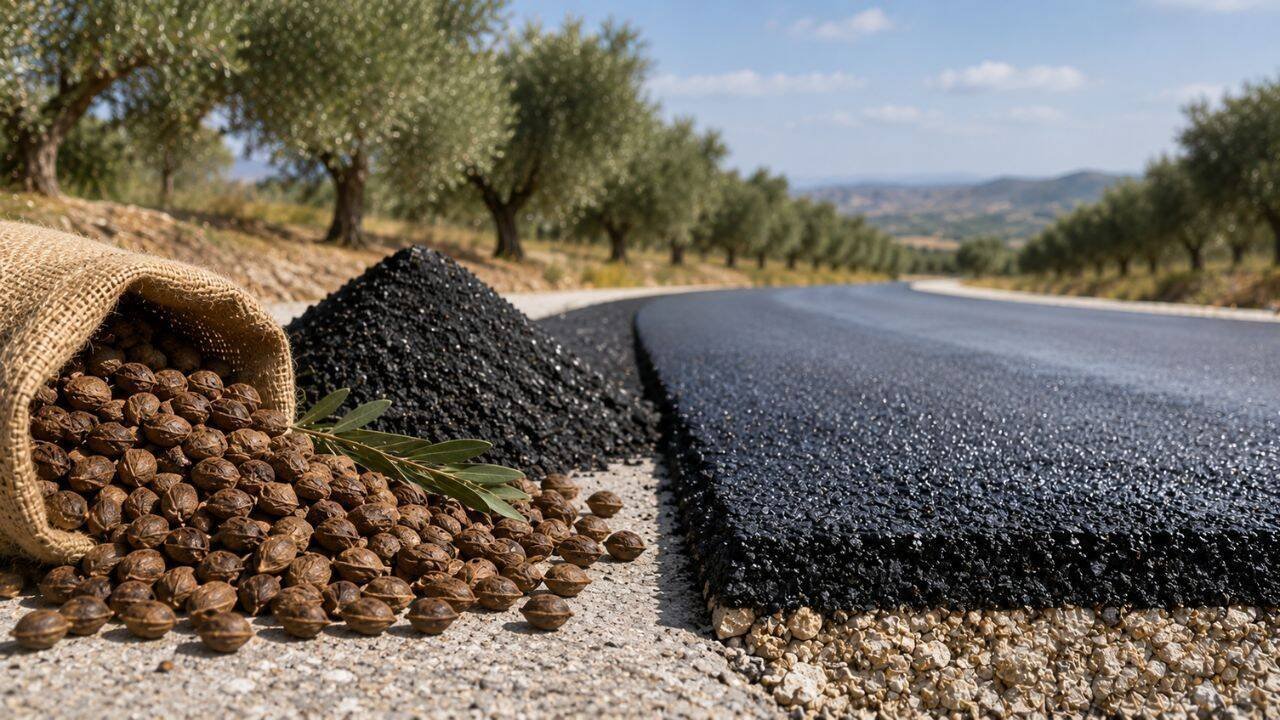
Cities spend huge amounts of money repairing roads, sidewalks and public spaces, but the environmental costs of these materials receive little attention. Asphalt may look ordinary once it’s laid, but the production and transportation of the ingredients that go into the road surface creates significant emissions. Across Europe, local authorities are increasingly looking for ways to reduce their footprint without compromising durability or safety.In Barcelona, an experiment is testing whether agricultural waste could be part of the answer. Rather than relying solely on traditional mineral ingredients, engineers developed an asphalt mixture that contains biochar made from olive pits and other plant residues. According to the Advanced Carbon Council, The material has been tested on a public street in the city and its performance monitored under real traffic and weather conditions. The project offers a glimpse into how future roads may serve a second purpose beyond transportation: storing carbon within the infrastructure itself.
How olive pits are converted into biochar sustainable road construction
Spain produces a large number of olives each year, resulting in a large number of olive pits, which are often considered a by-product of the food industry. Rather than letting the material break down or burn, engineers working on the Barcelona project convert it into biochar through pyrolysis, a process that heats organic matter in the absence of oxygen.The result is a solid, carbon-rich material that can be incorporated into building products. The biochar project replaces mineral fillers typically used in asphalt with biochar derived from olive pits and pine residue, according to the Advanced Carbon Council. The concept stems from Barcelona’s ‘21st Century Street Section’ challenge, which seeks practical ways to reduce emissions associated with rebuilding roads and pavements.The proposal was developed through a collaboration between the architecture firms AMSA and ELSAN and researchers from the Polytechnic University of Catalonia.
How olive pit biochar helps roads store carbon and reduce emissions
What’s unusual about this material is the way it handles carbon that would otherwise be returned to the atmosphere. Olive trees absorb carbon dioxide as they grow. If these pits are allowed to decompose or be used as fuel, much of the stored carbon will eventually be released again.Pyrolysis changes this pathway. The carbon remains locked within the biochar, and when the biochar becomes part of the asphalt mix, it remains embedded in the road surface for years or even decades. This approach reportedly effectively transforms parts of urban infrastructure into long-term carbon storage assets.If the technology proves scalable, the environmental impact could be significant. The committee reported that Barcelona Mix aims to reduce the carbon footprint of asphalt paving by around 75% compared to traditional alternatives. Early data from pilot installations reportedly indicate reductions of similar magnitude.
Barcelona tests Olive Pit biochar road under real traffic conditions
Lab results can only reveal so much. Road materials face constant stress from vehicles, temperature fluctuations, rainfall and daily wear and tear, which is why the city has moved beyond controlled testing.According to reports, a pilot covering an area of approximately 2,000 square meters was installed on Cerdà Street in Barcelona’s Eixample district. Soliger Construction Group is evaluating how the surfaces perform under everyday conditions, examining factors such as durability, crack resistance and overall performance.The trial also aims to answer practical questions beyond engineering. Municipalities need to understand whether the material can be continuously supplied, whether it fits into existing procurement systems, and whether maintenance requirements differ from standard asphalt. These considerations often determine whether an innovation remains a pilot project or becomes part of regular public works.
Why olive waste could play a bigger role in low-carbon buildings
Part of the idea’s appeal lies in the raw materials themselves. Spain is the world’s largest producer of olive oil and produces large amounts of agricultural residue each harvest season. Converting waste into construction resources can provide an alternative to disposal while reducing reliance on traditional materials extracted from quarries. Researchers have also explored the use of olive pit biochar in concrete, where it shows potential to reduce carbon emissions and improve water permeability. This wider study suggests the technology may have other applications beyond road construction.The official project description cited by the committee states that the asphalt mixture remains fully recyclable, while the aim is to significantly reduce carbon emissions. Underscoring the wider potential of biochar-based building materials, Carboliva CEO Alvaro Espuny told Olive Oil Times: “Given that concrete is the second most consumed material in the world after water, incorporating biochar into the construction of future buildings will represent a major step forward in sustainability.“