
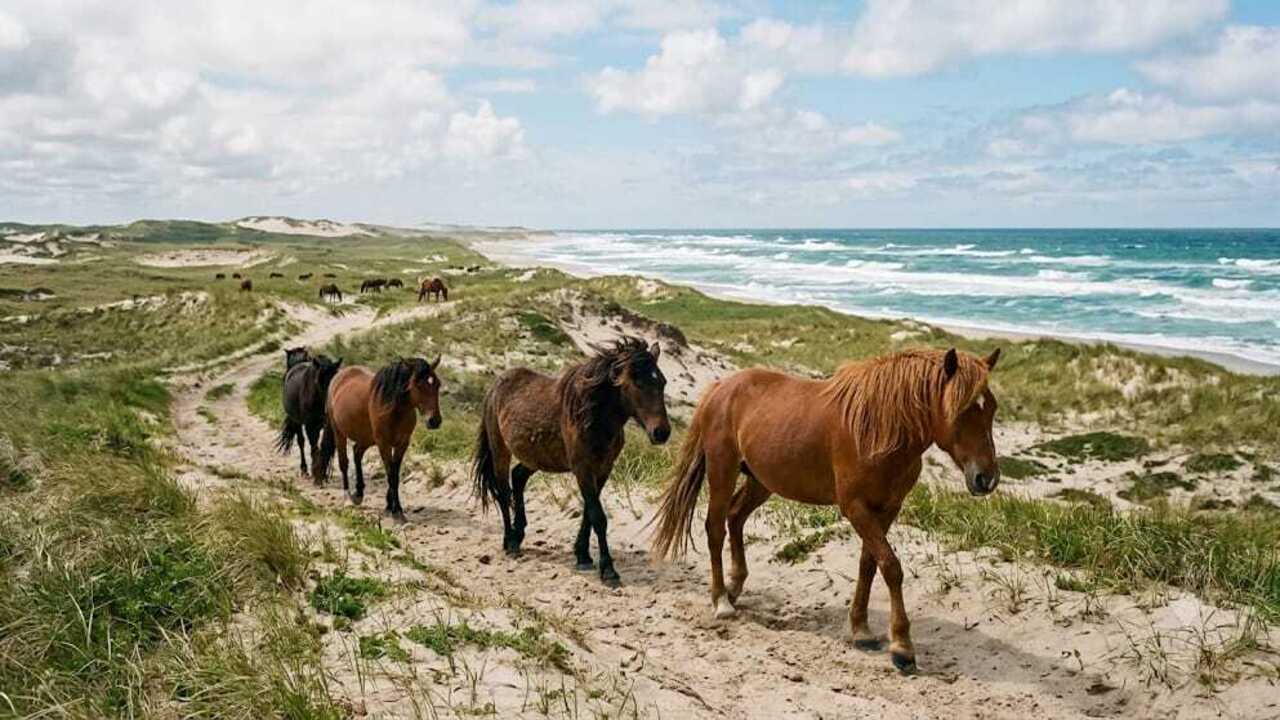
More than 300 kilometers off the coast of Nova Scotia lies one of Canada’s most extraordinary natural landscapes. Sable Island is a narrow, crescent-shaped shifting sand island in the Atlantic Ocean unlike any other in North America. Despite the harsh climate, shifting sand dunes, and complete isolation, the island is still home to a large population of wild horses that have lived without human management for generations. There are no permanent residents, no roads, and very few tourists each year. Protected as a national park reserve, Sable Island has become a haven for wildlife and a living laboratory, where scientists study everything from coastal erosion to animal behavior in one of the world’s most unique island ecosystems.
Where is Sable Island? What makes it one of Canada’s most unusual islands?
Sable Island is located in the Atlantic Ocean about 300 kilometers southeast of Nova Scotia, Canada. The island is approximately 42 kilometers long but rarely wider than 1.5 kilometers, making it one of the longest and narrowest sand islands in the world.Unlike most islands, Sable Island is made up almost entirely of sand deposited by ocean currents, according to Parks Canada. Powerful Atlantic winds and storms constantly reshape the dunes, meaning the island is always changing in size and appearance. Although it appears barren from a distance, hardy grasses and low-growing plants help stabilize parts of the dunes while supporting a surprisingly diverse ecosystem.The waters surrounding it have long been feared by sailors. Hidden sandbars, thick fog and unpredictable weather have caused more than 350 shipwrecks, earning Sable Island the nickname “Graveyard of the Atlantic.”Today the island is protected Sable Island National Park PreserveManaged by Parks Canada, public access is strictly regulated to protect its fragile environment.
How wild horses live on Sable Island
The island’s most iconic inhabitants are its wild horses, whose origins date back to the 18th century. Historians believe the animals are descendants of horses that were brought to Nova Scotia during colonial times and were eventually released or abandoned on the island.Over time, horses fully adapt to life in isolation. Without predators, fencing or human intervention, they developed into a self-sustaining wild population. Today, about 500 horses roam freely around the island, feeding on beach grass and drinking from freshwater ponds formed between the dunes.Unlike many wild horse populations elsewhere in the world, Sable Island’s horses do not receive supplemental feeding, veterinary treatment or population management. Canadian law protects them and allows natural processes to determine their survival and reproduction.Scientists have been monitoring these horses for decades, studying their family structure, genetics and behavior. Because the population has been isolated for centuries, it provides valuable insights into how animals adapt to changing environmental conditions without direct human influence.
More than just horses: an island rich in wildlife
Although wild horses attract global attention, Sable Island is home to a wide variety of other wildlife.The island is home to one of the largest gray seal breeding colonies in the world, with tens of thousands of pups being born on its beaches every winter. Harbor seals also inhabit the surrounding waters, while whales and dolphins are often seen offshore.Sable Island is equally important for birds. It is located along the Atlantic Flyway and is an important stopover for hundreds of migratory bird species migrating between North and South America. Since there are no land predators, some birds also nest on the islands.The dunes are dotted with freshwater ponds that provide habitat for insects, aquatic plants, and other wildlife, making the island’s ecosystem richer than its windswept landscape might suggest.
Why scientists continue to study Sable Island
Sable Island offers researchers a rare opportunity to observe an ecosystem with minimal human disturbance. Scientists monitor the island’s shifting dunes, vegetation, freshwater ponds and wildlife to learn how the isolated environment responds to natural and human-driven changes.The island is becoming increasingly important for climate research. Rising sea levels, stronger Atlantic storms and changing weather patterns are expected to reshape low-lying coastal landscapes around the world. Because Sable Island is composed almost entirely of sand, it provides scientists with a natural laboratory for studying erosion, dune movement, and coastal resilience.Long-term studies of the island’s wild horses have also helped researchers understand population dynamics, social behavior and the effects of environmental stress on the free-ranging mammals.
Vulnerable islands deserve protection
Although Sable Island appears untouched, it remains highly vulnerable to environmental changes. Severe storms frequently alter its coastline, while rising sea levels pose long-term challenges to its unique habitat.Access to the island is strictly controlled in order to minimize human impact. Most visitors require a Parks Canada permit, and there are strict guidelines against disturbing wildlife or approaching horses.These conservation measures ensure that Sable Island remains one of the few places where nature continues to largely shape the landscape on its own. For scientists, this is an invaluable research site. For conservationists, it’s a reminder of the importance of protecting isolated ecosystems. To the rest of the world, Sable Island remains a remarkable place where wild horses still roam freely on the quicksand, just as they have for centuries.