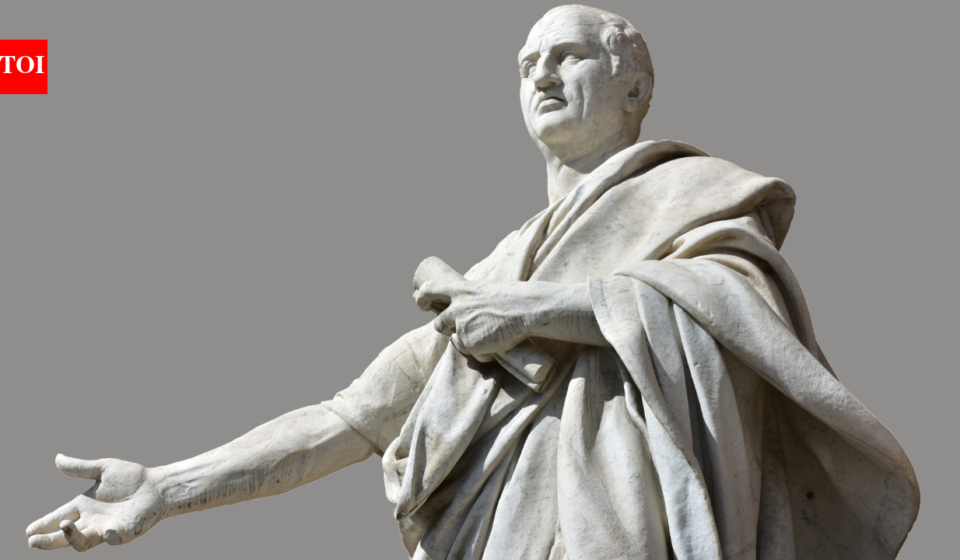
Quote of the day by Cicero: 'If we are not ashamed to think it, we should not be ashamed to say it' and the slow psychological toll of hiding what you really believe

Marcus Tullius Cicero (106–43 BCE) was a Roman statesman, lawyer, philosopher, and one of history’s greatest orators
A boardroom full of executives sits in silence, agreeing with an aggressive expansion plan that several of them privately believe will fail. Each person can see the serious problems, but no one chooses to speak.This gap between what people think and what they say creates a culture of silent agreement. It is this kind of self-censorship that the Roman statesman Marcus Tullius Cicero criticized when he wrote: “If we are not ashamed to think it, we should not be ashamed to say it.” (Si non pudet quia cogitatur, ne subeat quidem pudor quia dicitur.)In simple terms, Cicero argues that our thoughts and words should match. If an idea passes your own moral judgment, staying silent because of fear, social pressure, or a desire to avoid conflict is a failure of courage.
His words remain a challenge to empty politeness, political posturing, and silence in the face of truth.
A letter to a friend in a collapsing Republic
Cicero wrote these words in his Epistulae ad Familiares (Letters to Friends), a collection of private letters written during the final years of the Roman Republic in the first century BCE.Unlike his famous courtroom speeches or philosophical books written for the public, these letters to close friends such as Lucius Papirius Paetus contain honest reflections on politics, friendship, and personal integrity.
At the time, Julius Caesar was expanding his political power, making open criticism increasingly dangerous. Roman public life depended on debate and public speaking, and leaders were expected to defend their beliefs openly in the Forum. As a lawyer and former consul, Cicero believed that hiding one’s true opinions for political convenience was a sign of moral decline.The quote appears in a discussion about parrhesia, or frank speech. Cicero argued that honest opinions, when expressed without malice, should not be silenced because of social expectations or political fear.
He believed that when ordinary people stop speaking necessary truths, institutions begin to weaken from within.
The philosophy of matching thought and speech
At its heart, Cicero’s idea is based on Stoic and Academic Skeptic views about truth, character, and moral responsibility.The Stoics believed that true virtue requires consistency. A person cannot claim to be honest while holding one set of beliefs in private and expressing another in public. When thoughts and words no longer match, character becomes performance rather than integrity.Political philosopher Hannah Arendt later explored a similar idea. She argued that public life begins to decline when people replace honest discussion with careful compliance. When individuals hide their real opinions simply to fit in, several problems follow.
- Cognitive dissonance: Hiding sincere beliefs creates mental conflict, leading people to justify their silence and gradually move away from their own values.
- Loss of
institutional trust : Organizations that discourage honest discussion often create the appearance of agreement while hiding serious problems until they become much harder to solve.
For Cicero, if an idea is morally acceptable enough to think about honestly, keeping it hidden only protects bad decisions from being questioned. Truth survives only when people are willing to speak it.
Speaking up and the cost of silence
Even today, Cicero’s message remains relevant to workplaces, governments, education, and personal relationships.Modern corporate history shows how dangerous silence can be. When engineers, safety inspectors, or managers notice serious problems but choose not to speak because they fear conflict or punishment, the results can be disastrous. Many industrial accidents and financial scandals have been made worse because people stayed silent even when they knew something was wrong.Harvard Business School professor Amy Edmondson introduced the idea of psychological safety—a workplace where people feel comfortable raising concerns without fear of embarrassment or retaliation. Cicero’s quote complements this idea by focusing on the individual’s responsibility to speak honestly when it matters.
Whistleblowing and accountability: Many investigations into corporate or political wrongdoing begin because someone decides to report problems instead of remaining silent.- Academic freedom and innovation: Universities and research institutions suffer when scientists avoid sharing unpopular findings or new ideas because they fear criticism.
- Personal relationships: Friendships and professional partnerships often weaken when people hide important concerns instead of discussing them openly.
Cicero was not encouraging people to speak without thinking or to be rude. His point was that honesty should come before comfort. If an idea meets your own standards of truth and morality, staying silent simply to avoid discomfort or personal risk is a failure of responsibility.As Cicero’s own life showed, speaking openly during times of political decline can be dangerous. But remaining silent allows bad ideas and poor leadership to go unchallenged.