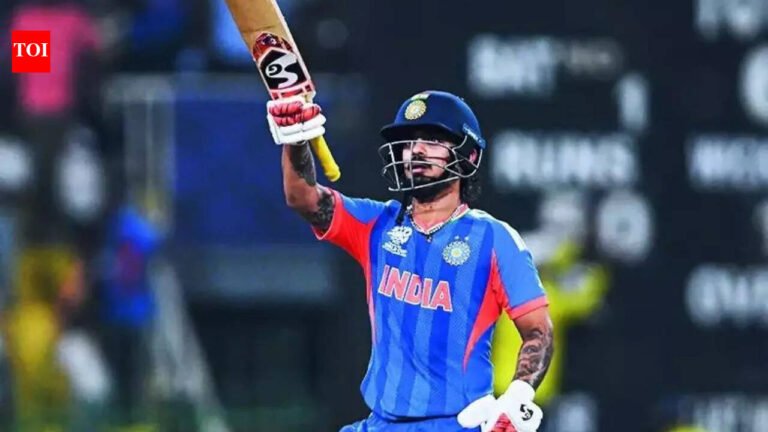

TimesofIndia.com in Colombo: On the surface, time is a luxury, survival itself is like an act of resistance, Ishan Kishan staged one of the most intense innings in the ongoing T20 World Cup. Against Pakistan, the pitch at the R Premadasa Stadium caught, turned and kept forcing the batsmen to check their shots as Kishan played an innings that put India ahead at 175 for 7.The left-handed bowler scored 77 runs off 40 balls while the other Indian batsmen scored only 98 runs in 80 deliveries.From the start, the signs were obvious. When Shaheen Afridi dug out a ball from short range, Kishan turned and fired the ball into the stands. This is not reckless bravado. This is intentional. Pakistan captain Salman Ali Agha personally bought the ball for spinners and got rid of Abhishek Sharma, the batsman that everyone was talking about before the match.What happened was a four-ball duck from Abhishek, who is yet to open his account in the T20 World Cup. Salman’s decision to open a bowling alley proved to be a masterstroke. After three dots, Abhishek decided to take a pick but the pass was poor and he mistakenly passed the ball to the middle where Shaheen easily caught the ball.Kishan understood early on that Pakistan wanted to cause damage on the ground. His answer is to stay ahead.The spin comes quickly and with it comes the real test. Off-spin balls from Salman Ali Agha and Saim Ayub immediately found their turn and the ball held on and veered sharply away for some distance. Kishan’s response was not to retreat defensively but to expand his options. Sweeps, sweeps, reverse bats and inside-outs followed one another, forcing Pakistan’s fielders to constantly readjust.Only 27 balls were launched out of the fifty, flying directly over the bowler’s head and it told a story that was more important than the numbers. It was a clear shot from Kishan, reading the length early and trusting his hands even if his feet didn’t always land. At one point, his right leg may have cramped, but that didn’t slow him down. If anything, it strengthened his resolve.Kishan showed rare adaptability in the face of Abrar Ahmed’s high ball. When the length is full, he goes straight. When it was short, he rocked back and stabbed through the gap. That even ill-timed shots were played safely is testament to how deep Pakistan were forced to set their field. The message is clear. The defensive line doesn’t work.The most brutal phase was against Shadab Khan. A floater in the middle disappears into the crowd with a ferocious sweep. Another slipped from his legs and was punished behind the phalanx. Pakistan’s plan to stifle India in the middle is being unraveled ball by ball.It wasn’t just the stroke play that made the innings stand out, it was the context. This is not a flat track designed for excess. The pitch required patience but Kishan refused to be trapped. He understands that in a high-pressure contest between India and Pakistan, momentum is as important as movement. Every boundary weakens belief and every six Pakistan fans remain silent in the stands.Fittingly, his dismissal was achieved through skill rather than force. Saim Ayub slowed down, pulled Kishan across the crease and let the surface do the rest. The ball catches, turns and clips the mid-section and top of the leg. Pakistan was visibly relieved as they celebrated.But by then, the damage had been done.Kishan walked back into the stands to a standing ovation, his 77 off 40 balls completely changing the trajectory of the innings. On a field where run accumulation felt like wading through sand, he sprinted. In a game where the margins are slim and conditions often dictate terms, this is a game like no other. It is fearless without being reckless, aggressive without being careless. More than anything, it’s a reminder that in the most important games, the bravest hitters don’t wait for things to get better. They bend them to their will.

Global AI Challenge in India: Over 4,000 entries reduced to 70 finalists | India News
New Delhi: India on Sunday announced the finalists for three major global AI challenges ahead of the AI Impact Summit, underscoring the country’s growing role in developing responsible and human-centric AI solutions.According to a statement, the three challenges – “AI for ALL”, “AI by HER” and “YUVAi” – have received more than 4,650 applications from more than 60 countries. After a multi-stage evaluation by experts and industry leaders, 70 teams were shortlisted to showcase their innovations at the summit in Delhi from February 16 to 20.The AI for ALL challenge attracted more than 1,350 entrants and focused on using artificial intelligence to solve real-world problems in areas such as healthcare, agriculture, education, climate resiliency, governance and financial inclusion. Solutions that made the top 20 include infection screening, soil health analysis, climate risk assessment, digital healthcare and accessible education.The AI by HER challenge, which promotes female-led AI innovation, received more than 800 applications from more than 50 countries. Thirty finalists were selected to showcase AI tools in cancer screening, multilingual healthcare support, precision nutrition, financial inclusion, education and sustainable development. The initiative highlights efforts to promote greater participation of women in the global AI ecosystem.The response to the “YUVAi” Global Youth Challenge was overwhelming, with more than 2,500 applications received from young innovators aged 13 to 21 from 38 countries. The 20 finalists have developed AI solutions ranging from malaria detection and telemedicine in rural areas, to deepfake detection, forest fire warnings and assistive technology for the visually impaired.Shortlisted teams will present their solutions to policymakers, investors, industry leaders and academics during the summit, and winners will also receive support to promote their ideas nationally and globally. neural network
Is USPS closed on Presidents Day? Check holiday hours for DHL, FedEx, UPS, and more
Most postal services will remain closed on Monday in observance of Presidents Day. The United States Postal Service (USPS) will remain closed and some express operators, such as fedexwill conduct limited operations on January 16. Some carriers, such as UPS and DHL, will remain open.

The United States Postal Service (USPS) is a federal agency and is closed on federal holidays. Nearly all USPS services will be closed on Presidents Day 2026, with the exception of Priority Mail Express, which operates 365 days a year. Local USPS mail kiosks and lobbies may remain open, but delivered mail will not be picked up until Tuesday.
Will FedEx be open on Presidents Day?
FedEx to offer ‘modified service’ on Presidents Day 2026 holiday calendar state. The modified service means “advance pickup and drop box pickup (including drop box closures) available in certain areas,” according to the website. Please check with your local office for specific hours.
Additionally, FedEx Freight will be closed, while FedEx Office, FedEx Custom Critical and FedEx Logistics will operate as usual.
Will DHL be open on Presidents Day?
DHL’s 2026 holiday schedule does not include Presidents’ Day on January 16. Therefore, DHL will receive and deliver as normal on Monday and their schedule will not be affected by the federal holiday.
Does United Parcel Service (UPS) operate on Monday?
United Parcel Service (UPS) will be operating on Presidents Day. UPS pickup and delivery services are available and UPS store locations are generally open, but some shipping services related to federal holidays (such as UPS Ground Saver and UPS Mail Innovations) may require additional business days.
Also read: Presidents Day 2026: What’s open and what’s closed? All in banks, post offices, bond markets
The History of Presidents Day: Why Is It Celebrated?
Presidents Day is the third Monday in February and honors the President of the United States. It was originally created to celebrate George Washington’s birthday. Over time, it evolved into a broader commemoration that recognized the presidency itself, often including honoring Abraham Lincoln, whose birthday was also in February.
In 1971, the holiday was moved to the third Monday in February, creating a long weekend under the Uniform Monday Holiday Act.
Another World Cup match, another win, Ishan se | India News
COLOMBO: Less than five minutes after the end of Sunday’s match at Premadasa Stadium, Hardik Pandya Shivam Dube returns to the middle and bowls on the practice field. There were no over-the-top celebrations, no outpouring of emotion, just a feeling of another routine victory over a Pakistan team that India felt was no match for them at the moment.The 61-match win, their fourth after a hat-trick against their one-time rivals in the Asia Cup, has now secured India’s place in the Super Eights. A lot happened in the build-up to this game and even on Sunday the much-anticipated handshake between the captains did not happen.While uneasiness persisted off the field, when the ball rolled, India’s performance was simply too much. Even a few months ago, Ishan Kishan (77 off 40 balls) Not even close to a berth in the Indian T20 team. But now, the 27-year-old has proven that he can compete with his teammate Abhishek Sharma as the best T20 opener in the world.Abhishek’s early elimination on the slow Premadasa track might have been a big blow, but that’s not the case when Ishan is in the form he is in now. Pakistan’s bowlers were scorned and the chip and sweep unleashed by the Jharkhand boys allowed India to score 52 runs in the first six overs, at least 20 over par on this track.“The pitch is not that easy. Sometimes, you just have to believe and focus on your strengths. I just looked at the ball, stuck to my strengths and let them run as much as possible,” Man of the Match Kishan said at the end of the match.After his exit, India showed ingenuity to reach a total of 175 with some quality spin, forcing Pakistan to take huge risks early in the chase.They were unprepared and Jasprit Bumrah (2-17) and Hardik Pandya (2-16) did the early damage. The spinner bowled 18 in Pakistan’s 20 overs and did not come into action for India until the pacer almost sealed the victory.“This is a match against India. We are playing the kind of cricket we want to play. We thought 175 is 15 to 20 runs above par – 155 will make the game very tight,” captain Surya Kumar Yadav said as thousands of touring India fans went home happily.The story continues on page 17 of the newspaper. We’ve added it below for your reading convenience.Jaishankar talks about Russia relations: Firmly adhere to strategic independenceNew Delhi: India remains firmly committed to strategic autonomy even as global energy markets change and partnerships change, External Affairs Minister S Jaishankar said on Saturday. He was responding to a question at the Munich Security Conference on whether the recent trade deal with the United States would affect New Delhi’s energy ties with Russia and whether India would find it difficult to exercise its strategic autonomy in the current circumstances.India maintains that its energy policy is driven by national interests and that actual crude purchases are done by oil companies considering pricing, reliability and other market conditions.“We are very committed to strategic autonomy because it is part of our history and development. It is something very profound and something that cuts across the political spectrum,” he said.In addressing concerns about energy procurement, EAM described the global oil market as complex and dynamic, emphasizing that commercial considerations guide procurement decisions.“It’s a complex market today when it comes to energy issues. Oil companies in India, oil companies in Europe, oil companies in other parts of the world are all going to look at availability, cost, risk and make decisions that they think are in their best interest,” he noted.Jaishankar said that in the rapidly changing global environment, countries are constantly re-evaluating their calculations and partnerships.“A lot of things are changing and a lot of us are doing calculations and recalculations,” he said, adding that while India may not agree with all partners on every issue, dialogue and a willingness to seek common ground remain important.“We’re not necessarily going to agree on everything, but I do believe that by doing that, if there’s a tendency to find common ground and overlap, that’s going to happen,” he said.Talking about independent decision-making in India, he said: “If the bottom line of your question is will I be independent-minded and make decisions? I will make choices that may sometimes be inconsistent with your ideas or other people’s ideas, yes, that can happen.”He met with G7 foreign ministers and global counterparts at the 2026 Munich Security Conference to reiterate India’s support for the United Nations’ 80th anniversary agenda and emphasized New Delhi’s role in maintaining global security.Jaishankar also highlighted India’s role in protecting sea lines of communication, acting as first responder to crises, enhancing port security and contributing to resilient submarine cable infrastructure.
Homeland Security oversight still blocks path to end of partial U.S. lockdowns
Lawmakers and the White House showed no signs of compromise on Sunday over oversight of federal immigration officials, a fight that has led to the suspension of funding for the Department of Homeland Security.

The partial government shutdown began on Saturday as congressional Democrats and President Donald Trump’s team failed to reach an agreement on legislation to fund the department through September. Democrats are demanding changes in how immigration operations are conducted after federal officers shot and killed U.S. citizens Alex Pretty and Renee Goode in Minneapolis last month.
Congress is in recess until February 23, with both sides appearing to have their own agenda. The impasse affects agencies including the Transportation Security Administration, Federal Emergency Management Agency, U.S. Coast Guard, Secret Service, U.S. Immigration and Customs Enforcement and U.S. Customs and Border Protection.
Work for ICE and CBP continues unabated as Trump’s tax cuts and spending cuts law starting in 2025 provide the agencies with billions of dollars to spend on deportation operations. About 90% of DHS employees continue to work without pay during the government shutdown, and missing pay could mean financial hardship. Last year, the government shutdown lasted a record 43 days.
White House border czar Tom Homan said the administration is unwilling to agree to Democratic demands that federal officers clearly identify themselves, remove their masks during operations and display unique identification numbers.
“I don’t like masks either,” Homan said, but, he said, “these men and women have to protect themselves.”
Democrats also want to require immigration agents to wear body cameras and authorize warrants for arrests on private property.
Senate Minority Leader Chuck Schumer, D-N.Y., said Democrats are simply asking federal agents to follow the same rules followed by law enforcement agencies across the country.
“The question Americans are asking is, ‘Why don’t Republicans agree with these common-sense recommendations?'” Schumer said. “They’re not crazy. They’re not the way out. That’s what every police department in America does.”
Sen. Markwayne Mullin, R-Okla., said he could support Democratic calls to equip immigration officers with body cameras and would support efforts to increase training. But he rejected their demands that federal officers remove their masks and clearly identify themselves, noting that some officers involved in immigration enforcement operations face doxxing and other harassment.
“What are you going to do, expose their faces so you can terrorize their families?” Mullins said. “We want ICE to do its job. We want local law enforcement and states to work with us.”
Sen. Katie Britt, R-Ala., a Trump ally who has pushed for a two-week extension of DHS funding while negotiations continue, said it would be “short-sighted” for “Democrats to walk away” from the negotiations.
Trump has made enforcing the nation’s immigration laws a centerpiece of his 2024 White House campaign, pledging to aggressively detain and deport people living in the United States without legal permission.
The Department of Homeland Security reports that it has deported more than 675,000 immigrants since Trump returned to office last year and claims that about 2.2 million more people have “self-deported” as the Republican president makes cracking down on immigration a priority.
“President Trump will not abandon the mission that the American people want him to accomplish, which is to secure our borders and make sure we actually enforce the law from within,” Britt said.
Homan appeared on CBS’ “Face the Nation,” Schumer and Mullin appeared on CNN’s “State of the Union,” and Britt was interviewed on “Fox News Sunday.”
Trump’s ‘love letter’: PAC sends Valentine’s Day fundraising email to US president; ‘Do you still love me?’
According to reports, a political action committee (PAC) representing Donald Trump A fundraising email was sent in the form of a love letter on the occasion of Valentine’s Day. Hundreds of people reportedly received the email, including author E. Jean Carrol, who won an $83 million defamation lawsuit after Trump denied sexually abusing her.

The email made headlines because it found Jean E Carrol because of its bizarre content. The email was reportedly sent on behalf of Never Surrender Inc., a leadership political action committee affiliated with former House Representative Mark Green. tennesseeaccording to open secrets. It raised more than $175,494 in the 2023-2024 election cycle.
The email is written in the following form: love letteralso attracted a lot of people’s attention. “Roses are red and violets are blue. Do you still love Trump as much as I love you?” it noted. “Before you read my letter, do you still love me and our great sport? I love you, and I’m pretty sure you love me too! Is everything okay?”
The email included a photo of Trump dropping the purported love letter into a mailbox. It also “begs” the reader to read it.
E Jean Carrol confirmed the email was genuine and questioned why she had received it, even though she had never signed up. “Yes. This is a real email. No. I am not signed up for this mailing list. Yes. We live in a crazy world,” she wrote.
Also read: At 19, Barron Trump quietly launched a surprising new business
Trump brags about raising $1.5 billion
Trump’s fundraising efforts come as the 2026 midterm elections approach and the president’s approval rating hits new lows. However, this doesn’t seem to be hampering fundraising efforts, as the US president boasted of raising over $1.5 billion for the upcoming election. If true, that could provide Trump with huge funds for spending ahead of the November midterm elections.
According to the “Capitol Hill” report, Trump’s political operations are heavily funded by the super political action committee MAGA Inc., which brought in more than $100 million in revenue in the second half of 2025 and carried over more than $300 million to the new year. The Republican National Committee also reported fundraising of $172 million last year.
However, much of Trump’s political funding comes from small political action committees such as Never Surrender Inc., which sent the so-called love letters. These smaller PACs face fewer disclosure requirements, and funds can be moved between these nonprofits and super PACs, making them harder to track, the report noted.
US admiral praises India’s ‘tactical execution’ of Operation Sindoor, says defense ties are on ‘dramatic upward trajectory’ India News
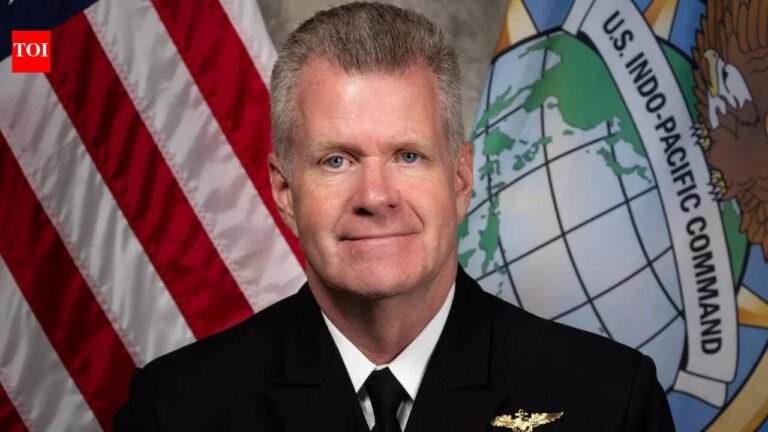
New Delhi: Gen. Samuel J. Paparo, commander of the US Indo-Pacific Command, “praised India’s tactical execution during military operations against Pakistan” during his visit to India on Sunday. operation sindor And said “there are always lessons to be learned from every conflict in the world.”He said the U.S.-India defense relationship is on a “dramatic upward trajectory,” even as he expressed concern about increasing “coercion” and “aggression” in the Indo-Pacific region.
Replying to a query from TOI about his views on the Sindoor operation, the US commander, who was interacting with a select group of journalists, said: “First of all, I have the utmost respect for the horrific events (Pahalgam terror attack) that happened before the crisis. In discussions with partners, I appreciated the tactical execution (of the operation). We also sincerely commend the restraint shown. We want to work together to ensure that horrific events like this never happen again.The general also said he saw the Indian military’s strong commitment to learning lessons from the conflict.Asked what lessons the United States learned from Operation Sindor, in which Pakistan used Chinese weapons, General Paparo said, “Sophisticated long-range weapons with complex long-range kill chains.” With the “combination of 21st century sensors, communications, thrusters, warheads, and seekers, geography is no longer a commodity…”Regarding China’s growing military strength, the admiral, who is responsible for all US military operations in the region, said, “Deterrence is our highest duty. My job is to think about the worst-case scenario and prepare for it. India also has some concerns in the Indo-Pacific region, as the region is home to 60% of the world’s population, more than 60% of the world’s GDP and seven of the world’s largest militaries.“We address these issues through an evolving partnership…a mutually respectful sovereign relationship between the world’s oldest democracy and the world’s largest democracy,” he said, adding that the United States and India were both committed to the principles of sovereignty, freedom of navigation and freedom of the seas.“We commend India for its tremendous contributions to the security of the Indian Ocean region,” he said. The two sides also considered strengthening maritime security cooperation, including cooperation in the field of undersea domain awareness.Considering the upcoming Milan Exercises, Admiral Paparo said, “It is good to see the deepening of the Indo-US defense partnership, as reflected in the defense agreement recently signed by US Secretary of War Pete Hegseth and Indian Defense Minister Rajnath Singh in Kuala Lumpur. A series of joint exercises and personnel exchanges such as Exercise Yod Abhayas in Alaska, Exercise Milan, Malabar Series, COPE India and Tiger Triumph Series and personnel exchanges are strengthening the relationship between India and the United States.” We cherish this relationship. “Regarding modern warfare strategy, the admiral said, “The 21st century will increasingly be dominated by actors who master the information environment, namely space, counterspace, electronic warfare, low observability and other technologies.”At the Artificial Intelligence Summit to be hosted by India, he said: “Prime Minister Modi’s visionary Artificial Intelligence Summit. I celebrate India’s vision on how to leverage artificial intelligence in the 21st century. Artificial intelligence has many connections with defense, and the U.S. Indo-Pacific Command is at the forefront of defense applications of artificial intelligence.”
Epstein ranch twist: MAGA candidate Don Huffins named mystery buyer of Jeffrey Epstein’s New Mexico home World News
The mysterious owner of one of them Jeffrey EpsteinThe most famous residence is a ranch in New Mexico said to be the home of MAGA millionaire and Texas Comptroller candidate Don Huffines. The real estate mogul purchased the convicted child sex offender’s “Zorro Ranch” in 2023, using an LLC he created weeks before the purchase, the Santa Fe New Mexico newspaper reported. His wife is listed as a trustee and his son is listed as an LLC manager, The Center Square reported.“Four years after Mr. Epstein’s death, the Huffins purchased a property at public auction in New Mexico, with proceeds benefiting his victims. They never toured the property before it was listed at auction,” Huffins’ campaign spokesman Ellen Blackmore said in a statement on Friday.The New York Times previously reported that the 7,600-acre ranch in southern Santa Fe County was the center of Epstein’s so-called plan to “seed humans with DNA by impregnating women.” The ranch was mentioned 4,200 times in more than 3 million documents released with the Epstein dossier.The millionaire renamed the ranch “Rancho de San Rafael,” which apparently contained the bodies of at least “two foreign girls,” both of whom had been strangled, according to an email from the Justice Department’s recently released database of Epstein files. On Friday, a New Mexico official called for an investigation of the property over the email. “If you’re buying a piece of land, the first thing you need to do is be completely transparent. If the property is implicated in criminal activity, why not be transparent with state officials in New Mexico? Huffins wants to manage Texas’ finances, but he’s not going to be transparent about his dealings with Epstein’s former assets,” Wayne Hamilton, former executive director of the Texas Republican Party, told The Center Square. Journalist Molly Jong-Fast questioned in an X post: “It’s such a weird thing to buy this property.”
Who is Don Huffins?
Huffins is a proud Republican and Trump supporter, according to his campaign website. The 67-year-old former Republican state senator for Dallas County’s 16th District is currently running for comptroller, the statewide office in Texas that oversees the state’s financial affairs. Not just a politician, his son Russell Huffines was hired by the Trump administration as deputy director of agency outreach in June 2025 and still holds the position today, with an annual salary of $83,500, RealClear Investigations reported.He unsuccessfully challenged Gov. Greg Abbott in 2022 and now faces competition from Acting Comptroller Kelly Hancock, a former state senator who was appointed last summer by Abbott, Michael Berlanga and Railroad Commissioner Christy Craddick in the March 3 Republican primary.According to his campaign mention on LinkedIn, he plans to implement DOGE for Texas by “reducing government waste and increasing efficiency.” He co-owns and operates Huffines Communities, a real estate and land development company in North Texas, and graduated from the University of Texas at Austin with a degree in finance. He and his wife, Mary Catherine, have four sons and a daughter, and according to his social media profiles, he is also a grandfather. The revelation of his ownership of one of the disgraced financier’s personal properties also formed a major centerpiece of his scandalous criminal saga, raising many questions. The late convict was found dead in his New York jail cell in 2019, but documents released by the Justice Department revealed his vast network that included elected leaders, tech billionaires and even Hollywood celebrities.
Europe and America lose millions of Christians, Africa becomes largest region with 697 million believers |
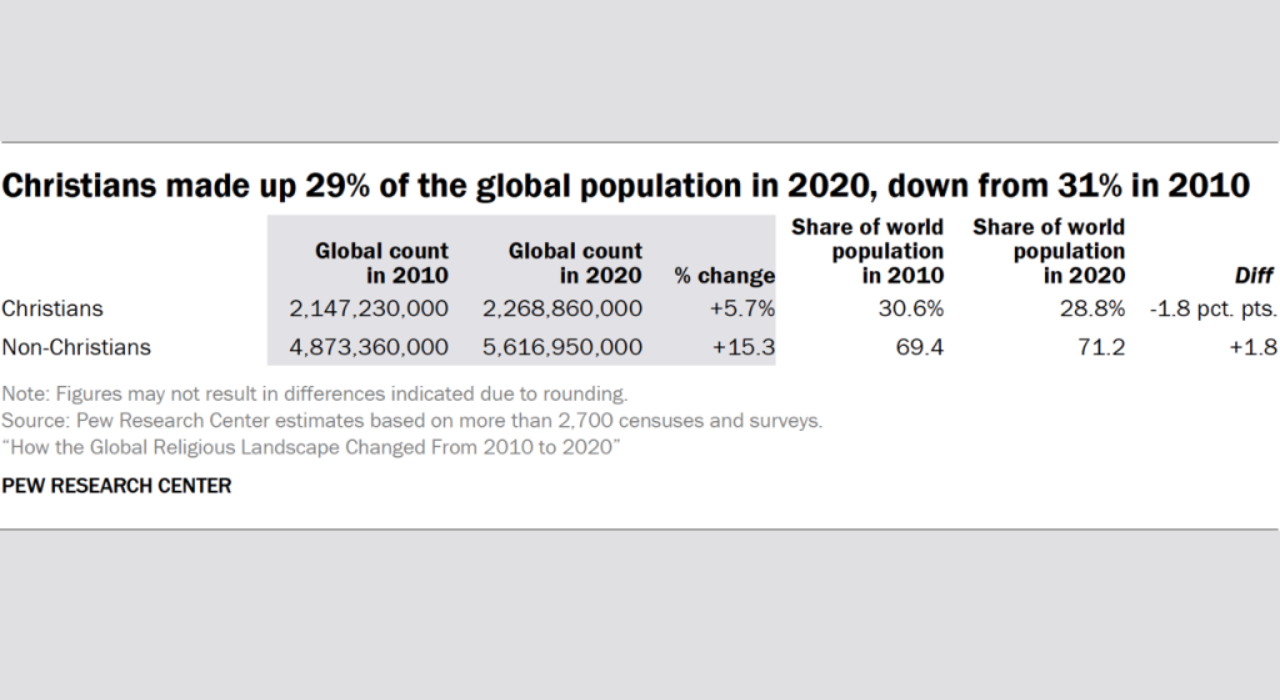
Over the past two thousand years, Christianity has expanded from a small Jewish sect in the Eastern Roman Empire to become the world’s largest religion. Imperial recognition in the fourth century AD, medieval missionary networks throughout Europe, and later colonial-era missionary activity in the Americas, Africa, and parts of Asia steadily expanded its reach. As of 2020, it still accounts for the largest share of humanity, accounting for 28.8% of the global population, or approximately 2.3 billion people. However, new demographic analysis from the Pew-Templeton Future of Global Religion Project shows that underneath this dominance, a quieter shift is taking place. Christianity is still growing in raw numbers but shrinking in proportion, losing followers in dozens of countries while rapidly expanding in others and shifting geographically from its historic base in Europe to sub-Saharan Africa. The findings, which draw on more than 2,700 censuses and surveys in 201 countries and territories, track religious change between 2010 and 2020 and examine the forces driving this change, particularly fertility patterns and religious “conversions” (people giving up their faith in adulthood).
From imperial religion to global majority
The early spread of Christianity relied on itinerant missionaries and the promise of close-knit communities to provide social support and universal salvation. Its trajectory changed dramatically when Emperor Constantine legalized the faith in 313 AD, and it later became the state religion of Rome. Missionary activities in the Middle Ages brought it to various parts of Europe, and from the 15th century onwards, European expansion exported it to all parts of the world. Colonial powers such as Spain, Portugal, England, France, and Belgium often combined territorial expansion with conversion. Missionaries established schools and medical services, translated scriptures, and in some areas used coercive taxation and legal systems to suppress indigenous religions. In modern times, Christianity has become the dominant faith on many continents around the world.
From 2010 to 2020, the number of Christians increased by 6%, from 2.1 billion to 2.3 billion, and remains the largest religion in the world.
Such a lengthy expansion explains its contemporary scale. Between 2010 and 2020, the number of Christians still increased by 122 million, from 2.1 billion to 2.3 billion, an increase of 6%. But the global population is growing faster, with non-Christians growing by 15%, causing the share of Christianity to drop from 31% to 28.8%, with all Christians being lumped into one category, including Catholics, Orthodox, and Protestant denominations such as Baptists, Lutherans, Anglicans, Methodists and Pentecostals.
Geographic shifts: Africa rises, Europe falls
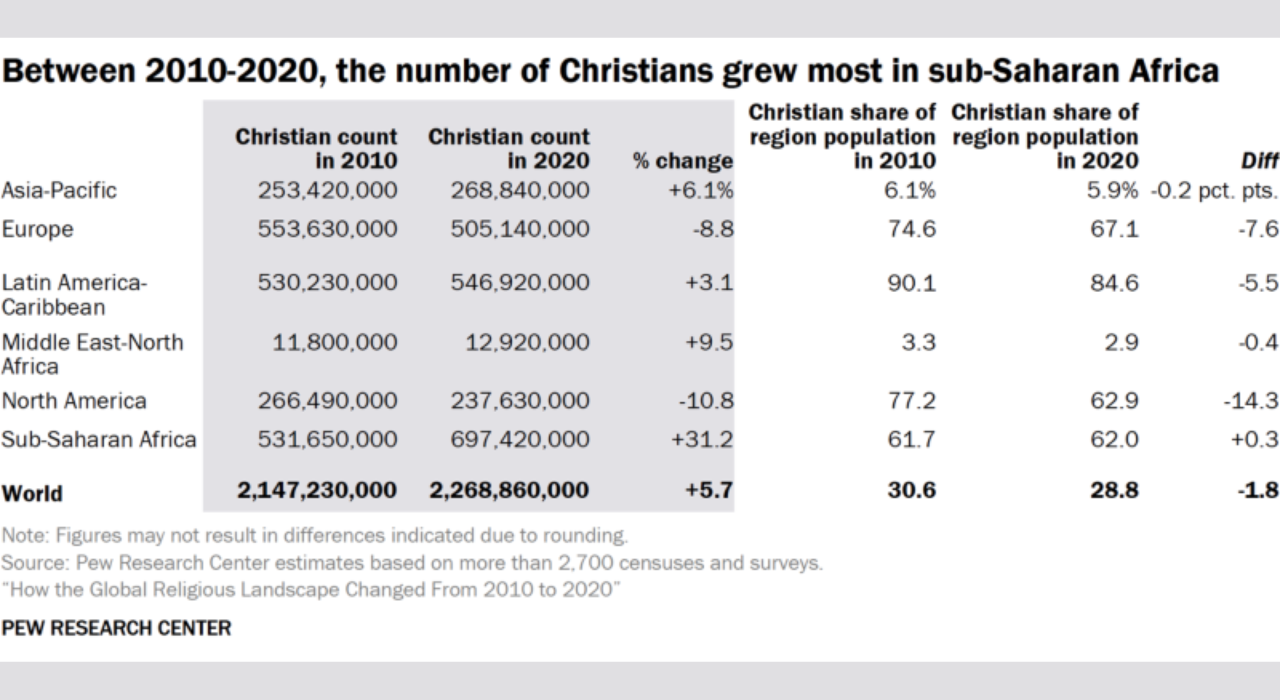
The most striking changes of this decade were geographical rather than numerical. Europe, the historical center of Christianity, no longer has the largest Christian population. The number of Christians declined in both regions. In Europe, the number of Christians fell to 505 million (down 9%). In North America, this number decreased to 238 million (down 11%). In every other region, the number of Christians is growing. Sub-Saharan Africa saw the largest increase, reaching 697 million (+31%).
- Sub-Saharan Africa: 697 million Christians (up 31%)
- Europe: 505 million (down 9%)
- North America: 238 million (down 11%)
As of 2020, 31% of Christians live in sub-Saharan Africa, compared with 22% in Europe. Latin America and the Caribbean account for 24% of the world’s Christians, and North America 10%.
Between 2010 and 2020, the number of Christian believers in sub-Saharan Africa increased by 31%, reaching 697 million believers.
The proportion of the population identifying as Christian has also changed:
- North America: 63% (down 14 percentage points)
- Europe: 67% (down 8 percentage points)
- Latin America and the Caribbean: 85% (down 5 percentage points)
- Sub-Saharan Africa: 62% (up slightly, less than 1 percentage point)
In the Asia-Pacific and Middle East-North Africa regions, Christians still account for less than 10% of the population, down by less than one percentage point.
As of 2020, there are approximately 238 million Christians in North America, accounting for approximately 10% of the world’s total Christian population.
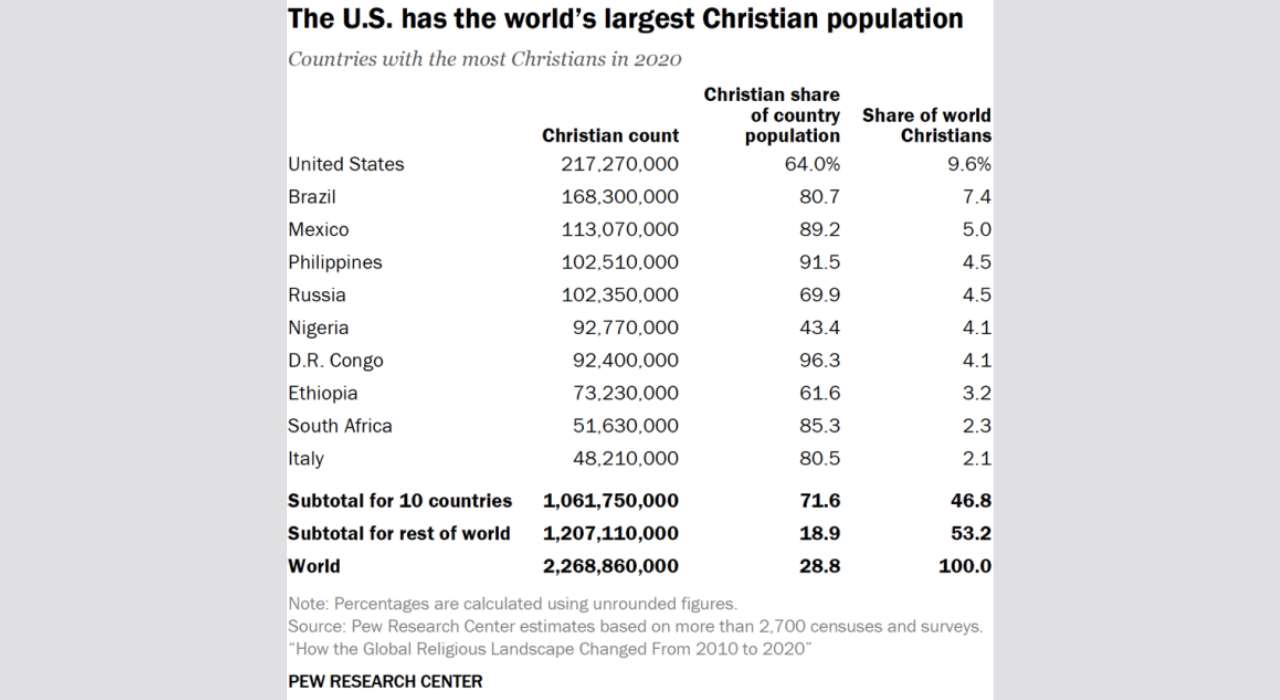
However, when measured by individual countries rather than regions, the United States still has the largest Christian population of any country. As of 2020, about 64% of Americans consider themselves Christians, accounting for about one-tenth of the world’s Christians.Also read: Is religion in decline? As Christianity declines, a quarter of the world’s people are now irreligious, making it the third largest group
Where Christianity declined and where it grew
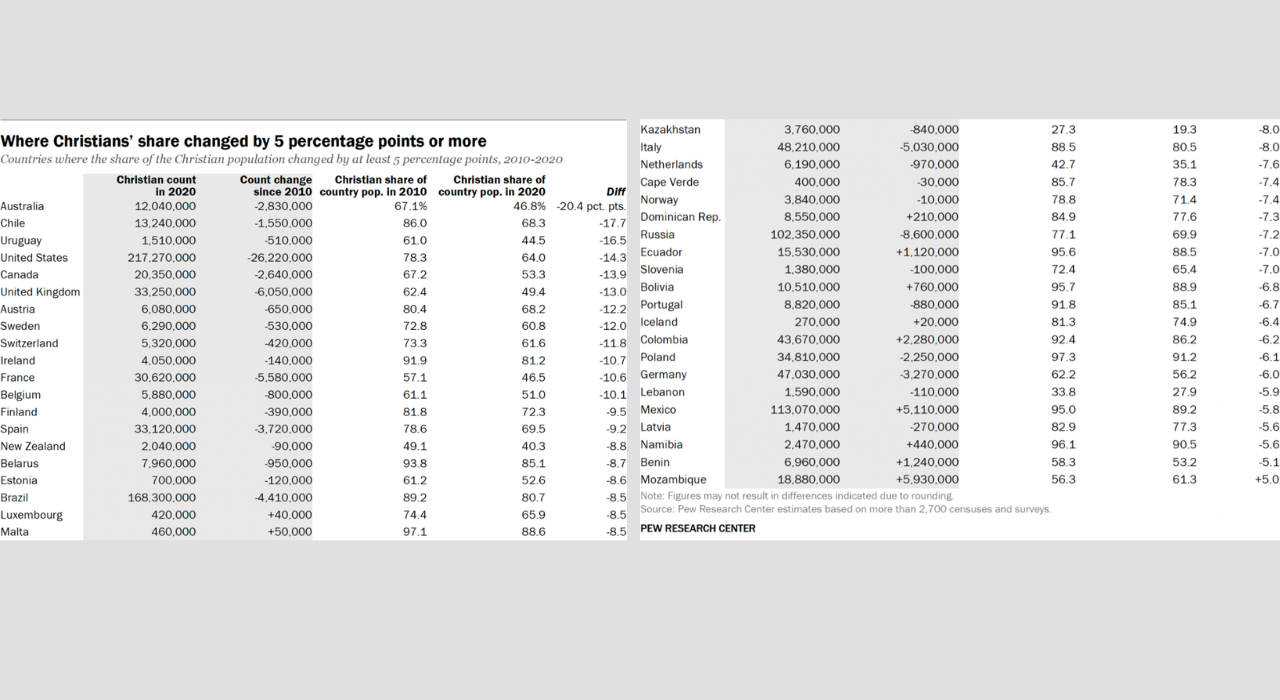
Significant changes (defined as shifts of at least 5 percentage points) occurred in 41 countries, more than for any other religion. Christianity declined in all but one country. Maximum drop:
- Australia: down 20 points
- Chile: down 18 points
- Uruguay: down 16 points
- United States: down 14 points
- Canada: down 14 points
- Benin: down 5 points
Between 2010 and 2020, the share of Christians in North America fell by 14 percentage points, while in Europe it fell by 8 percentage points.
In some countries, Christianity has lost its majority status:
- UK: 49%
- Australia: 47%
- France: 46%
- Uruguay: 44%
In each case, the religiously unaffiliated made up 40 percent or more of the population. Mozambique was the only country to see a significant increase, rising by 5 percentage points to 61% following the end of the anti-religious government movement in the 1980s. Overall, Christians remain a majority in 120 countries and territories, down from 124 in 2010.
Mechanism: Give up religious belief
The central driver of change was not just birth rates but religious conversion. Christians experienced the greatest net losses: For every 1 person who joins Christianity, 3.1 people leave Christianity. Most people do not join other religions; they become irreligious. This movement explains the declining share of Christianity and the simultaneous growth of “nonbelievers.” Globally, religious conversion shows a clear direction: more people are leaving religions than converting. Among adults aged 18 to 54, for every one person who joins a religion, 3.2 abandon it. Fertility remains important, with Christian birth rates relatively high, but the conversion offsets this. In contrast, Muslim population growth is driven primarily by a younger age structure and higher fertility rates, rather than conversion.
The changing religious landscape
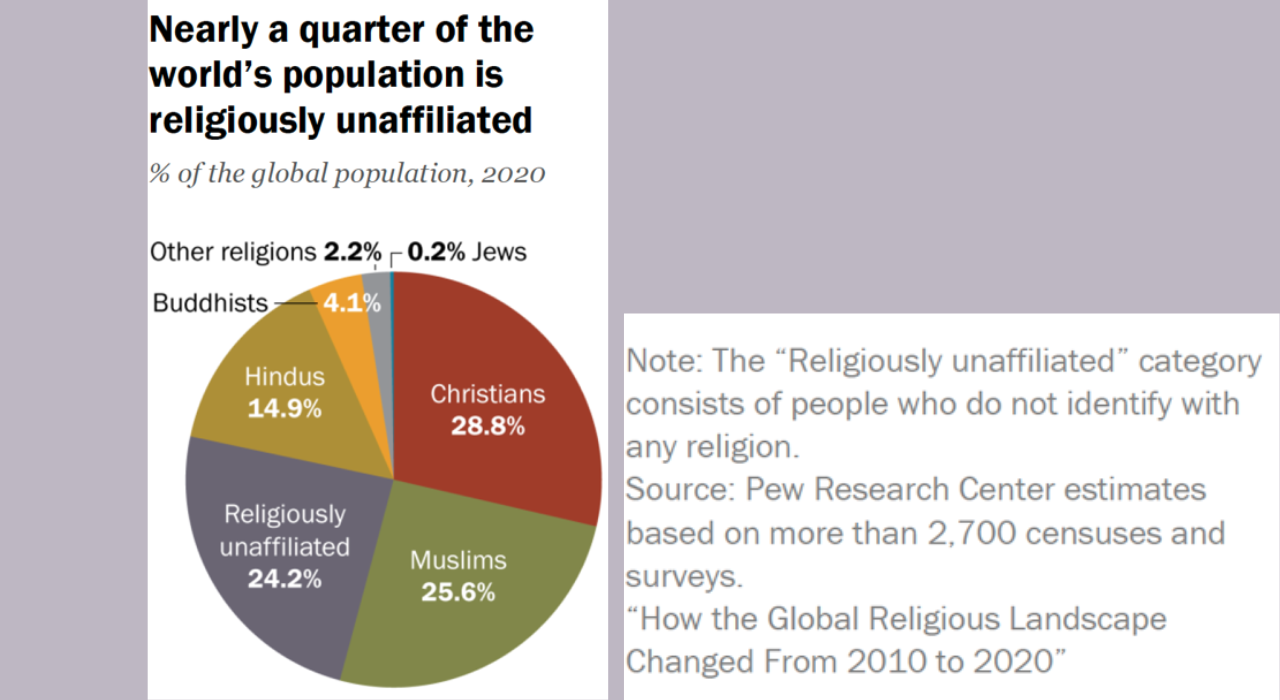
By 2020:
- Christian: 28.8% (2.3 billion)
- Muslim: 25.6%
- No religious affiliation: 24.2%
- Hindus: 14.9%
- Buddhist: 4.1%
Globally, 75.8% of people have a religious affiliation and 24.2% have no religious affiliation.
Currently, independents make up 24.2% of the global population, largely due to the Christian schism.
Figures show Christianity remains the world’s largest religion, but is increasingly concentrated in the Global South and increasingly affected by Western divisions. Over the past century, it has spread across every continent. Over the past decade, its center has quietly shifted.