Sameer Rizvi showed his style with a composed unbeaten 70 to lead Delhi Capitals to a comfortable six-wicket win over Lucknow Super Giants in Match 5 of IPL 2026. Under pressure from Delhi for 26 for 4, Rizvi showed maturity beyond his years in a modest chase of 142 runs. He combined with Tristan Stubbs to put up an unbeaten partnership of 119 that completely turned the game on its head, sealing the victory in just 17.1 overs.Staying calm under pressure: Rizvi’s maturity shines throughRizvi revealed after the game that role clarity and support from the team management played a key role in his performance.“The coaches are rooting for me to finish fourth this season. I just try to play according to the situation,” he said.Rizvi initially hoped to play a positive role but had to quickly reassess after Delhi lost consecutive wickets.“But when two wickets fell in the next game, the situation completely changed. So I tried to talk to Stubbs. He said, let’s take some time. There are many overs left and the run-rate has also come down. We should respect the conditions, so we discussed and decided to play our game. Not only after reaching fifty, I also tried to pick up the loose deliveries and that was my plan throughout the innings,” Rizvi concluded.
Game-changing collaboration
Rizvi-Stubbs’ 119* stand not only saved Delhi from collapse but also etched itself in the history of the IPL. This is the second-highest partnership after 4 runs below 30 points, after the 134* between KKR’s Yusuf Pathan and Shakib Al Hasan in 2016.This also became Delhi Capitals’ highest partnership for the fifth wicket or below, surpassing the previous 111*. Stubbs played a perfect supporting role with an unbeaten 39 to ensure no further damage was done, while Rizvi gradually changed direction.Tristan Stubbs reflects on his partnership with Sameer Rizvi, “Yeah, we’ve been saying, keep batting normally, keep looking to score runs. “I think Sameer plays naturally against spin, accepts it, so that makes my job a little easier. Just mess it up and let him strike. We always knew the game was over and then it was just about running the ball and taking away the game, the shots you need to make and yeah, luckily we did that. We said at the beginning of the game, let’s see if it spins. I think the first three balls were probably around 12 balls. “
Axar backs bowlers and young talents
Delhi captain Axar Patel attributed the win to the bowlers and winning partnership.“The new ball did some good. We told our bowlers to take advantage of that and they did really well. The key was to build a big partnership in the chase and Rizvi and Stubbs executed that perfectly.”Axar also highlighted the team’s strategy during the break between innings.“During the strategic pause, our message was clear that we are only one partner away from taking control of the situation and the plan is to bring in Rizvi as early as possible. He has performed well in training and it is great to see him perform well,” Al-Aqsa added.
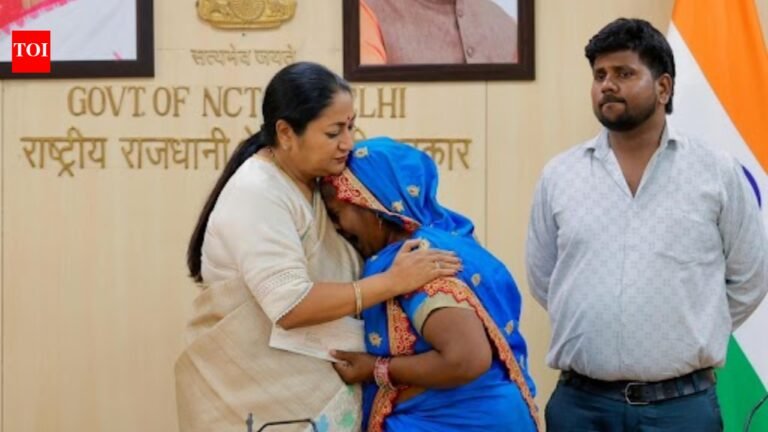
New Delhi: Chief Minister Rekha Gupta on Wednesday handed checks of Rs 1 crore each as financial relief to the families of six Delhi government employees who lost their lives during the COVID-19 pandemic. Gupta said the gesture was not just a form of government but a heartfelt expression of gratitude, compassion and respect. “When the world was filled with fear and uncertainty, these brave men put their duty above all else and continued to serve their people without fearing for their lives,” she said.A statement from the CMO said that while interacting with the families, Gupta assured that the Delhi government would continue to support them like a big family and extend all possible support.The six families are related to deceased employees of MCD, DTC, Delhi Jal Board, Spinal Injury Center of India, NDMC and Maulana Azad Medical College. The chief minister expressed regret over the delay in disbursing aid by the previous government in Delhi and said no compensation could make up for the losses suffered by the families. The beneficiaries also include the family of late Radhey Shyam, assistant sub-inspector of Delhi Traffic Police, and a deceased child of Dwarka, the statement said.
Space missions rely on power systems that can operate away from sunlight and without maintenance. Solar panels struggle in deep space, where light diminishes with distance. Such constraints have forced agencies to rely on nuclear energy for decades. Known as radioisotope power systems, these systems quietly support missions operating in the solar system.Spacecraft such as the Voyager 1 and Perseverance rovers continue to operate using this technology. The concept is not new, but the development of alternative isotopes is generating renewed interest. leader’s job NASA Working with the University of Leicester to propose changes to the running times of future missions. Nuclear batteries that can last for centuries are no longer just theoretical.
Plutonium 238 space nuclear battery: the main fuel used in space nuclear batteries
For decades, plutonium-238 has been the primary fuel used in space nuclear batteries. It is reported to have a half-life of about 88 years, meaning its energy output slowly decreases over time. Missions performed by Oak Ridge National Laboratory and Idaho National Laboratory rely on the production and supply of this isotope. It remains the backbone of current deep space power systems.Spacecraft such as the Curiosity rover continue to operate using plutonium-based systems. The steady decay of isotopes provides enough heat to keep instruments, communications systems and onboard electronics operating for extended periods of time.After a period of limited production, production has restarted with the support of a coordinated effort by national laboratories. Due to the complexity of handling and producing the materials, supply remains carefully managed.
Americium-241 and its extended half-life
Attention now turns to americium-241 as a possible replacement. Its half-life is approximately 433 years, significantly longer than plutonium-238. This property means that the isotope retains usable energy for a longer period of time. It doesn’t necessarily produce more power at a given moment, but it decays more slowly.Research at Los Alamos National Laboratory focuses on improving production methods and evaluating safety and performance. Early research suggests it may be suitable for long-duration missions requiring extended power availability. According to NASA reports, Americium-241 is still being tested. It has not yet replaced plutonium in operating spacecraft. The evaluation process includes material stability, heat output efficiency and long-term reliability under space conditions.
How nuclear batteries produce energy
Radioisotope power systems (commonly known as RPS) exploit the natural degradation of radioisotopes. When radioactive isotopes degrade, heat is produced. This heat is then harnessed in specialized ways to generate electricity. The process is continuous, meaning no charging is required and it is not dependent on the sun. It can function in darkness, cold or extreme conditions.Inside a radioisotope power system, the radioisotope is in a solid ceramic state. This minimizes the danger while keeping the radioactive isotope stable. The heat generated is then transferred to a converter, which then uses the heat to generate electricity. The electricity produced is constant rather than pulsating. These power supplies are small, reliable, and long-lasting, and are best suited for tasks where reliability is more important than power generation.
Free-piston Stirling converter in space nuclear battery
The heat produced by radioactive decay must be converted into useful electrical energy. The conversion was accomplished using a free-piston Stirling converter. Free-piston Stirling converters have moving parts that float in the system. Moving parts are driven by temperature differences and convert motion into electrical energy. The system is designed for less wear and tear, and components float within the system, making it suitable for long-term use in microgravity.Tests were conducted on a free-piston Stirling converter and the results showed that the system can operate without maintenance for a long period of time. According to reports, the system can operate continuously for more than ten years.
New Delhi: Ritha PantLucknow Supergiants’ humiliating defeat at the hands of Delhi Capitals in the IPL 2026 opener raised questions about his role in the first innings.Pant’s exit ended with a strange outing in the third innings. Direct drive from Mitchell Marsh Deflected onto the stumps by Mukesh Kumar, Pant was caught at the non-striker’s end. The LSG captain, who has scored seven of nine goals, was visibly frustrated after his unfortunate dismissal.
watch
Angkrish Raghuvanshi only cares about the team’s victory
Looking back on that moment, Pant said: “I think the best way to recover from it is to ignore it. I think that’s the best way to look ahead because you know something like that, you have no control over, but thinking about it definitely puts you at a disadvantage.” He also admitted that the team has struggled to form partnerships: “Look, it’s always the case but you know the way we bat, we can’t form partnerships for the long term.”Pant reaches the top and breaks the established combination Aiden Markram Marsh raised his eyebrows. Talking about whether he will continue as opener, he said, “I think it’s a 50-50 decision but we’ll see. But it will definitely see me at the top.”Despite Markram starting the match and Marsh scoring 35 runs, LSG’s batting was poor throughout, scoring just 141 runs in 18.4 overs. Lungi Ngidi and T Natarajan picked up three wickets each while Kuldeep Yadav got the crucial breakthrough.
Rizvi, Stubbs win for Washington, D.C.
Chasing 142, Delhi found themselves in trouble before Sameer Rizvi (70*) and Tristan Stubbs (39*) put on a match-winning 119-run stand. Rizvi’s fearless batting turned the game around as DC chased down the target in 17.1 overs.With the opening experiment failing and LSG batting at fault, Pant now faces a crucial decision regarding his future position.
University Registrar R Gunasekaran in a notification announced the revised academic calendar for the academic year 2025-26, which will reduce the working days from 90 to 79 days “due to administrative reasons”.
Local cherries: pondicherry university Due to LPG shortage, the school decided to postpone the exams from May 6 to April 21 and directed students to vacate their hostels by May 1, much to the chagrin of the students.University Registrar R Gunasekaran in a notification announced the revised academic calendar for the academic year 2025-26, which will reduce the working days from 90 to 79 days “due to administrative reasons”. Summer vacation for all undergraduate/graduate students will begin on May 1st. Deans of colleges, departments and center heads were told to ask students to move out of their dormitories before May 1.The Students’ Federation of India Puducherry University (SFI PU) has condemned the university’s arbitrary decision to advance exams and direct students to vacate their hostels. In a statement, the student forum demanded that the school immediately withdraw its decision and resume its original schedule. The university administration should prioritize the academic well-being of students over administrative convenience and ensure that no student is penalized due to circumstances beyond their control, the statement said.Instead of passing the burden on to students by compressing the academic calendar, universities should explore other arrangements to address the LPG issue, the report said. SFI PU said: “Immediate steps should be taken to ensure uninterrupted campus operations, including procurement of alternative fuels. Failure to do so will not only disrupt academic studies but also severely impact student attendance, especially for those students who depend on campus facilities for their daily livelihood.” “While the BJP-led NDA government continues to deny any LPG crisis and the Prime Minister Narendra Modi It is publicly claimed that there is no shortage of LPG, but this is not the case in reality. It is deeply shocking that a central university would take such extreme measures. It exposed the ‘administrative failure’ and ’emptiness’ of the coalition’s claims. “
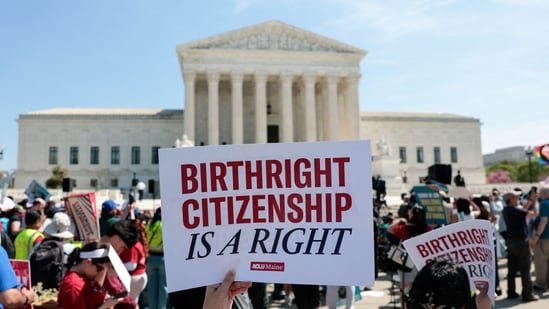
The Supreme Court on Wednesday appeared poised to strike down President Donald Trump’s restrictions on birthright citizenship, in a case amplified by his unrivaled appearance in the courtroom.
Trump spent more than an hour in court hearing arguments from the Republican administration’s top Supreme Court attorney. (AFP)
Conservative and liberal judges questioned whether Trump’s order declaring that children born to parents who are illegally or temporarily in the United States are not U.S. citizens is constitutional or federal law.
The arguments lasted more than two hours in a packed courtroom that included not only Trump, the first sitting president to argue before the U.S. Supreme Court, but also Attorney General Pam Bondi and Commerce Secretary Howard Lutnick, as well as a seat reserved for the justice’s guest, actor Robert De Niro.
Trump spent more than an hour in the court hearing arguments from Deputy Attorney General D. John Sauer, the Republican administration’s top Supreme Court lawyer. The president left shortly after attorney Cecilia Wang began a speech defending broad birthright citizenship.
After the court adjourned, Trump posted on Truth Social: “We are the only country in the world stupid enough to allow ‘birthright’ citizenship!” In fact, about three dozen countries, almost all in the Americas, guarantee citizenship to children born on their soil.
Judge asks Trump about legal basis for order
Trump heard Sauer face one skeptical question after another. The judges asked about the legal basis for the order and expressed more practical concerns.
“Did this happen in the delivery room?” asked Judge Ketanji Brown Jackson, delving into the logistics of how the government actually determines who is entitled to citizenship and who is not.
Chief Justice John Roberts said Sauer was relying on a bizarre exception to citizenship to make a broad argument against people who are here illegally. “I’m not quite sure how you get such a large group from such a small and unique example,” Roberts said.
Justice Clarence Thomas sounds like the most likely of the nine justices to side with Trump.
“How much of the debate surrounding the Fourteenth Amendment had to do with immigration?” Thomas asked, noting that the purpose of the amendment was to grant citizenship to black people, including freed slaves.
The justices heard Trump’s appeal of a lower New Hampshire court’s ruling striking down citizenship restrictions, one of several courts that has blocked them. These restrictions are not yet in effect anywhere in the country.
The case is another test of Trump’s assertions of executive power and goes against longstanding precedent for a court that has largely ruled in the president’s favor, with some notable exceptions, and Trump responded with nakedly personal criticism of the judges. A final ruling is expected in early summer.
Trump signed birthright citizenship on the first day of his second term as part of his Republican administration’s broad crackdown on immigration.
Birthright citizenship is Trump’s first immigration-related policy to reach the courts for a final ruling. Judges previously blocked global tariffs imposed by Trump under emergency powers laws, which have never been used in this way.
Trump reacted angrily to the tariff decision in late February, saying he was ashamed of the judges who ruled against him and calling them unpatriotic.
On Sunday, he took to his Truth Social platform to preemptively lash out at the court. “Birthright citizenship is not about the rich in China and the rest of the world who want their children, and hundreds of thousands more, to ridiculously become citizens of the United States of America for pay. It’s about the babies of slaves!” the president wrote. “Stupid judges and justices don’t make a great country!”
What effect will Trump’s order have?
Trump’s order would upend the long-held view that the 14th Amendment to the Constitution, ratified in 1868 and federal law since 1940, confers citizenship to everyone born on U.S. soil, except for the children of foreign diplomats and foreign occupying forces.
The Fourteenth Amendment was intended to ensure citizenship for black people, including former slaves, although the citizenship clause was much broader. “All persons born or naturalized in the United States and subject to its jurisdiction are citizens of the United States and of the state in which they reside,” it reads.
In a series of rulings, lower courts struck down the executive order because it was likely illegal under the Constitution and federal law. The rulings cited the high court’s 1898 ruling in the Wong Kim Ark case, which held that children of Chinese citizens born in the United States were citizens.
The Trump administration has argued that the prevailing view of citizenship is wrong, claiming that the children of noncitizens are not subject to U.S. “jurisdiction” and therefore are not entitled to citizenship.
Sauer wrote that the court should use the case to correct “longstanding misunderstandings about the meaning of the Constitution.”
Saul told the court that unrestricted citizenship encourages illegal immigrants and “birth tourism” where pregnant women travel to the United States to give birth.
Roberts asked Saul how important birth tourism is.
No one knows for sure, he said, adding, “But, of course, we’re in a new world now” where 8 billion people can “have a child who is a U.S. citizen” just by flying on a plane.
The chief justice responded: “It’s a new world. The constitution is the same.”
Justice Neil Gorsuch, a Trump appointee, also expressed skepticism about Sauer’s position, when the deputy attorney general said the 1898 Supreme Court case should be read to support Trump’s view of citizenship. “I’m not sure how much you want to rely on Wong Wong,” Gorsuch said.
Justice Brett Kavanaugh, another conservative appointed by Trump, suggested to Wang that the court could resolve the case in Wang’s favor or issue a “brief opinion” saying that the ruling in the Wong Kim Aok case was correct, meaning Trump’s order was unconstitutional.
Or, he said, a judge could avoid the constitutional issue and find that the order is illegal under federal law.
Wang told the justices that no court has accepted the Trump administration’s arguments, and lawyers for pregnant women whose children would be affected by the order said the Supreme Court should not be the first to do so.
Questions about the word “residence”
The toughest question Wang faced came from several justices over the repeated use of the word “domicile” in the Kim Wong case, which the government said showed the court’s view of birthright citizenship temporarily or unlawfully excluded people from the country.
Roberts said the word was used 20 times in the 1898 decision. “Isn’t that something worth at least caring about?” he asked.
Wang said the Chinese parents in the case did settle in the United States, but the decision was not based on that fact.
Overall, though, the intensity of the questions asked by the justices decreased over the course of her presentation, which is often a sign of what the court will do.
More than a quarter of a million babies born in the United States each year will be affected by the executive order, according to research from the Migration Policy Institute and Penn State University’s Population Research Institute.
While Trump’s rhetoric and actions have focused primarily on illegal immigrants, birthright restrictions also apply to people living in the U.S. legally, including students and applicants for green cards or permanent resident status.
Sameer Rizvi showed stunning composure and presence after coming on as an impact substitute to lead Delhi Capitals to a comfortable six-wicket win over Lucknow Supergiants in the IPL on Wednesday.Chasing a modest target of 142 runs, Delhi found themselves in trouble early on, managing to score 26 for 4 in the first 5 overs. However, Rizvi (70 off 47 balls) stepped up and formed an unbeaten partnership of 119 runs for the fifth wicket with Tristan Stubbs (39 off 32 balls). The duo ensured that Delhi crossed the finish line with ease, sealing victory by just 17.1 points.
Stunning restoration of Rizvi, Stubbs’ script
Rizvi’s innings stood out for its maturity. He withstood the challenge of Mohammad Shami, Mohsin Khanand Prince Yadav before switching gears. Rizvi hit five fours and four sixes in an over to help the seamers, making the chase look much simpler than it initially seemed.The turning point came in the tenth over, bowled by Shahbaz Ahmed. Rizvi took full advantage, scoring 16 points through a combination of sweeps, pulls and deft placement. From that moment on, the momentum shifted firmly in Delhi’s favour.He later demonstrated his range by staking out Aiden Markram The long wait and dispatch of Mohsin Khan with authority gradually dashed LSG’s hopes. Stubbs played the perfect supporting role, rotating the attack and making sure the pressure never mounted.
Despite early breakthrough, LSG’s bats falter
Lucknow started the match well. Mohammed Shami struck KL Rahul for a duck on his first delivery. Mohsin Khan got rid of Nitish Rana and Pathum Nissanka fell cheaply into the hands of Prince Yadav. Delhi captain Axar Patel was also beaten to score the first ball due to his pace and movement.However, LSG were unable to capitalize on the early momentum as Rizvi and Stubbs took charge.Earlier, LSG’s performance with the bat was disappointing, scoring just 141 runs in 18.4 overs. Captain Rishabh Pant made an unexpected tactical move to open the innings and disrupt the set combination. Pant, who scored 7 runs before being run out, never looked comfortable.Aiden Markram showed brief promise but was dismissed by Axar Patel, while Ayush Badoni fell for a duck. Nicholas Pooran was beaten by a clever, slow delivery from Lungi Ngidi, who fell late and hit the stumps.Ngidi showed great variety by taking 3 wickets, while T Natarajan also took 3 wickets. Kuldeep Yadav scored two wickets, including the crucial wicket of Mitchell Marsh, a well-disguised lob.Overall, it was a clinical performance from Delhi Capitals. Despite an early collapse, Rizvi’s brilliance and Stubbs’ composure fueled a remarkable comeback to win the campaign for Derry.
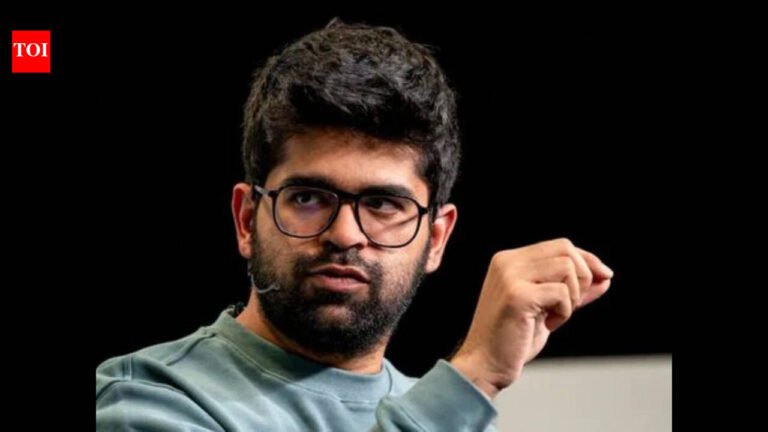
Aravind Srinivas, CEO of artificial intelligence startup Perplexity, said there is nothing wrong with AI-induced job losses because people hate their jobs anyway.
Perplexity AI’s Indian-origin CEO Aravind Srinivas has been embroiled in major controversy after he defended AI-induced layoffs and said people don’t love their jobs anyway. Srinivas, who studied at the Indian Institute of Technology Madras and later received his PhD from the University of California, Berkeley, said in the podcast that unemployment will open many new doors and provide new opportunities for people to do what they love. “The reality is that most people don’t like their jobs. Suddenly there’s a new possibility… to use these tools, learn them, and start your own small business… Even if you have to deal with temporary job displacement, this glorious future is what we should look forward to,” Srinivas said, making layoffs look desirable. The comments were heavily criticized as social media users called for his deportation. As Oracle laid off 30,000 people worldwide, the comment took on greater significance as people took to social media to lament being blindsided and received an email at 6 a.m. that March 31 would be their last day at Oracle after decades. A multimillion-dollar man just told a single mother who lost her job that she should be grateful because now she can start a business using his product and called her unemployment a glorious future,” one commenter wrote on X. “This is what happens when you don’t need a paycheck to live on.Perplexity reacted to the controversy, with a spokesperson defending Srinivas’ comments, citing data from the New York Post. “Since Perplexity launched in December 2022, Americans have submitted 16 million new business applications, helping to reverse 40 years of decline and proving once again that breakthrough technology does not eliminate opportunity, but creates it,” the spokesperson said. “When you’re at the top of building AI, disruption looks like opportunity. For millions of workers facing real uncertainty, the view from the ground up is very different. Are these AI technology leaders—predicting grand futures for humanity while detached from day-to-day impacts—out of touch with reality? Or do they see things that others haven’t faced yet?” one wrote.
Eight women workers were killed on the Nagpur-Mumbai highway in Maharashtra’s Jalna district when a truck collided with them at a speed they were standing. The accident occurred on the Samruddhi Highway in Jalna when workers were waiting to leave in a side lane after get off work when they were hit from behind by a truck that changed lanes, police said.“Seven people were killed in this tragic incident. Sixty-seven people were seriously injured… The police have detained the truck driver responsible for the accident. A case has been registered against him and further legal action is being taken, including arresting him…,” Jalna city police chief Ajay Kumar Bansal said. chief minister of maharashtra Devendra Fadnavis He called the accident “extremely tragic” and expressed his condolences to the victims and their families. Fadnavis posted on
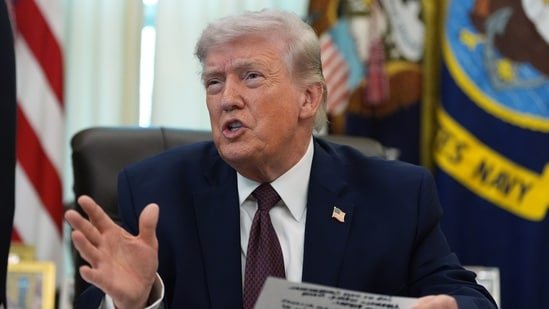
president Donald Trump Never sat on King Cecilia Wednesday’s entire Supreme Court argument. The 79-year-old left the courtroom as the American Civil Liberties Union’s legal director spoke out in support of birthright citizenship. Previously, Trump became the first sitting US president to participate in an oral debate in the House of Representatives. He can be seen traveling with his motorcade to the White House.
President Donald Trump answers reporters’ questions after signing executive order (AP)
Supreme Court raises concerns
The Supreme Court appears skeptical of the Trump administration’s restrictions on birthright citizenship. The case revolves around an executive order signed by Trump on the first day of his second term that seeks to deny citizenship to children born in the United States to undocumented parents or who are temporarily in the country. The move is part of a broader government crackdown on immigration that could affect more than 250,000 births each year, according to estimates from the Migration Policy Institute and Penn State University.
During oral arguments Wednesday, both conservative and liberal justices pressed the administration on the legal and practical implications of the policy. Judge Ketanji Brown Jackson expressed concern about how such a rule would be enforced in real time, asking: “Is this happening in the delivery room?”
Justice Clarence Thomas, meanwhile, seemed more open to the administration’s stance, questioning the historical scope of the Fourteenth Amendment: “How much of the debate around the Fourteenth Amendment has to do with immigration?”
Huang Jinde case
The case came to court after multiple lower courts, including in New Hampshire, blocked the order from taking effect nationwide. These rulings relied heavily on long-standing precedent, particularly the Supreme Court’s 1898 decision in United States v. Wong Kim Ark, which affirmed that children born on U.S. soil were citizens regardless of the nationality of their parents.
At the center of the dispute is the interpretation of the Fourteenth Amendment, which states: “All persons born or naturalized in the United States and subject to the jurisdiction thereof are citizens of the United States and of the state in which they reside.” While historically widely applied, the Trump administration has argued that the children of noncitizens are not fully “subject to the jurisdiction of the United States.”
Sauer urged the court to reexamine what he said were flawed assumptions underpinning decades of legal interpretation, writing that the justices should correct “longstanding misunderstandings of the meaning of the Constitution.”
However, opponents of the policy warn that the government is attempting an unprecedented redefinition of citizenship. “The president of the United States is trying to fundamentally reinterpret the definition of American citizenship,” Wang said.
The policy’s impact extends beyond undocumented immigrants. It would also extend its impact further by affecting children born to individuals legally present in the country, including students and green card applicants.