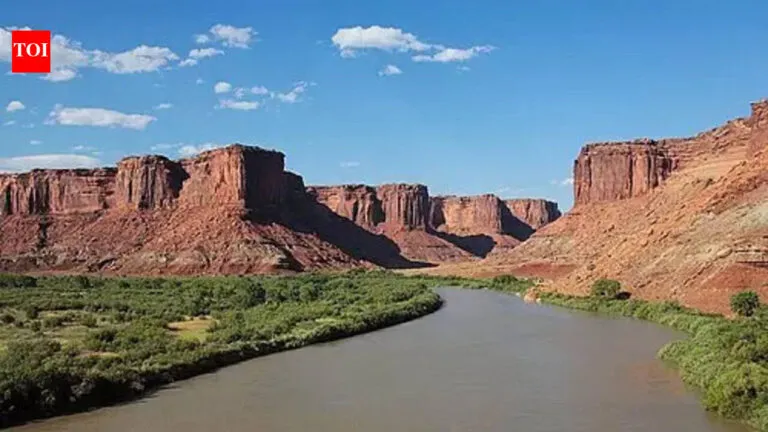
The long-standing question of how the Green River flows through the Uinta Mountains is closer to resolution. New geological analysis suggests the answer lies not just in rivers but deep within mountains. The study explores how the Green River merged with the Colorado River, a change that reshaped drainage systems in western North America. There is evidence that rivers carved their way millions of years after mountains were formed and long after active mountain building had ended. By combining river geometry, sediment records and seismic imaging, the researchers believe that subtle but powerful changes in the Earth’s mantle altered the landscape from below, allowing rivers to cross what was once a major continental divide.
Researchers connect in depth earth processes Green River through the Uinta Mountains
High in the Uinta Mountains, the river valleys are wide and gently sloping. Looking down, these rivers become steeper and cut deeper. This contrast is important. This suggests that the upper river network reflects an earlier period when erosion was slower and the landscape was more stable. These preserved features, called relic topography, indicate that something later changed the rate at which rivers eroded the rock.By reconstructing the previous shape of these river networks, the study “Lithosphere dripping triggers fusion of Green River and Colorado rivers” It is estimated that the center of the mountain range has risen approximately 450 meters relative to base level. This uplift occurred long after the mountains were formed 50 million years ago. It is not driven by surface faults or climate change, which appear to play only a minor role.
Dripping water from the lithosphere changes the landscape from below
Seismic images below this range show vast amounts of lithosphere sinking into the mantle. This process, known as lithospheric dripping, removes heavy material from the bottom of the Earth’s crust. A hotter mantle rises to replace it, lifting the surface above. Calculations show that the drop separated about 2 to 5 million years ago.
Time coincides with green Colorado River Integration
The estimated timing of this deep Earth process matches independent evidence of when the Green River crossed the Uinta Mountains and joined the Colorado River. As the land rises unevenly, the base level changes, the river becomes steeper and incised faster. This created the conditions for the Green River to break through the mountains and form the Lodore Gorge.
Deep processes quietly reshape surface systems
Only a small portion of the uplift can be explained by erosion and isostatic rebound. Most were driven by mantle dynamics, which left few surface traces at the time. The findings show how deep geological processes quietly reorganized river systems, reshaped landscapes and transformed ecosystems long after mountain building activity ceased.