
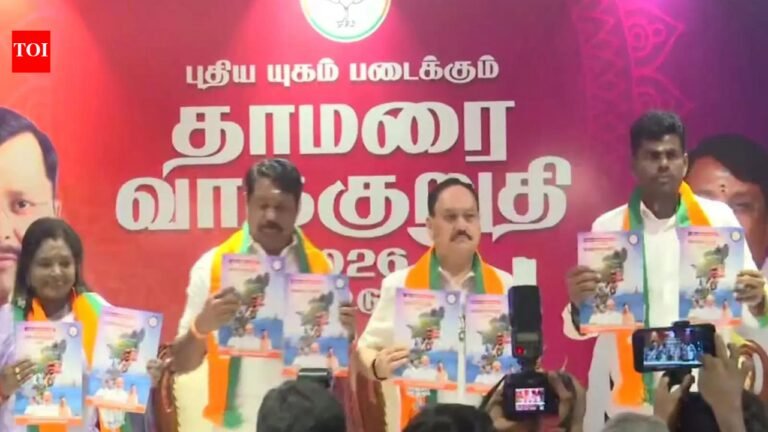
this bjp The manifesto for the upcoming Assembly elections in Tamil Nadu, released on Tuesday, promised monthly assistance of Rs 2,000 to women heads of households and a one-time assistance of Rs 10,000 to each family.Announcing the initiative, Union Minister JP Nadda outlined key proposals aimed at providing financial assistance, security and economic empowerment to women. “The main highlight of the manifesto is that we will provide a monthly assistance of Rs 2,000 to all women heads of households and a one-time assistance of Rs 10,000 to every family when we come to power under the AIADMK leadership,” he said.Apart from the above promises, the party has also promised to provide free LPG cylinders every year and provide support of Rs 25,000 to eligible women for purchasing electric scooters. It also proposes to provide interest-free loans of up to Rs 50 lakh to women-led cooperative societies, self-help groups and MSMEs and make it mandatory for manufacturing units to source 20 per cent of their procurement from these groups.The party has also proposed women safety measures in its manifesto such as zero FIRs, victim witness protection and special fast-track courts for heinous crimes like sexual offences. The party also promised to achieve 100 per cent blind-spot-free CCTV coverage in buses, schools and colleges and better utilization of Nirbhaya funds.For farmers, the BJP said it will increase benefits under Pradhan Mantri Kisan Samman Nidhi by adding Rs 3,000 to the existing annual support of Rs 6,000.Tamil Nadu will go to polls in phases on April 23 and counting of votes is scheduled for May 4.The main contest is expected to be between the DMK-led Secular Progressive Alliance, which includes the Indian National Congress, DMDK and VCK, and the AIADMK-led National Democratic Alliance, which includes the Bharatiya Janata Party and PMK as allies.
US oil blockade will boost US exports and oil prices

President Trump is promoting the U.S. Navy Blockade of the Strait of Hormuz An opportunity for U.S. oil and gas exporters. Tight supply is a bad sign for oil prices.

U.S. plans to seize control of the key waterway from Iran could cut off the roughly 2 million barrels of oil Iran continues to ship through the strait each day, much of it destined for China.
NH project land acquisition tax exemption
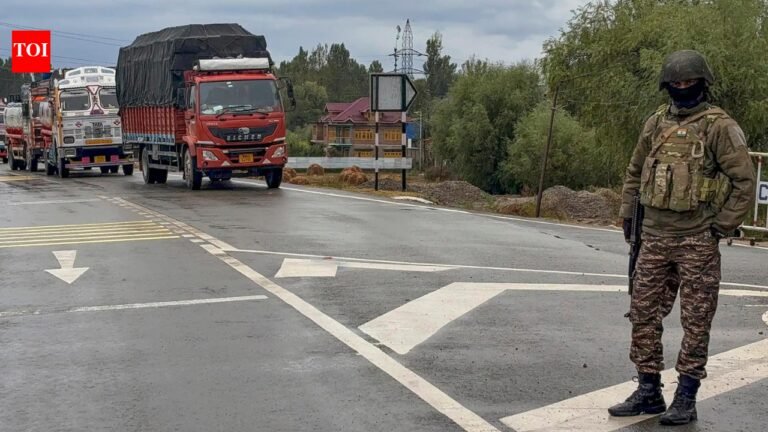
NEW DELHI: People receiving compensation for land acquisition for national highway projects have been exempted from income tax and stamp duty, a move that will bring relief to a large number of landowners and farmers. The Union Road Transport Ministry said that such compensation shall not be deducted from tax at source (TDS) and asked all NH-affiliated agencies to adhere to this norm. In the financial year 2025-26, various agencies paid around Rs 20,000 crore to acquire more than 10,000 hectares of land for highway development. In a notification to NH agencies, including NHAI, the road transport ministry said the compensation paid in acquisition of land under the NH Act, if determined as per the provisions of the Land Acquisition Act, 2013, will be “exempt” from income tax under the Act. The letter referred to the notification issued by the Central Board of Direct Taxes (CBDT) on October 25, 2016 and Section 402 of the Income Tax Act, 2025, which clearly states that compensation received on awards exempted under the Land Acquisition Act, 2013 shall not be taxable even in the absence of specific provisions.
Amazon worker dies at Oregon warehouse, employees continue to work around body: report

An employee at an Amazon fulfillment center in Troutdale, Oregon, died while on duty last week, and reports suggested that work at the facility continued even after the employee fell to the ground.

The company confirmed the death in a statement, saying it was contacting the worker’s family and providing support to staff on site. The incident occurred at the PDX9 warehouse, where the employee reportedly collapsed on the floor, technology crunch the report said.
“We are deeply saddened by the loss of our team member and our deepest condolences go out to their loved ones during this difficult time,” Amazon spokesman Sam Stephenson said.
ALSO READ | oneAmazon employee says she got 10% raise but still feels financial hardship: ‘It’s kind of disappointing’
According to the company, the employee was sent home early after the incident and was paid for the remainder of the shift. Night shifts were canceled but workers were still compensated.
An investigative report by Western Edge covering the Pacific Northwest said the employee lay on the warehouse floor while operations continued around him. Individuals claiming to work at the facility posted online that conditions inside the building were unusually warm.
ALSO READ | Amazon seeks environmental permission to build data center near Taloha
Some workers attributed this to the installation of soundproof curtains, which they said may have reduced airflow. They speculate that high temperatures may increase the physical demands of the job. The same report noted that when employees returned the next day, the warehouse appeared cooler.
Authorities say the incident was not work-related
Amazon said the Oregon Occupational Safety and Health Administration (OSHA) reviewed the case and determined the death was not related to workplace conditions.
The PDX9 facility has previously been criticized for working conditions. A 2018 Reveal survey found that 26% of workers at the warehouse were injured. Data from 2024 also shows that injury rates in Amazon fulfillment centers are more than double the warehouse industry average.
The company faces multiple investigations by federal agencies and prosecutors regarding workplace safety, including allegations of underreporting workplace injuries. The U.S. Attorney’s Office for the Southern District of New York is currently investigating security practices at Amazon warehouses.
Amazon said its global recordable incident rate has dropped 43% since 2019. The company added that it has invested more than $2.5 billion in security measures during this period, including significant spending in 2026.
Australia welcomes first female Army Chief of Staff Susan Coyle

Canberra, Australia, will have its first female Army Chief of Staff, appointing Lieutenant General Susan Coyle to the post.

Coyle, the current head of joint capabilities, is the first woman appointed to head any of the Australian military services.
Prime Minister Anthony Albanese announced the appointment of a new military chief on Monday, ahead of the government’s 2026 defense strategy and investment statement later this week. Appointments will begin in July.
Vice Admiral Mark Hammond, the current Chief of Naval Staff, will succeed Admiral David Johnston as the new Chief of Defense Staff.
Hammond commanded submarines and the Australian fleet. He will serve as Commander of the Navy from 2022. As the second consecutive naval officer to serve as Commander of the Australian Defense Force, his expertise is particularly important in Australia’s handling of the AUKUS agreement.
Coyle joined the Army Reserves in 1987 and has worked at the tactical, operational and strategic levels and in command positions. These include the Afghanistan Task Force Commander and the 17th Signal Regiment Commander. She succeeds Lieutenant General Stewart as Chief of Staff of the Army.
Rear Adm. Matthew Buckley has been promoted from deputy chief of staff to chief of naval staff.
Defense Minister Richard Marlers said Coyle’s appointment was significant for women in the Australian Defense Force and for women considering future service.
Hammond appeared in court alongside Albanese and Marlers to confirm the Australian navy’s ability to respond to any US request for help in the Strait of Hormuz – even though the US had not made any request.
“We now have 10 surface combatants, eight of which are at sea today. The Navy is as ready as ever,” Hammond said.
Albanese earlier said Australia was not asked to help Trump block the strait.
“I want to see peace talks resume. We want to see an end to this conflict. It has a devastating impact on the global economy and the longer it goes on, the greater the impact and the longer the tail,” he told the Australian Broadcasting Corporation.
Albanese will set off on Tuesday on a fueled diplomatic trip to Brunei and Malaysia, following a similar visit to Singapore last week. Binh Duong
Binh Duong
This article was generated from automated news agency feeds without modifications to the text.
Packaged food, daily damage: As crisis intensifies in India, global heart agency flags dietary risks

NEW DELHI: The evening snacks, the fast food, the sugary drinks you drink without a second thought — doctors say they are quietly creating your next health crisis.The American Heart Association (AHA) has issued a stark warning that daily eating habits, especially an increasing reliance on ultra-processed foods, are exacerbating heart disease, diabetes and premature death.The warning was issued in the 2026 Scientific Statement at a time when India’s disease burden is already rising. Cardiovascular disease accounts for nearly 28% of all deaths, while more than 100 million people have diabetes and millions more are at risk. “One in five deaths in India is directly attributable to poor diet,” said Dr. Ambuj Roy, professor of cardiology at AIIMS, Delhi.In its latest guidance, the American Heart Association shifts the conversation away from dietary trends and quick fixes to what people actually eat every day. It calls for meals based on vegetables, fruits and whole grains, as well as healthier sources of protein such as dal, pulses, nuts and fish. It also recommends replacing butter and animal fats with vegetable oils and choosing minimally processed foods.Dr Roy said the principles could be adapted locally. He pointed out that the Mediterranean diet is a proven model for reducing the risk of heart disease, adding that a similar anti-inflammatory Indian diet can be constructed using locally available ingredients such as mustard oil, groundnut oil, seasonal fruits, vegetables, millets, pulses, nuts and traditional spices. “Reducing intake of ready-to-eat packaged foods, biscuits and salty foods can reduce the risk of heart disease by up to 30 per cent,” he said.Meanwhile, the American Heart Association calls for limits on ultra-processed foods, added sugar, excess salt and saturated fat. Packaged snacks, sugary drinks, refined flour products, and processed meats are major contributors to increases in obesity, diabetes, and cardiovascular disease.Dr Ravinder Goswami, Department of Endocrinology, AIIMS, agreed, saying conditions such as diabetes, hypertension and coronary artery disease often overlap and require similar lifestyle changes. He emphasizes portion control—“eat a little less than you can stomach”—as well as being mindful of what you eat and avoiding distractions like screens during meals.He also warned against consuming refined carbohydrates such as maida and recommended cutting back on fried foods and reheated oils. Choosing whole fruit over juice and baked snacks over fried snacks can make a big difference, he says.Urban lifestyles exacerbate risks, with food delivery and rapid trade making high-calorie, high-salt foods easily available. The American Heart Association also recommends limiting alcohol consumption and says people should not start drinking alcohol because they think it is good for their heart.“Simple habits like daily walking, sun exposure and watching your weight are just as important as diet,” Dr. Goswami said, adding that significant weight gain can be a warning sign in itself.Doctors say the risk increases over time through daily habits rather than occasional indulgences, and with lifestyle diseases on the rise among India’s youth, what you eat every day can affect your long-term health.
‘I almost gave up’: Janice Tjen on journey to WTA success | TOI Exclusive


New Delhi: Rising Indonesian tennis star Janice Tjen has quickly become one of the most high-profile breakthrough stories in the sport. After a stunning 2025 season, she made history by winning the Chennai Open, ending Indonesia’s 23-year wait for the WTA singles title and breaking into the top 50, becoming the first Indonesian woman to do so this century. The 23-year-old tennis player has soared from an unranked college tennis graduate to a career-high ranking of No. 36 (as of February 2026) in less than two years, with 77 wins, eight titles and a 27-match winning streak. With a US Open debut, a São Paulo final and a fascinating journey that almost saw her quit the sport, Janice is now a proud symbol of Indonesia’s return to the global tennis stage. Excerpts from the interview… Q) You went from college tennis to the top 40 in less than two years. What has been the hardest adjustment? Janice: The first few months were hard. College tennis is at an incredible level in the United States. But I think the most different part is, in college, you’re playing for something bigger than yourself, like you’re part of a team and you have people behind you supporting you. All of a sudden, you’re a pro and you have no one by your side. Compared with college, it is really lonely. Q) Win your first Women’s Tennis Association Chennai Open champion, what does this victory mean to you and Indonesian tennis? Janice: It means a lot. It’s huge. I had already had a successful year even before this win, and it was so motivating to end the year and the season with a Tour title. To be honest, I didn’t expect it to come so quickly. I am extremely proud to have put Indonesia back on the global tennis stage. Q) Does being the first Indonesian to win a WTA title in more than two decades give you pressure or motivation? Janice: I would say motivation. I didn’t think too much and I knew that Indonesia would always have my back as long as I kept working hard and doing my best. I think I’m very proud to be a part of that. Q) Was there a turning point game or week that changed your beliefs as a player? Janice: I would say maybe the second half, the U.S. Open. For me to be able to qualify for the U.S. Open and then be able to get to the first round and win a round, it means a lot to me. I think it helped me a lot with my confidence and trusting my level. Q) You almost quit before turning pro. What happened? Janice: I know tennis is very demanding. You basically have to travel every week of your life and that was a very tough ask for me. I don’t really enjoy traveling and considering that I couldn’t enjoy it being away from home for so long, I decided to call it quits. But I have a lot of good people around me who keep convincing me to give it a try. I decided to trust them and carry on. Q) In 2025 you played more than 90 games. How do you maintain physical and mental consistency? Janice: I have a great team around me. My coach Chris Bint is a very positive person and he always brings optimism to me which helps me a lot. He is very knowledgeable and knows how to keep my body healthy and makes sure I stay healthy and avoid injuries. Q) What are your thoughts on India hosting the BJK Cup and how prepared are they? Janice: I think this is huge for India. I know they hosted the Group 1 tournament in Pune last year and I heard a lot of good things about the BJK Cup. With many Indians joining, it means a lot to the country.
‘Picture abhi baaki hai’: Iranian Bollywood slams Trump over Hormuz blockade; warns missile boats ‘warming up’


New Delhi: Iran strikes back at US president Donald Trumpclaimed its navy by demonstrating its fast missile boats and citing Shah Rukh Khan Movie dialogue.The Iranian consulate in Mumbai lashed out at Trump in a social media post and shared a video of their naval vessel, saying “Red Bees of the #PersianGulf” Yes, the fast missile boats are heating up.“Further warning the US, it said, “Interestingly, #Trump keeps claiming that the #Iranian Navy is ‘done’… now it’s up to them to figure out how to get a bunch of people to pin you down real fast,” and added SRK’s dialogue from the film Om Shanti Om, “Abhi toh Sirf trailer hai, picture abhi baaki hai (this is just the trailer, there’s still more to the movie).”Trump has repeatedly claimed that the Iranian navy is “completely screwed” and that the United States has sunk many ships. Trump said in the latest news released on Monday, “158 ships of the Iranian Navy have sunk to the bottom of the sea and were completely destroyed. What we did not hit were a small number of what they called ‘fast attack ships’ because we did not think they posed much of a threat.”Iran, on the other hand, continues to deny the US president’s claims, saying its defense systems remain in place. They also claimed control of the Strait of Hormuz, mocking Trump’s decision to order another blockade.
Artificial intelligence is looking for vulnerabilities that hackers can exploit. Get ready for Bugmageddon.

The software bug can cause operating systems used by firewalls, servers and network devices to crash. For 27 years it remained undiscovered.

Last month, I was caught Mythos, the latest AI model From Anthropic Yes frightened the white housebank executives and cybersecurity professionals around the world.
Norwegian company will provide 18 large waterjet propulsion systems for the Indian Navy’s next-generation guided missile ship project

New Delhi: Norwegian company Kongsberg Maritime has bagged a major contract to supply 18 large-scale advanced Kamewa waterjet propulsion systems for the project indian navyNext Generation Missile Ship Program (NGMV).Unlike traditional propellers, waterjet propellers suck in water, accelerate it, and eject it at high speeds, offering superior stealth, high-speed performance and rapid acceleration, superior maneuverability, reduced draft, ideal for shallow waters, and better survivability because there are no exposed propellers. These capabilities are critical for modern naval platforms, especially guided missile ships that require agility and precision in demanding maritime environments.The contract is with Cochin Shipyard Ltd.ships are currently being built. The NGMV program is a Rs 9,805-crore initiative launched by the Indian Navy to procure six advanced high-speed stealth frigates for anti-surface warfare. The ships will serve as primary strike platforms and will be equipped with eight BrahMos missiles, 24 VL-SRSAM missiles and advanced surveillance systems to enhance sea denial capabilities.A spokesman for Cochin Shipyard said: “We are delighted to be working with Kongsberg Marine to supply the waterjet propulsion system…Kongsberg Marine has been a valuable and reliable partner to CSL on several commercial projects in the past, an association marked by strong technical collaboration and mutual trust. We look forward to Kongsberg delivering a high-quality and reliable system that meets the stringent standards required for this important project.”“The contract is Kongsberg’s largest single waterjet order to date and marks a strong return to large-scale waterjet manufacturing after a relatively quiet period over the past decade.Anders Valkeinen, Vice President High Speed Vessels at Kongsberg Maritime, said: “This is a landmark project that demonstrates the trust placed in our waterjet technology in demanding naval applications. Our Kamewa waterjets will deliver the speed, agility and reliability these advanced missile ships require.”