
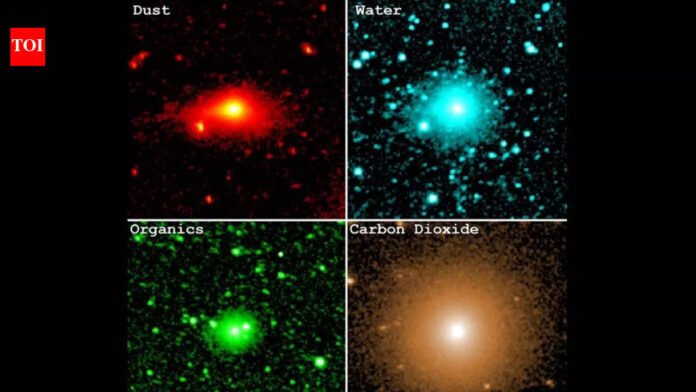
Comets usually disappear quietly after passing by the sun. Interstellar comet 3I/ATLAS did not follow the same path. Instead, it burned dramatically as it began to exit the solar system. NASA’s SPHEREx space telescope captured the burst in December 2025 and found water vapor, carbon dioxide and complex organic compounds flowing into space. For astronomers, this is not only a beautiful display, but also a rare one. A chemical snapshot of the material forming around another star. 3I/ATLAS is the third confirmed interstellar visitor ever, and it provides the clearest observations yet of alien ice outside of the solar family.
NASA’s SPHEREx observes Comet 3I/ATLAS still glowing
By December 2025, Comet 3I/ATLAS has left the inner solar system. It passed its closest approach to the sun two months ago. Typically, activity peaks around this point. The heat rises. The ice evaporates. Gas and dust leak outsideNASA’s SPHEREx (short for Spectrophotometer for Cosmic History, Era of Reionization, and Ice Explorer) observed the comet in infrared light. The comet is exploding, getting brighter and brighter. Throws out a puff of gas and dust. Study co-author Phil Korngut explained that the comet likely formed a radiation-treated shell during its long journey between stars. Beneath this shell, the original ice remains locked away.The comet is “going full blast” after a close flyby of the sun, said the study’s lead author, Carey Lees of the Johns Hopkins Applied Physics Laboratory in Laurel, Maryland. Even water ice sublimates into gas in interplanetary space.
What SPHEREx actually detects
SPHEREx detected water vapor, carbon dioxide, methane, methanol and traces of cyanide from comet 3I/ATLAS. The same goes for organic molecules. The comet appears to have developed a luminous coma rich in these components. When rock fragments are ejected, a pear-shaped dust tail forms. This is only the third interstellar object to be confirmed, following 1I/’Oumuamua in 2017 and 2I/Borisov in 2019.