
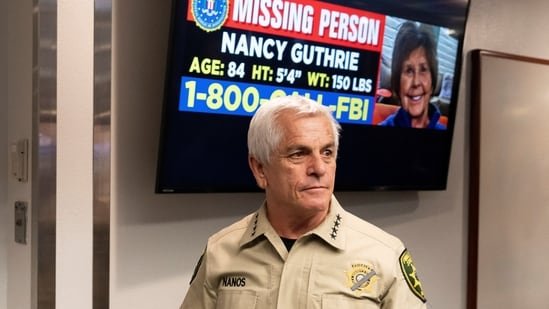
More than four months after Nancy Guthrie disappeared from her home in Arizona, Pima County Sheriff Chris Nanos defended the speed of the investigation, saying complex forensic testing and legal procedures had delayed the high-profile case.

Nanos said in an interview with Tucson-based KOLD-TV that the investigation relied heavily on lab work and scientific protocols rather than quick arrests.
“It’s not like a detective goes out and talks to someone and we can make an arrest,” Nanos said. “This is a very sensitive case, but what really extends the time is that we do rely on the lab.”
Guthrie, 84, is the mother of NBC Today co-host Savannah Guthrie. Authorities have not publicly identified the suspect, announced an arrest or revealed Guthrie’s whereabouts.
DNA evidence sent to private lab before FBI testing
Investigators initially sent hair samples collected from Guthrie’s Catalina Foothills residence to a private genetics lab in Florida, according to Fox News, which said there was a public disagreement between the Sheriff’s Office and the FBI.
Approximately 11 weeks later, the samples were transferred to the FBI’s Quantico laboratory for more advanced forensic analysis. Fox Digital News also reported that investigators encountered mixed DNA samples, which are often more difficult to isolate and interpret.
Nanos defended the lengthy process, stressing that forensic science must adhere to strict standards.
“When you look at these labs and the work they do, you see there’s a science there, and science has rules that it has to follow,” he said. “Even if it’s not, they will tell you that DNA is not an exact science, but it is over 99 percent accurate.”
Nanos added that investigators are working to avoid mistakes while ensuring innocent people are not falsely accused.
“We want to make sure the DNA does more than just identify the suspect,” he said. “It also exonerates those innocent people.”
FBI may deploy new technology just in case
Fox News further reported that federal sources familiar with the investigation said the FBI was discussing deploying more technology tools to help advance the case.
Morgan Wright, CEO of the National Cold Case Center, told the outlet that digital evidence could ultimately be crucial.
“I think the solution to this case will be technical,” Wright said, pointing to video forensics, signal analysis and investigating genetic genealogy as possible avenues.
Meanwhile, attorney RJ Dreiling criticized the speed of the investigation, telling Fox News the public deserves clearer answers from authorities.