
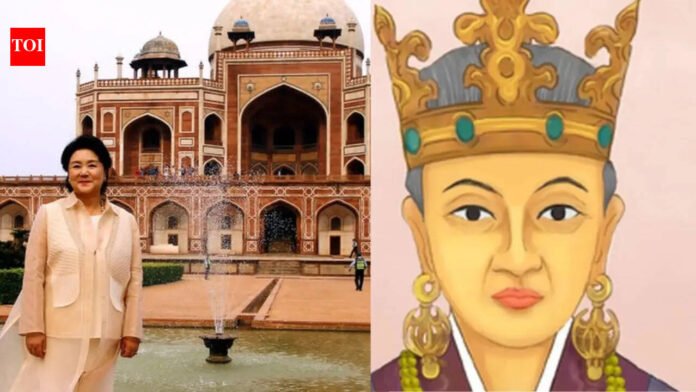

Princess Surilatna of India and her journey to ancient Korea as Queen Heo Hwang-ok
It all started back around AD 48, when rumors spread that a young Indian princess named Suriratna had left her country for Korea. According to traditional literature, she is said to have become Queen Heo Hwang-ok after marrying King Kim Suro, the founder of the Gaya Kingdom, the BBC reported.After a long sea voyage to an unfamiliar shore, she married a king who founded a new kingdom. All these events are recorded in documents such as “The History of the Three Kingdoms”, one of the oldest collections of stories and history in Korea. Her homeland is known as “Ayutthaya” and many researchers claim to be Ayodhya in India, although this idea remains uncertain.
Queen Heo Hwang-ok in Korean Tradition and Her Lasting Legacy
The character of Queen Xu Huangyu plays an important role in this legend. In Korea, she is commemorated as a queen from another country, a member of the Gaya Dynasty royal family. In Indian folklore, the queen’s name is identified as Suriratna, and the story is associated with the city of Ayodhya.It is said that she married King Kim Suro and bore him many children. Historians believe the lineage the two founded continues today in some Korean families, such as the Kim Hae Kims and the Huo Clan. Family history claims their lineage descends from the Queen, and they proudly tell it generation after generation.According to some accounts, several members of their family lived in different parts of Korea. But historians believe these claims are not supported by facts.
How do modern historians evaluate its historical evidence?
However, most modern researchers and historians consider the legends about the princess to be myths rather than historical facts. There is no concrete archaeological evidence to confirm the authenticity of the existence of this princess who came to Korea from India. It can explain the name “Ayuda” mentioned in some old Korean documents, and the word can also imply other places different from India.Scholars, including those who study Korean history, believe the legend about the princess may be the result of centuries of evolution. In other words, imagination, symbolism, and people’s desire to trace their origins to distant and extraordinary places can play an important role in the emergence of stories.

Related articles
Recent articles