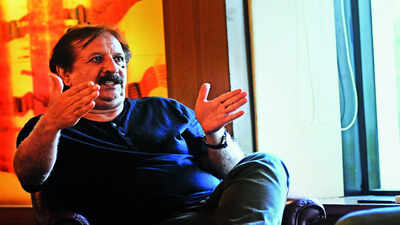
NEW DELHI: Amid a fragile ceasefire after Islamabad peace talks failed, one of Iran’s best-known filmmakers, Majid Majidiwho left cinema to devote himself to relief work and joined the Iranian Red Crescent, told The Times of India in Tehran that the war he had witnessed had irreversibly changed daily life in cities across his homeland.Oscar-nominated Majidi is not an unfamiliar voice to Indian audiences. His films belong to a tradition that has a visceral resonance here. He often spoke of his admiration for Satyajit Ray, who like the late “master of world cinema” explored the world of children, their moral dilemmas, resilience in poverty, family relationships and moral choices.Speaking about the ongoing conflict, Majidi said: “For more than a month, the city has been facing bombardment. While these are described as targeted strikes, in reality we are seeing homes, hospitals and schools affected. He singled out the February 28 strike in Minab, which he said killed dozens of school children, and which he said “must be remembered and investigated in an international court.”The consequences of that attack, which Iran says killed more than 150 children and teachers, are lingering in unexpected ways. The Iranian Embassy in New Delhi on Monday displayed drawings recovered from the attack site in an exhibition titled “Angels of Minab.” It captures the world before the children’s death: smiling families holding hands, a bright house under an oversized sun, a blue sky dotted with flowers and birds.Majidi’s account of war is defined by what he calls “access and participation.” After taking part in relief efforts on the ground, he spoke of shortages, displacement and the pressures on civilian life. “Ordinary people are caught in the middle,” he said, adding that the impact of violence goes far beyond direct casualties.Distinguishing between the government and the people, he said, “We are isolated by the government, not the country…Global public opinion, despite pressure and propaganda, remains with the Iranian people. There are widespread demonstrations in Europe, Asia, and even within the United States…People are calling for an end to the war.”The filmmaker said Iran’s resilience remains undiluted. “In our culture, surrender means nothing. Our people have shown courage on the battlefield and in the streets,” Majidi said. He described Iran’s stance as unprecedented – in his words, Iran is facing off against some of the most powerful militaries in the world.“Throughout history, even in the most difficult of times, the artists and thinkers of this land have remained steadfast,” Majidi said. “Western powers are blind to Iran’s history and underestimate it. They must study our past before deciding on our future.”Majidi was so connected to his homeland that he rejected the idea of leaving. “We are rooted in this land, and it is our responsibility to contribute to the progress of this land, both in life and in death.”For Majidi, the war is not only a geopolitical crisis but also a human crisis – one that he warns could have consequences far beyond Iran, could lead to widespread regional instability and trigger massive migration flows involving millions of people. “Governments around the world must go beyond statements and take action,” he said. The producer of films such as “Children of Paradise” (which became one of the highest-rated Iranian films in India) has long expressed a desire to tell a story set here, and he realized that vision with “Beyond the Clouds,” which was shot in Mumbai, calling for broadcast: “The humanitarian aid provided, especially medicines, is still very limited. Iran needs this.”