
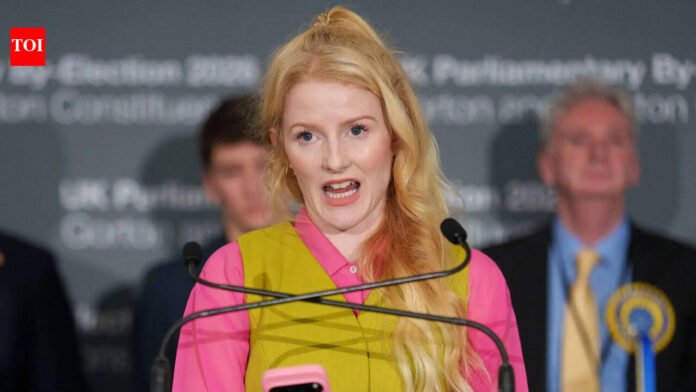

British politics has entered a dangerous phase for both major parties. The Greens’ stunning victories in the Gorton and Denton by-elections were about more than just local dissatisfaction. This is a structural warning that Labor and the Conservatives are losing control of their traditional alliance. Reform Britain is chipping away at the right-wing Conservative vote, while the Greens are starting to erode Labour’s urban strongholds from the left. This was more than just an embarrassing defeat for Keir Starmer. It’s a sign that the political coalition that brought Labor to power may be falling apart.These figures alone illustrate the scale of Labour’s collapse. The Green Party received 14,980 votes, accounting for 40.7% of the electorate. Reform UK came in second with 10,578 votes (28.7%). Labor came in third with just 9,364 votes (25.4%). The Conservatives, once Labour’s main rival, now received only 1,721 votes, or 4.7%, making them a fringe party. Turnout was 47.6%, suggesting this was a serious electoral contest rather than a fringe protest. Labor’s majority of more than 13,000 votes at the last election was wiped out in one parliamentary term.This is not a marginal fluctuation. This is a systemic rupture.
this green swing
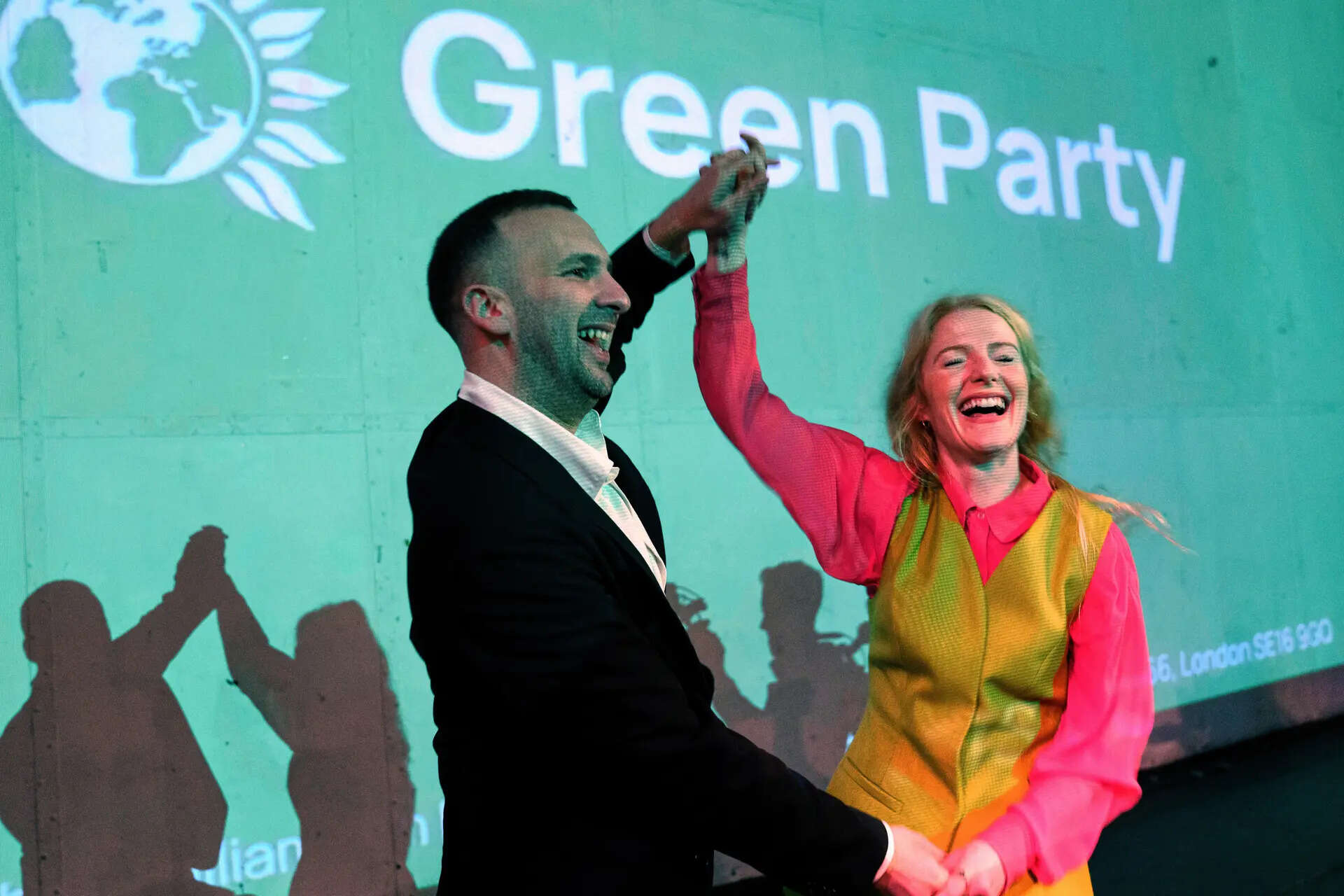
Green Party candidate Hannah Spencer (right) celebrates with party leader Zac Polanski during a volunteer appreciation event after winning the Gorton and Denton by-election on Friday, February 27, 2026 in Manchester, England. (AP Photo/Jon Super)
For decades, the Green Party has existed as an ideological conscience rather than a contender for governance. Its voters are often motivated by principle rather than expectation. Supporting the Greens allows voters to express their dissatisfaction with Labor while also acknowledging that Labor will eventually win. This arrangement protects Labour’s electoral dominance because when the bets come true, progressive voters return.Gorton and Denton’s results changed this psychological balance. The Greens did not simply increase their vote share. They proved they could achieve a decisive victory in seats long considered safe for Labour. Once voters see that an insurgent party can turn support into victory, the risk of voting for it disappears. What was once a symbolic vote became a viable alternative.This shift is significant because Labour’s strength has always depended on consolidating progressive voters behind a single electoral vehicle. Urban constituencies with younger populations, large student bodies and diverse demographics have traditionally formed Labour’s safest base. These constituencies now represent fertile ground for green expansion. Young voters, in particular, have weaker attachments to traditional party identities and stronger attachments to specific issues such as climate policy, housing affordability and foreign policy. When Labor appears cautious or progressive, these voters become increasingly receptive to alternatives that offer clearer ideological commitments.
Conservative reform issues
While Labor faces encroachment from the Greens, the Conservatives face a more dramatic collapse from Reform Britain. The Reform Party came in second with 28.7% of the vote, and the Conservatives’ support fell to less than 5%, which shows how thoroughly the Reform Party has captured the hearts of anti-establishment right-wing voters.

Elon Musk and Nigel Farage
It’s part of a broader national pattern in which reform has emerged as the main challenger to Conservative dominance among voters disillusioned with immigration policy, economic stagnation and political weakness. For these voters, reform provided ideological clarity and conviction while the Conservatives seemed compromised by years in power.The result is that Britain’s two major political parties are in a mirror crisis. Labor is losing progressive voters to the Greens, while the Conservatives are losing nationalist and anti-establishment voters to reformers. Both parties are simultaneously being hollowed out, not by the other party but by their insurgent rivals on their respective ideological flanks.This erosion of symmetry represents a tectonic shift in British politics.
Britain is moving from a two-party system to a four-party system
The joint rise of the Green Party and the Reform Party marks the emergence of a true four-party political landscape. Labor and the Conservatives no longer dominate their respective ideological spheres unchallenged. Instead, they must constantly compete with insurgent parties with a more distinct ideological identity.In a traditional two-party system, Labor can afford to lose some progressive votes because the Conservatives remain the only viable alternative government. Likewise, Conservative voters dissatisfied with their party often remain loyal to prevent Labor from winning. This logic enhances the stability of the system.That logic is breaking down now. When rebel parties prove they can win seats, it becomes less necessary for voters to vote tactically. Progressive voters no longer automatically support Labor, and right-leaning voters no longer automatically support the Conservatives. This fragmentation undermines the structural dominance of the two major parties.
Labor’s governing coalition is splitting
Labour’s electoral victory under Keir Starmer depends on building a broad and internally diverse coalition. The coalition includes moderate centrists seeking stability after years of Conservative turmoil, as well as young progressive voters demanding structural change on climate, housing and inequality.Sustaining such an alliance requires balancing competing priorities. A centrist government can reassure moderate voters but also risks alienating more ideological supporters. When progressive voters see Labor as insufficiently ambitious, they become more open to alternatives that better align with their priorities.Green’s victory in “Gorton and Denton” reflects exactly this dynamic. This suggests that Labor can no longer automatically command the loyalty of progressive voters, even in constituencies where it once held a landslide majority. Once that assumption collapses, Labour’s electoral map becomes even more fragile.
The strategic squeeze facing Labor and the Conservatives
Both Labor and the Conservatives now face the same structural dilemma. If Labor moves to the left to win back voters from the Greens, it risks alienating moderate voters and increasing the appeal of reform. If it remains anchored in the centre, it risks hastening a defection by the Greens. The Conservatives face the same challenge. A move to the right to win back reformist voters risks alienating moderates, while a move to the center risks further losses for reformists.This creates a political squeeze from which neither side can easily escape. The rise of insurgent parties forces the ruling party to defend multiple fronts simultaneously while maintaining internal coherence. Failure to manage this balance can lead to disintegration.
Why this failure is particularly dangerous for Keir Starmer
Keir Starmer’s leadership is defined by competence, moderation and institutional stability. These qualities helped Labor appease voters and return to power after years of political turmoil. However, insurgent parties thrive in environments where voters seek ideological clarity rather than governance capabilities.

British Prime Minister Keir Starmer (right) and Michael Owen (left) visit the Premier League youth training facility in Mumbai, India. AP/PTI(AP10_08_2025_000239B)
The Greens’ victory exposed a weakness in Starmer’s governance model. While moderation may win elections against discredited opponents, it does not necessarily prevent insurgent challengers from defecting and provide a clearer ideological identity. If similar losses occur in other city constituencies, Labor’s majority in parliament could gradually be eroded.That’s why the Gorton & Denton results are so important. This suggests that Labour’s dominance in British cities is no longer guaranteed.
The beginning of a new political era
The deeper significance of this by-election is what it reveals about the future of British politics. The traditional Labor versus Conservative binary is being replaced by a more fragmented and unstable system in which insurgent parties can win seats and reshape electoral competition.British reform is dismantling Tory dominance on the right. The Greens began to challenge Labour’s dominance on the left. Both major parties are losing the automatic loyalty that has sustained them for generations. For Keir Starmer, the warning is clear. Winning power is only the first challenge. It will be more difficult to hold a fragmented coalition together in a rapidly changing political landscape.