
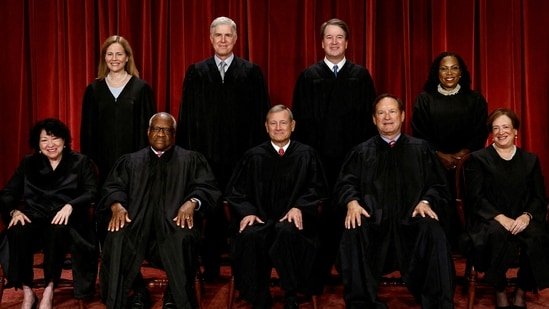
Justice Ketanji Brown Jackson on Tuesday criticized Justice Clarence Thomas for dissenting from the Supreme Court’s ruling upholding birth rights as reflecting “one of Dred Scott’s core tenets.” Country of Citizenship.

She agreed with the majority opinion in Trump v. Barbara, jackson Holds that the Citizenship Clause of the Fourteenth Amendment was historically intended to cover all individuals born in the United States, including the descendants of illegal immigrants.
This is related to Thomas’s Claims that the amendment was specifically ratified to grant citizenship to slaves who were freed after the Civil War.
This is what Judge Ketanji Brown Jackson said
“Freed Black people fought for the common humanity of all people. The great liberator ultimately foresaw that the only way forward to prevent any return to slavery and race-based subordination was to bind the fate of all people together,” Jackson said.
“The great irony, of course, is that while people are talking about the abhorrent Dred Scott decision, the administration and [Thomas] It is recommended to return to its core purpose. Their bottom line is that for some people, being born on U.S. soil is not enough to confer citizenship. “
By citing “Dred Scott“, Jackson referred to the 1857 Supreme Court decision in which the majority ruled that people of African descent “are not included in the term ‘citizens’ in the Constitution, nor were they intended to be included in the Constitution, and therefore cannot claim any of the rights and privileges provided and guaranteed by that instrument to citizens of the United States. “
This is what Judge Clarence Thomas said
However, according to Thomas, Jackson’s broad interpretation of the historical context Fourteenth Amendment Lack of foundation.
After the Civil War, the Reconstruction Congress first passed the Civil Rights Act of 1866; Country of Citizenship Thomas said this is a provision of the Fourteenth Amendment. “Both the Civil Rights Act and the Citizenship Clause guarantee citizenship to those born and residing in the United States, regardless of race. Neither guarantees citizenship to those who do not reside in the United States.”
Thomas went on to elaborate on what he sees as the differences between black Americans and foreigners living in the country.
People of African descent are granted citizenship like Americans, the judge said, adding that they have no other fatherland, no allegiance to any foreign country and are not subject to the jurisdiction of any other authority.
“The situation is different for the children of temporary foreign tourists. Foreign temporary tourists are attached to their home country, lack similar ties to the country, and would not be called upon in times of war.”
According to Thomas, the definition of citizenship is Fourteenth Amendment One must be born in the United States and have a legal concept of what he calls “domicile,” which includes both a person’s actual place of residence and their enduring loyalty to the country. Thomas argued that the descendants of temporary foreign visitors do not meet this standard because during their stay they remain affiliated with another sovereign nation under U.S. law and are not fully “subject to the jurisdiction of the United States” in a constitutional context.
In response, Jackson criticized the view, calling it “short-sighted.”