
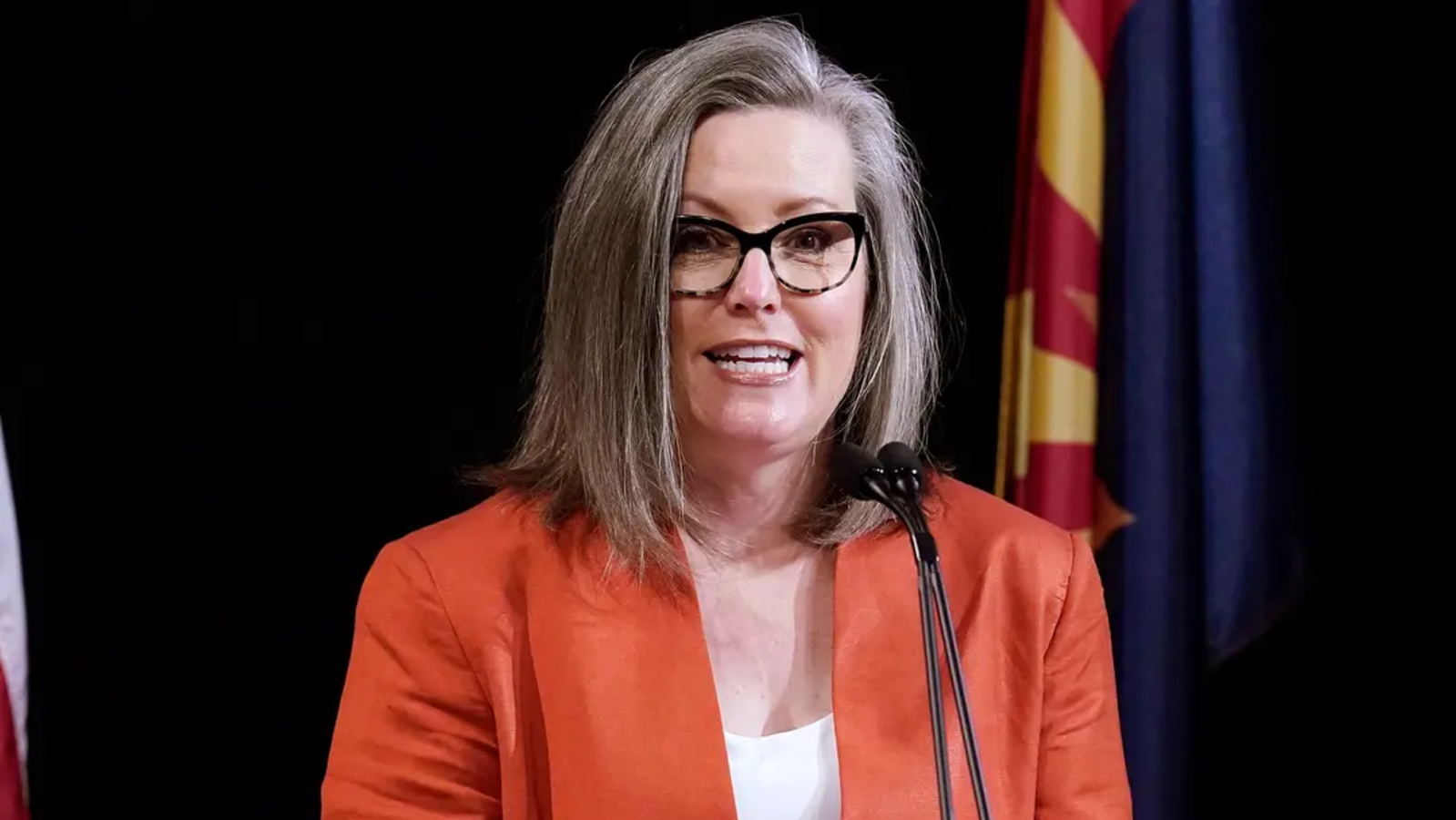
Katie Hobbs did not begin her career in politics. Before becoming Arizona’s governor, she worked as a social worker, helping homeless young people and people affected by domestic violence. Her experience in social services shaped her approach to public service and continues to feature prominently in her political career.

Now seeking a second term as governor, Hobbs faces a closely watched election in which affordability, housing, water security, immigration and economic development are major issues. Her record in office, along with questions about her handling of state policy and a campaign-finance controversy, has become an important part of the 2026 election debate.
Katie Hobbs’ age, early life and education
Born on December 28, 1969, in Phoenix, Arizona, Katie Hobbs grew up in Tempe in a working-class family and began working while still young to help support herself and her education.
Her first job was at Burger King in Tempe. She later worked at Pizza Hut while attending college. Hobbs graduated from Seton Catholic High School in 1988 before enrolling at Northern Arizona University, where she earned a bachelor’s degree in social work in 1992. She subsequently completed a master’s degree in social work at Arizona State University in 1995.
After graduating, Hobbs began working professionally as a social worker. She helped homeless young people and later worked at the Sojourner Center, a major domestic violence shelter in Arizona. She also held a leadership role at the organization.
Katie Hobbs’ political career and rise to governor
Hobbs entered electoral politics in 2010, when she won a seat in the Arizona House of Representatives. She subsequently served in the Arizona Senate, representing District 24, and became Senate Minority Leader.
In 2018, she was elected Arizona’s secretary of state. She served in the position from 2019 until 2023, overseeing the state’s election administration during a politically contentious period.
Hobbs entered the 2022 gubernatorial race and defeated Republican Kari Lake in the general election. She was sworn in on January 2, 2023, becoming Arizona’s 24th governor and the fifth woman to hold the office.
Katie Hobbs’ husband and children
Katie Hobbs is married to Patrick “Pat” Goodman, whom she met through their church in 1992. The couple have two children, Hannah and Sam, and live in Phoenix.
Hobbs has spoken about her family’s financial difficulties while growing up and the challenges of making ends meet. Her campaign biography has also discussed the experience of losing a home to foreclosure, which she has connected to her interest in housing affordability.
Housing, affordability and economic development policies
Housing affordability and economic opportunity have been important parts of Hobbs’ agenda as governor. She has supported efforts to increase housing supply, reduce barriers to development and expand assistance for families seeking to buy homes.
Her administration has also focused on workforce development, apprenticeships and training programs designed to help people secure well-paying jobs without necessarily obtaining a four-year college degree.
Hobbs has promoted investment in Arizona’s technology and manufacturing industries, particularly semiconductor production. The state has sought to attract major manufacturers and expand its position in advanced manufacturing.
Her administration has also highlighted tax relief and other measures aimed at reducing financial pressure on households. The 2026 state budget included a reported $1.4 billion tax-cut package for working families.
AI, data centers and Arizona’s water concerns
Artificial intelligence (AI) and data-center development have become important economic and political issues in Arizona. Hobbs has supported technology investment and the creation of high-skilled jobs but has also raised concerns about the resources required to operate large data centers.
Water consumption, electricity demand and the potential impact on local communities have become central to the debate.
In June 2026, Hobbs signed the state’s budget, which included a three-year moratorium on new tax exemptions for data centers. The measure was intended to give lawmakers more time to develop policies governing the industry’s expansion and its impact on Arizona’s resources.
The decision did not ban data-center construction. Instead, it paused new applications for the relevant tax incentives while the state considers how to balance economic growth with water security and affordability.
Katie Hobbs’ position on Trump tariffs and trade with Mexico and Canada
Trade policy has also been a point of disagreement between Hobbs and President Donald Trump.
Hobbs has criticized Trump’s tariffs on imports from Mexico and Canada, arguing that higher trade costs could affect Arizona families and businesses. She has warned that tariffs could increase the prices of groceries, fuel and housing while hurting important industries, including semiconductor manufacturing and agriculture.
Her position reflects Arizona’s close economic relationship with its neighboring countries. Mexico is the state’s largest trading partner, while Canada is also an important market for Arizona businesses.
Hobbs has called for stable and predictable trade relations across North America, arguing that uncertainty over tariffs could disrupt supply chains, investment and employment.
Iran war and rising fuel prices in Arizona
The conflict involving Iran has also entered Arizona’s political debate, particularly through its impact on fuel prices.
In May 2026, Hobbs blamed the rise in gasoline prices partly on the war in Iran and criticized the Trump administration’s approach to the conflict. She argued that higher fuel costs were adding to the financial pressure on households.
The issue has provided another point of political disagreement between Hobbs and Republican critics, who have questioned her administration’s response to the state’s affordability challenges.
Also Read: Pope Leo XIV makes history as first sitting pontiff to vote in US elections
Sunshine Residential Homes controversy and investigation
One of the most significant controversies involving Hobbs concerns political contributions from Sunshine Residential Homes, an Arizona foster-care provider.
The company made political contributions connected to Hobbs before receiving a substantial increase in its reimbursement rates from the state. The timing raised questions about whether political donations had influenced government decisions and prompted an investigation into possible pay-to-play arrangements.
In August 2026, Arizona Attorney General Kris Mayes announced that her office had found insufficient evidence of a quid pro quo to support a criminal bribery charge against Hobbs.
Mayes said investigators had reviewed campaign-finance records, procurement documents, bank records and state communications but had not found evidence that the governor exchanged political favors for contributions.
However, the attorney general also called for changes to improve transparency around political donations involving state contractors. The investigation therefore ended without a bribery prosecution, but the controversy continued to attract political attention.
Katie Hobbs’ 2026 re-election campaign and key challenges
Hobbs is seeking another term in the November 2026 election, facing Republican Congressman Andy Biggs.
Water security has emerged as one of the most prominent issues in the campaign. Arizona faces long-term pressure from drought, reduced Colorado River supplies, population growth and rising demand for water. Hobbs has defended her administration’s efforts to protect the state’s water interests, while her Republican challenger has criticized aspects of her approach.
Affordability, housing, immigration, border security and economic development are also important election issues. Hobbs has highlighted tax relief, job creation and investment in infrastructure as achievements of her administration. Her opponents have questioned whether those measures have done enough to address the cost of living and the state’s long-term challenges.