

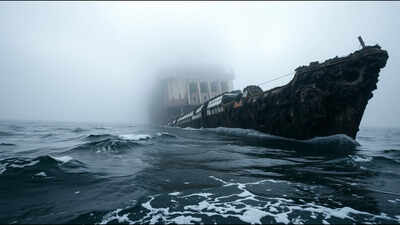
Seventy years after the Andrea Doria sank in the North Atlantic, divers are still descending to the deteriorating Italian liner, exploring newly exposed sections and recovering artefacts before parts of the wreck disappear for good. Eighteen divers have died while trying to explore it. The ship lies on its starboard side about 50 miles south of Nantucket, with the seabed roughly 250 feet below the surface, well beyond normal recreational diving depths. Powerful currents, limited visibility, cold water and long decompression stops make the descent demanding, while collapsing passages, loose metal and heavy silt add to the danger inside the ship itself. Decades on the seafloor have already reshaped the wreck, with whole decks collapsed and the vessel now standing about 30 feet shorter than it once did.
How the Andrea Doria sank after colliding with the Stockholm in 1956
The Andrea Doria left Genoa on July 17, 1956, carrying 1,706 passengers and crew, bound for New York on what would become its 101st and final transatlantic crossing. On July 25, nearing the end of that voyage, the ship ran into dense fog while the outbound liner Stockholm sailed in clearer conditions nearby, and officers on both vessels reached different conclusions about how to pass each other after tracking one another by radar. At 11.05 pm, the Andrea Doria’s captain ordered a four-degree turn to port, and two minutes later the Stockholm’s third officer ordered a roughly 22-degree turn to starboard. By the time the two ships spotted each other’s lights at 11.10 pm, less than a mile separated them, and neither manoeuvre could prevent what followed. Less than a minute later, the Stockholm’s reinforced bow struck the Andrea Doria’s starboard side at 18.5 knots, driving about 40 feet into the larger ship and tearing open seven of its 11 decks just behind the bridge. The collision killed 46 people aboard the Andrea Doria and five aboard the Stockholm, though the liner stayed afloat for nearly 11 hours, long enough for nearby ships to rescue the remaining passengers before it finally sank the next morning.
Why divers call it the Mount Everest of wreck diving
Divers reached the wreck almost immediately, with two men descending to it the very next day using wetsuits, basic equipment and an underwater camera, and expeditions have continued ever since. The site earned its nickname among divers because of both the difficulty of the descent and the dangers of entering the wreck itself, and eight divers died there between 1992 and 1999 alone. Rising about 80 feet from the seabed, the ship exposes divers to roughly six to eight times the pressure found at the surface, and they burn through their air supply at a similarly increased rate, raising the risk of narcosis, oxygen toxicity and decompression sickness. Inside the hull, divers must navigate sideways stairways, collapsing passages, decaying metal and dangling wires, and any silt disturbed along the way can billow into the water and sharply cut visibility within seconds.
How mixed gas diving changed what was possible at the wreck
In 1996, divers Steve Gatto and Tom Packer became the first to reach the ship’s engine room, and while filming its gauge panel, Gatto lost track of his exit route and began experiencing narcosis before finding his way back out using one of the strobe lights the pair had placed along their path. Mixed gas diving later allowed divers to replace some of the nitrogen in their tanks with helium, reducing narcosis and making deeper dives more manageable, though the technique brought its own complications, since divers still needed lengthy decompression stops and had to carry the correct gas mixture for each depth or risk a fatal mistake. Gatto, who has made more than 250 dives to the Andrea Doria over the years, has said some divers were substituting technology for the experience needed to dive safely.
What divers recovered from the wreck in 2025
On July 11, 2025, diver Chris Ogden was around 230 feet below the surface inside a confined section of the wreck when he spotted the circular top of a gyrocompass repeater, a five-foot-tall brass navigation instrument that once stood on the ship’s bridge wing. With only four dives left on the expedition and barely 40 minutes on the bottom each time, Ogden and his diving partner Joe Mazraani spent most of three dives clearing nets, cables and roughly eight feet of debris before finally freeing the instrument and lifting it to the surface using an inflatable bag rated for 500 pounds. The gyrocompass reached the surface largely intact, though its face was missing, and weeks later filmmaker Al Giddings came forward saying he had recovered that same piece decades earlier during a 1968 expedition and still had it in his home.
Why salvage from the wreck remains a contested question
Atlantic Wreck Salvage, whose ongoing recovery work at the site is documented on its own record of the Andrea Doria’s history and diving conditions, has made annual trips to the wreck since 2010 and restores what it recovers for public display. Removing artefacts from historic shipwrecks continues to divide opinion, with some arguing that objects should remain in place or be recovered only by trained archaeologists, while divers who work the Andrea Doria counter that its rapid deterioration means items left behind risk being crushed or buried for good as more of the structure collapses. The wreck sits within a stretch of ocean that the National Oceanic and Atmospheric Administration’s Stellwagen Bank National Marine Sanctuary recognises as part of the region’s protected maritime heritage, underlining how significant these sites remain even as they continue to change. Seven decades after it went down, the Andrea Doria keeps exposing new sections of itself to the divers willing to reach it, even as more of the ship settles permanently into the seabed.