
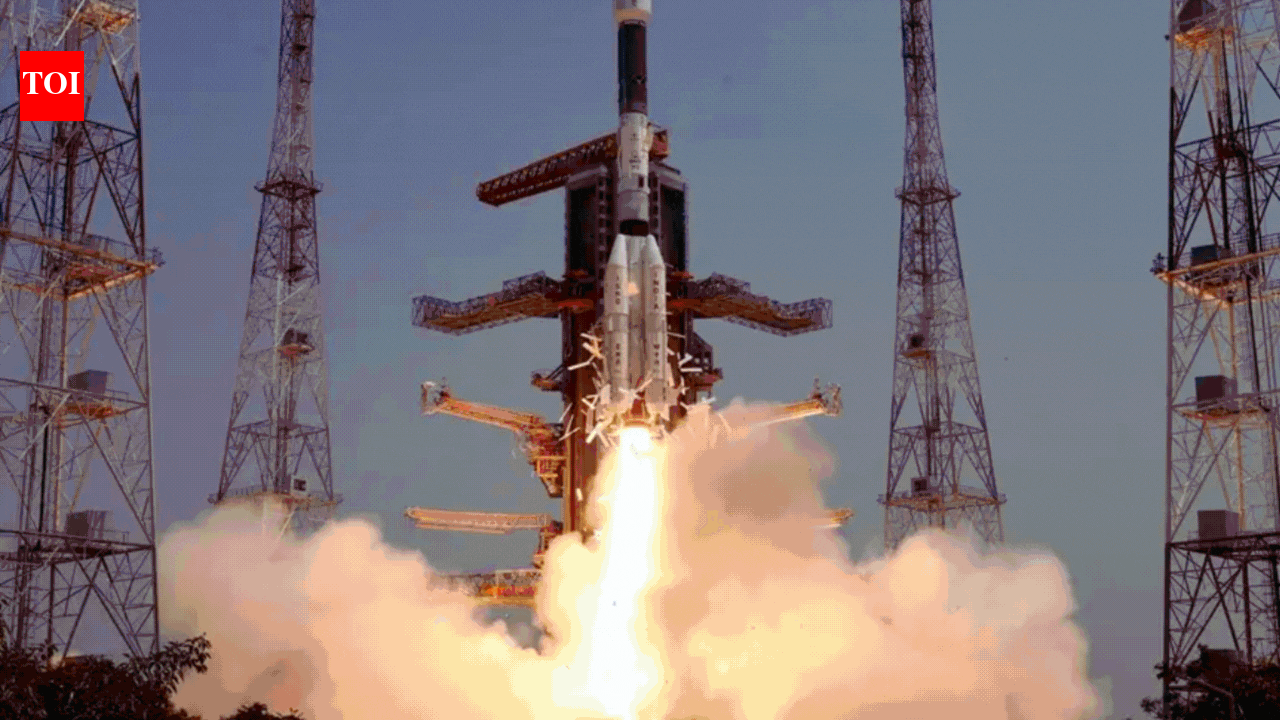
Bangalore: Scientists from YisroIndia’s Space Applications Center (SAC) has identified a promising landing zone in the moon’s rugged south polar region for India’s first lunar sample return mission, Chandrayaan-4. Detailed topographic studies using images from the Chandrayaan-2 Orbiter High Resolution Camera (OHRC) have identified a one square kilometer area near Monsmuthun as the safest landing option. The study, conducted by Amitabh, K Suresh, Ajay K Prashar, Kannan V Iyer, Abdul S, Shweta Verma Trivedi and Nitant Dube, has been accessed by TOI.Chandrayaan-4 will be ISRO’s most complex lunar mission. The spacecraft will include a propulsion module, a descent module, an ascent module, a transfer module and a reentry module. The descender and ascender must soft-land on the moon, collect samples and launch them back into lunar orbit for return to Earth.Choosing the right location is crucial. Engineers must ensure that local slopes are gentle, that there is at least 11-12 days of adequate sunlight, clear radio visibility to the Earth, and that hazards such as craters and boulders are minimized. The lander design limits the acceptable slope to about 10° and requires boulders to be smaller than 0.32 meters.Early assessments based on rough data highlighted several candidate areas between 84° and 90° south latitude. This new work focuses on five areas around Mouton of Mons, analyzing them using sharper OHRC stereo images with a resolution of 32 cm. One of the sites was abandoned because it was permanently in shadow.The researchers generated a digital elevation model with a 0.32-meter fine grid and studied terrain relief, lighting patterns and hazard distribution. Parameters such as average slope, height range and number of safe landing grids of 24 x 24 meters were compared at four locations marked MM-1, MM-3, MM-4 and MM-5.Among them, the MM-4 region with -84.289° north latitude and 32.808° east longitude has become the leader. The lowest danger level is 9.89%, the average slope is 5°, and the maximum number of safety grids is 568. The area also provides good lighting and limited shadows from nearby terrain.The risk is higher in other locations. MM-1 and MM-3 recorded hazard levels of over 12%, while MM-5 provided only 72 safety grids within the target area. The sites range in elevation from 4,800 meters to more than 6,100 meters, reflecting the fractured topography of the moon’s south pole.Scientists say the analysis shows how high-resolution imaging can guide precise landing decisions. The OHRC’s data allowed them to map craters, boulders and slopes with a clarity not achieved in earlier missions.If approved by the landing site selection committee, the MM-4 patch will be India’s first attempt to bring back lunar debris. Success would make ISRO one of the few space agencies capable of returning extraterrestrial samples, opening a new chapter in the country’s planetary exploration program.